


Expanded Metal 8×2
In the landscape of industrial filtration and structural support, the specification of mesh components determines the efficiency, longevity, and safety of a system. Expanded metal 8×2 represents a specific geometry often utilized in demanding environments where a balance between open area and mechanical rigidity is paramount. Unlike perforated metal, which is created by punching holes and removing material, expanded metal is produced by simultaneously slitting and stretching a solid sheet. This process results in a continuous, jointless mesh that offers unique structural advantages.
For engineers and procurement specialists, understanding the technical nuances of expanded metal 8×2—ranging from its diamond dimensions to material compatibility—is essential for optimizing filtration performance and reducing total cost of ownership. This guide examines the engineering properties, application contexts, and selection criteria for this specific mesh configuration within the broader category of Perforated & Expanded Metal.
Technical Definition of 8×2 Mesh Geometry
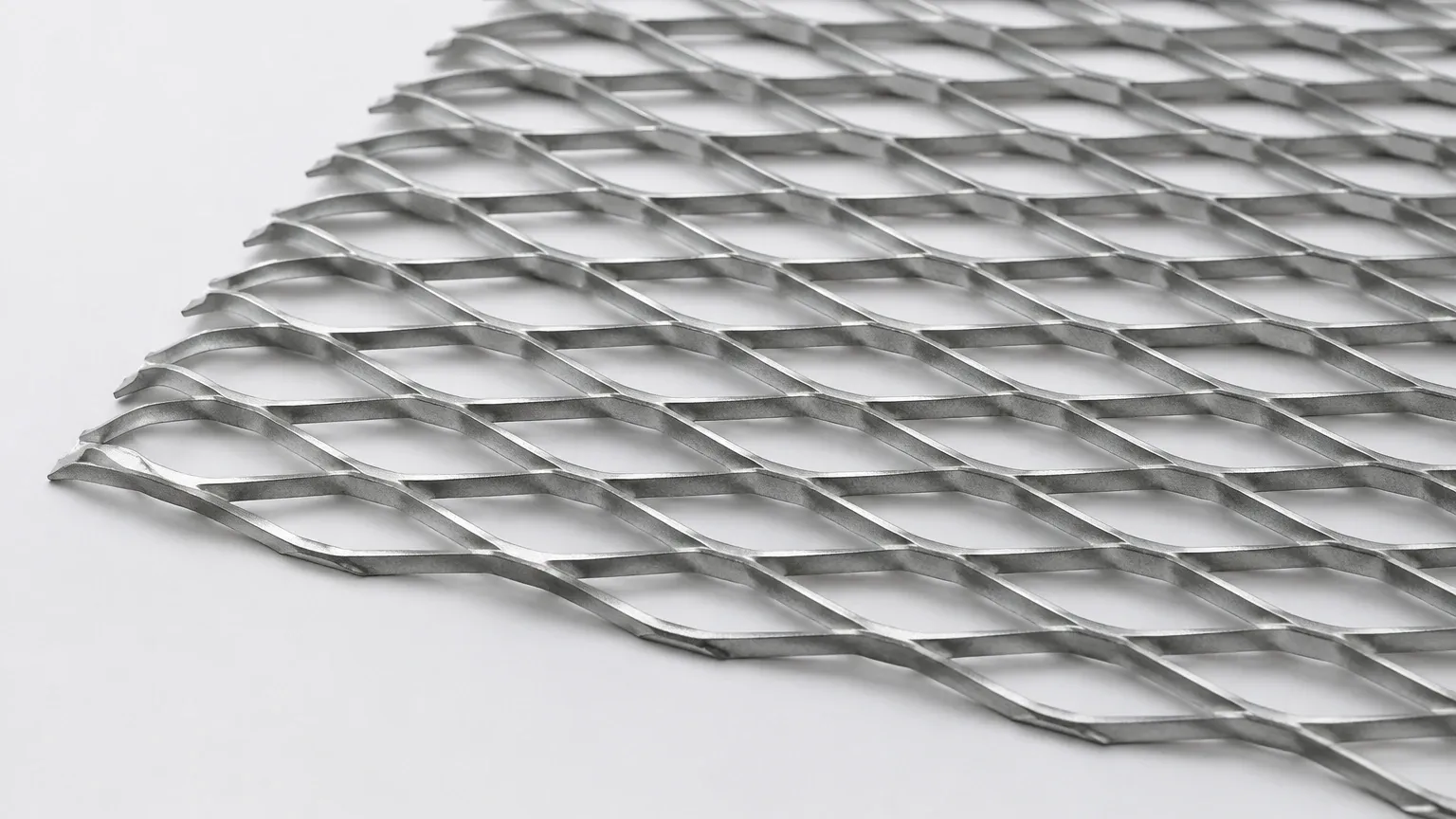
The term "8×2" in the context of expanded metal typically refers to the nominal dimensions of the diamond-shaped openings. In technical specifications, these are defined by the Long Way of the Diamond (LWD) and the Short Way of the Diamond (SWD).
* LWD (Long Way of Diamond): This is the distance from the center of a bond to the center of the next bond across the long axis. In an 8×2 specification, this is nominally 8mm.
* SWD (Short Way of Diamond): This is the distance from the center of a bond to the center of the next bond across the short axis. In this specification, it is 2mm.
This 4:1 ratio creates a narrow, elongated diamond pattern. From an engineering perspective, this geometry is particularly effective for directional flow control and providing high lateral stiffness. When used as a support medium for finer wire mesh filters, the 2mm SWD provides frequent contact points, preventing the finer mesh from sagging or migrating under high-pressure differentials.
Beyond the opening size, the performance of expanded metal 8×2 is dictated by the strand width (the amount of metal between the openings) and the strand thickness (the thickness of the original base material). These variables directly influence the percentage of open area, which in turn affects flow rates and pressure drop across the filter element.
Material Engineering: Why Stainless Steel Dominates
While expanded metal can be produced from various alloys, industrial applications—particularly in chemical processing, pharmaceuticals, and food production—overwhelmingly require stainless steel. As a specialized manufacturer, Kaifil emphasizes the use of high-grade alloys to ensure chemical compatibility and thermal stability.
304 Stainless Steel
Grade 304 is the standard choice for general industrial applications. It offers excellent corrosion resistance to most oxidizing acids and is highly durable. In 8×2 expanded metal configurations, 304 provides the necessary ductility for the expansion process while maintaining structural integrity during fabrication into cylindrical or pleated filter cartridges.
316L Stainless Steel
For environments involving chlorides, high salinity, or aggressive chemical solvents, 316L is preferred. The addition of molybdenum enhances pitting resistance. The "L" (low carbon) designation is critical for components that require welding, as it prevents carbide precipitation and ensures the mesh retains its corrosion resistance at the weld joints. This is a vital consideration for custom filter components that must withstand rigorous Cleaning-in-Place (CIP) cycles.
Specialty Alloys
In extreme cases, such as high-temperature gas filtration or highly acidic processing, materials like Duplex stainless steel or Monel may be used. The choice of material must be balanced against the mechanical stress the 8×2 mesh will encounter during operation.
Structural Advantages in Industrial Filtration
Expanded metal 8×2 serves several critical roles in industrial filtration systems. Its unique structure offers benefits that perforated or woven materials sometimes cannot match.
1. High Strength-to-Weight Ratio
Because the expansion process involves stretching rather than removing material, the resulting mesh is lighter than a solid sheet of the same thickness but retains significant structural strength. The interlocking bonds of the diamond pattern distribute mechanical loads evenly, making expanded metal 8×2 an ideal outer cage or inner core for high-pressure filter cartridges.
2. Enhanced Flow Characteristics
In many fluid handling applications, the angled orientation of the strands in expanded metal can help induce turbulence or guide flow. For pre-filtration stages, the 8×2 geometry can trap elongated debris more effectively than a square mesh of a similar open area. Furthermore, the absence of welds or joins in the mesh structure eliminates potential points of failure or corrosion initiation.
3. Support for Secondary Media
One of the most common uses for expanded metal 8×2 is as a support layer. In multi-stage filtration, a very fine stainless steel wire mesh may lack the rigidity to withstand hydraulic shocks. By layering the fine mesh over an 8×2 expanded metal substrate, engineers can achieve high-precision filtration (down to micron levels) with the structural backbone required for industrial-scale flow rates.
Selection Criteria for Engineering Teams
When specifying expanded metal 8×2 for a project, several technical factors must be confirmed to ensure the component meets the application's demands. Generic specifications often lead to premature failure or inefficient performance.
Flattened vs. Raised Expanded Metal
* Raised (Standard): The strands are turned at an angle to the plane of the sheet. This provides maximum rigidity and a textured surface, which can be useful for certain mechanical separation tasks.
* Flattened: The raised mesh is passed through a cold-rolling reducing mill, which flattens the strands into the same plane as the sheet. Flattened 8×2 expanded metal is often preferred for filtration applications where a smooth surface is required to prevent damage to adjacent filter media or to facilitate easier cleaning.
Open Area Calculations
The percentage of open area is a critical metric for calculating pressure drop. For an 8×2 mesh, the open area is determined by the relationship between the SWD and the strand width. A narrower strand width increases the open area but reduces the structural strength. Engineers must find the "sweet spot" that allows for the required flow velocity without risking the collapse of the mesh under peak pressure.
Dimensional Tolerances
In precision metal filter components, tolerances are non-negotiable. Variations in LWD or SWD can lead to bypass issues or assembly difficulties. It is essential to work with a manufacturer capable of maintaining tight tolerances across large production runs, especially for OEM applications where the mesh must fit perfectly into pre-designed housings.
Manufacturing Tolerances and Customization
Standard off-the-shelf expanded metal often fails to meet the specific requirements of specialized industrial equipment. Customization is where manufacturers like Kaifil provide the most value. When ordering expanded metal 8×2, technical teams should consider the following customization options:
* Custom Sheet Sizes and Shapes: Beyond standard 4×8 sheets, expanded metal can be produced in specific widths or sheared into intricate shapes to minimize waste and simplify the assembly process.
* Edge Finishing: Expanded metal naturally has "random" edges where diamonds are cut. For safety and ease of installation, custom components can be produced with solid borders (unexpanded areas) or deburred edges to prevent snagging.
* Forming and Welding: If the 8×2 mesh is to be used in a cylindrical filter, the manufacturer should provide precision rolling and longitudinal welding services. Ensuring the weld is as strong and corrosion-resistant as the mesh itself is a hallmark of high-quality industrial fabrication.
Operational Maintenance and Lifecycle Management
The total cost of a filtration system is not just the purchase price but the cost of maintenance and replacement. Expanded metal 8×2, particularly when made from stainless steel, is designed for longevity, but its service life is dependent on proper maintenance.
Cleaning Protocols
Because expanded metal has a complex 3D structure (especially in its "raised" form), it can trap particulates in the "valleys" of the diamonds. For food and pharmaceutical applications, ultrasonic cleaning or high-pressure steam sterilization is often necessary. The choice of 316L stainless steel ensures that these aggressive cleaning methods do not lead to stress corrosion cracking.
Inspection for Fatigue
In hydraulic applications or systems with frequent pressure pulsations, the bonds of the expanded metal can experience fatigue. Regular inspection should focus on the integrity of the bonds and any signs of deformation. If the 8×2 mesh is used as a support for a wire mesh, technicians should check for any separation between the layers, which could indicate a failure of the internal support structure.
Replacement Cycles
While stainless steel expanded metal is highly durable, it is not infinite. Establishing a replacement cycle based on pressure drop trends (ΔP) rather than just time intervals ensures that the system operates at peak efficiency. When ΔP consistently remains high even after cleaning, it often indicates that the mesh has become fouled beyond recovery or that the structural integrity is compromised.
Conclusion
Expanded metal 8×2 is a versatile and robust solution for industrial filtration and structural support. Its specific diamond geometry provides a unique combination of flow efficiency and mechanical strength that is difficult to replicate with other materials. By focusing on material selection, precise geometric specifications, and the specific needs of the application, engineers can ensure they are utilizing the most effective Perforated & Expanded Metal solutions available.
For purchasing teams and engineering departments, the key to success lies in partnering with a manufacturer that understands the technical demands of the industry. Whether you require standard flattened 8×2 sheets or custom-fabricated cylindrical support cores, prioritizing quality and precision in the manufacturing process will result in more reliable, cost-effective industrial operations.
