


Expanded Metal Being Made
In the landscape of industrial fabrication and filtration, expanded metal stands as a versatile and resource-efficient material. Unlike perforated metal, which is produced by punching holes into a sheet and creating scrap material (slugs), expanded metal is manufactured through a unique process of simultaneous slitting and stretching. This method ensures that no material is lost, resulting in a high strength-to-weight ratio that is critical for structural support and filtration applications. Understanding the technical nuances of expanded metal being made is essential for engineers and procurement teams who must specify materials for demanding environments such as chemical processing, hydraulic systems, and water treatment.
As a specialized manufacturer, Kaifil utilizes advanced expansion technology to produce high-precision metal components. By examining the mechanical transformation from a solid sheet to a functional mesh, technical professionals can better evaluate how this material integrates into complex filtration assemblies.
Understanding the Slitting and Stretching Process
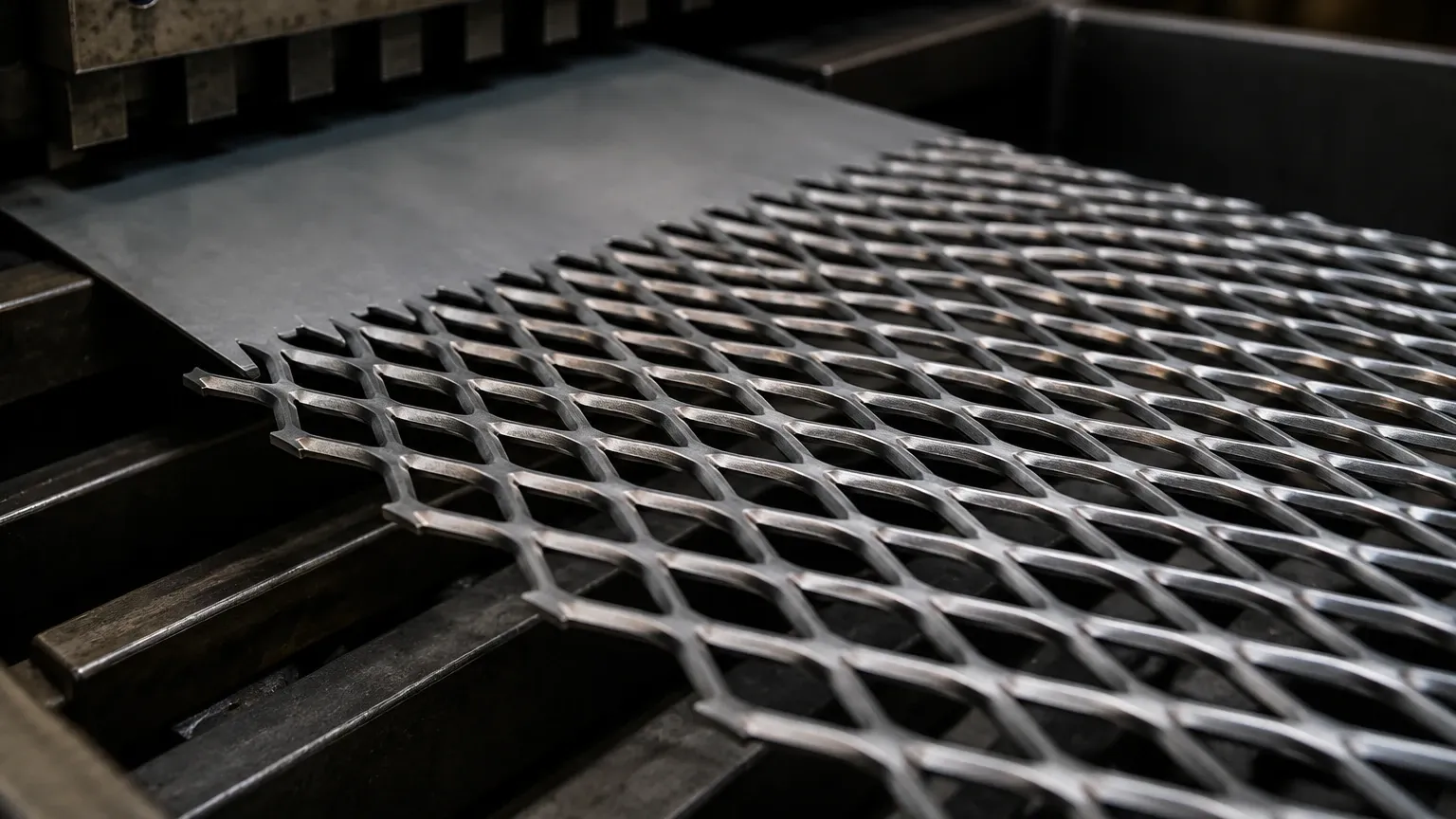
The fundamental principle of expanded metal being made involves a reciprocating knife that performs two actions at once: it slits the base metal and stretches it into a diamond-shaped pattern. This process begins with a solid metal plate or coil, typically stainless steel, carbon steel, or aluminum, which is fed through an expanding machine.
The machine is equipped with a specialized upper blade that features a "stepped" or serrated profile. As the blade descends, it creates a row of precise slits. Simultaneously, the pressure of the blade forces the metal to stretch outward, forming the characteristic diamond openings. After one stroke is completed, the blade retracts, the metal sheet advances, and the blade shifts laterally. This offset ensures that the next row of slits connects with the previous ones, creating a continuous, jointless mesh.
Because the material is stretched rather than cut out, the resulting mesh is actually longer than the original sheet. For example, one foot of solid material can be expanded into several feet of mesh, depending on the opening size and strand width. This efficiency is a primary driver of the cost-effectiveness of Perforated & Expanded Metal in large-scale industrial projects.
Key Dimensional Parameters: SWD, LWD, and Strand Geometry
When specifying expanded metal for industrial filtration or structural support, engineers must define several critical dimensions that dictate the material's performance. These parameters are determined during the manufacturing process by the blade design and the machine's feed rate.
1. Short Way of Diamond (SWD): This is the distance measured from the center of a bond to the center of the next bond across the short axis of the diamond. It defines the density of the mesh.
2. Long Way of Diamond (LWD): This is the distance across the long axis of the diamond. The ratio between LWD and SWD determines the shape and angle of the openings.
3. Strand Width: This refers to the amount of metal between the slits. It is controlled by the distance the base material is fed into the machine between blade strokes.
4. Strand Thickness: This is the thickness of the original base metal. In standard expanded metal, the strand thickness remains the same as the original sheet, but the strand is tilted at an angle.
These dimensions collectively determine the "open area" percentage. In filtration applications, the open area is a critical calculation for flow rate and pressure drop. A larger open area allows for higher throughput but may offer less structural support for fine wire mesh layers. Conversely, a smaller SWD provides a more rigid structure, which is often required for high-pressure hydraulic filters.
Standard vs. Flattened Expanded Metal: Manufacturing Differences
There are two primary forms of expanded metal used in B2B applications: standard (raised) and flattened. The choice between these two depends heavily on the intended application and the need for surface uniformity.
Standard Expanded Metal
Standard expanded metal is the immediate product of the expanding machine. The strands and bonds are set at a uniform angle to the plane of the sheet. This creates a three-dimensional surface that provides excellent grip and structural rigidity. In filtration, standard expanded metal is frequently used as an outer guard or a support core because the angled strands provide additional turbulence in fluid flow, which can sometimes be beneficial in specific mixing or separation processes.
Flattened Expanded Metal
Flattened expanded metal is produced by passing standard expanded metal through a cold-rolling reducing mill. This secondary process flattens the strands and bonds into the same plane as the sheet. The result is a smooth, flat surface that is slightly thinner and wider than the original expanded sheet.
For engineers designing filter cartridges, flattened expanded metal is often preferred when the mesh serves as a support for delicate filter media. The smooth surface prevents the expanded metal from abrading or puncturing the fine wire mesh or synthetic membranes placed against it. Additionally, flattened metal is easier to clean and provides a more consistent profile for welding and assembly.
Material Science in Expanded Metal Production
The performance of expanded metal is largely dictated by the metallurgy of the base material. While carbon steel is common for general industrial use, Kaifil specializes in stainless steel expansion to meet the rigorous demands of the chemical, pharmaceutical, and food industries.
* Stainless Steel 304: The most common grade used for expanded metal in filtration. It offers good corrosion resistance and excellent formability during the expansion process.
* Stainless Steel 316/316L: Specified for environments involving high chloride concentrations or acidic solutions. The addition of molybdenum enhances pitting resistance, making it the standard for marine and pharmaceutical filtration.
* Specialty Alloys: For high-temperature or highly corrosive environments, materials like Monel, Inconel, or Titanium can be expanded. These require specialized machinery and tooling due to their higher work-hardening rates.
During the process of expanded metal being made, the material undergoes significant mechanical stress. High-quality manufacturers like Kaifil ensure that the base material has the appropriate ductility to prevent micro-cracking at the bonds during the stretching phase. This is particularly important for filtration components that must withstand cyclical pressure loads.
The Role of Expanded Metal in Industrial Filtration Systems
In the context of industrial filtration, expanded metal rarely acts as the primary filtration medium. Instead, it serves as a critical structural component. Its role is twofold: protection and support.
Support Cores and Cages
In pleated filter cartridges or cylindrical wire mesh filters, expanded metal is often rolled into a tube to form the inner core or outer cage. The inner core must resist the differential pressure of the fluid as it passes through the filter media. Because expanded metal is a single piece of material without joins or welds (until it is rolled into a cylinder), it distributes mechanical stress more evenly than woven structures.
Media Pleat Support
For high-flow applications, filter media is often pleated to increase surface area. Expanded metal can be layered with the filter mesh before pleating. The expansion process allows for a mesh that is rigid enough to maintain the pleat shape under flow pressure while remaining open enough to allow fluid to reach the entire surface area of the filter media.
Pre-filtration and Debris Removal
In larger water treatment systems, heavy-duty expanded metal screens are used as pre-filters to remove large debris before the water reaches finer filtration stages. The "raised" nature of standard expanded metal can help deflect large particles, preventing them from clogging the mesh as quickly as a flat perforated plate might.
Quality Assurance and Procurement Considerations for Engineers
When sourcing expanded metal, particularly for custom OEM projects, there are several quality factors that must be confirmed to ensure long-term performance and ease of integration.
1. Edge Conditions:
Expanded metal can be supplied with "random sheared" edges or "bond sheared" edges. Random shearing results in sharp points (open diamonds) at the edges, which can be hazardous and difficult to weld. Bond shearing cuts through the center of the bonds, providing a safer, more stable edge for assembly.
2. Flatness and Camber:
During the expansion process, internal stresses can cause the sheet to bow (camber) or twist. For precision filter manufacturing, it is essential to specify flatness tolerances. Kaifil utilizes leveling processes to ensure that expanded metal components meet strict dimensional accuracy requirements for automated assembly lines.
3. Surface Cleanliness:
In the food, beverage, and pharmaceutical sectors, the presence of oils or metallic dust from the manufacturing process is unacceptable. Engineers should confirm that the manufacturer provides appropriate degreasing and passivation treatments, especially for stainless steel components, to ensure the material is ready for clean-room or sanitary use.
4. Customization and Tooling:
Standard expanded metal sizes may not always fit the specific requirements of a custom hydraulic filter or chemical reactor. Working with a manufacturer that offers custom tool design allows for the creation of unique diamond patterns, strand widths, and open areas tailored to specific pressure and flow calculations.
Conclusion
The process of expanded metal being made is a testament to engineering efficiency, transforming solid metal into a high-performance mesh with zero waste. For B2B professionals, selecting the right expanded metal involves more than just choosing a hole size; it requires an understanding of material ductility, dimensional geometry, and the mechanical differences between standard and flattened finishes.
By focusing on precision manufacturing and material integrity, Kaifil provides the technical foundation necessary for durable and efficient filtration solutions. Whether used as a support core in a high-pressure hydraulic system or a protective cage in a chemical processor, expanded metal remains an indispensable component in modern industrial engineering. For those seeking to optimize their filtration hardware, it is advisable to Review product options and application support to ensure the selected material aligns with the specific mechanical and chemical demands of the application.
