


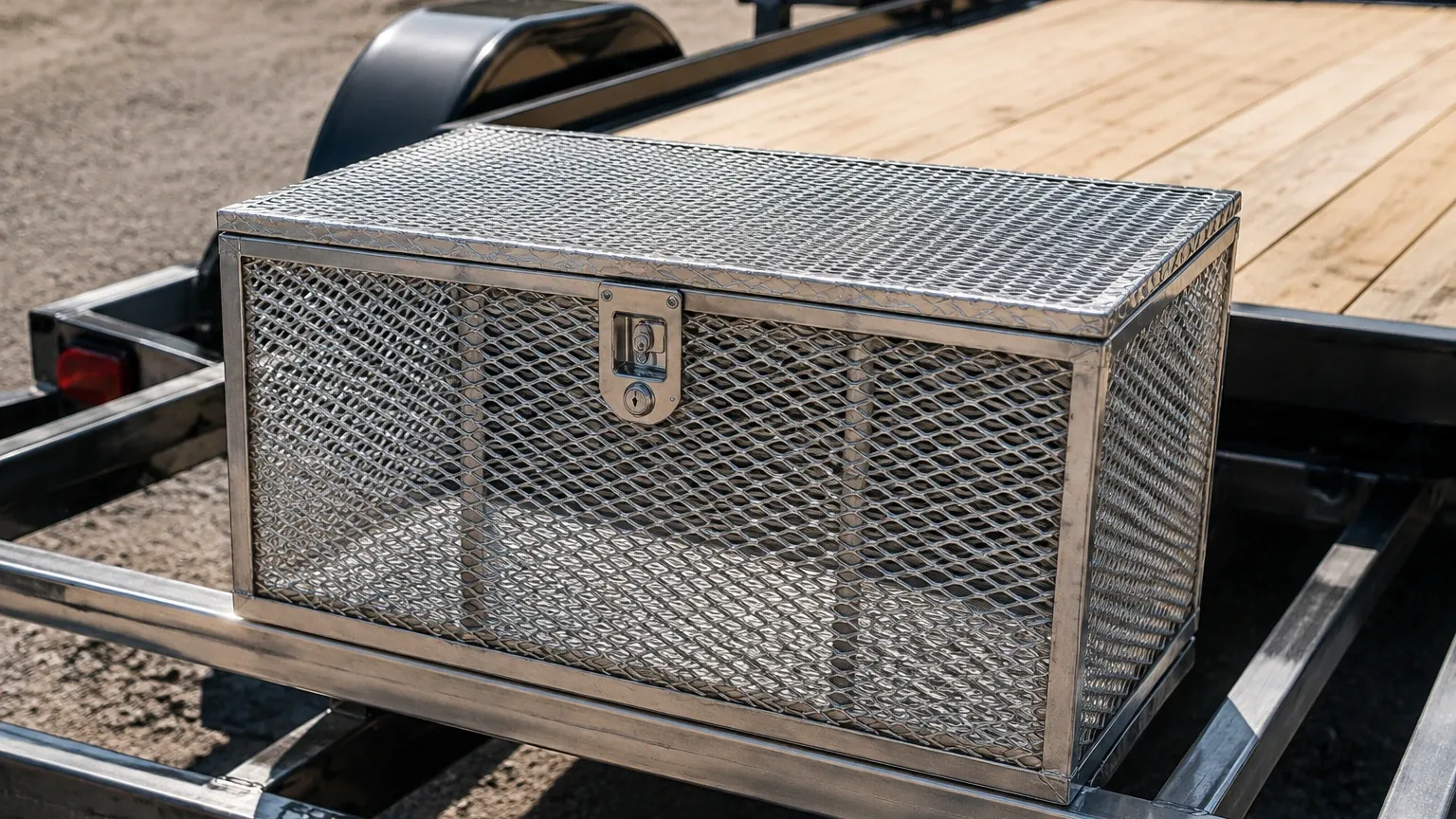
Expanded Metal Box for Trailer
In industrial transport and utility logistics, the demand for secure, durable, and lightweight storage solutions is constant. An expanded metal box for trailer applications represents a specialized engineering choice that balances structural integrity with functional transparency. Unlike solid-walled enclosures, expanded metal offers unique advantages in terms of ventilation, drainage, and weight management, making it a preferred material for professional-grade trailer accessories.
For engineers and procurement specialists, selecting the right storage configuration requires an understanding of material properties, manufacturing tolerances, and the specific environmental stresses encountered during transit. This guide examines the technical considerations behind Perforated & Expanded Metal solutions and how they are optimized for trailer-mounted storage boxes.
Understanding Expanded Metal in Trailer Applications
Expanded metal is produced by simultaneously slitting and stretching a single sheet of metal—typically stainless steel, carbon steel, or aluminum. This process creates a diamond-shaped pattern of openings, where the "strands" and "bonds" (the intersections of the strands) form a continuous, one-piece structure.
Unlike woven wire mesh, expanded metal does not unravel if cut, and unlike perforated metal, it involves no material waste during the expansion process. For a trailer box, this translates to a high strength-to-weight ratio. The resulting mesh is rigid and capable of withstanding the vibrations and mechanical shocks common in heavy-duty hauling. In B2B contexts, the choice often leans toward stainless steel expanded metal due to its superior corrosion resistance in outdoor and chemically aggressive environments.
Engineering Benefits of Expanded Metal for Storage
When designing or sourcing an expanded metal box for trailer use, several engineering benefits drive the selection process:
1. Ventilation and Airflow
The open area of the mesh allows for constant airflow. This is critical when the trailer box is used to store equipment that may be damp, such as hoses or industrial cleaning tools, or machinery like portable generators that require cooling. Proper ventilation prevents the buildup of moisture, which can lead to rust on the tools stored inside.
2. Visibility and Security
Security is a dual-layered requirement. While the box must physically protect its contents from theft, it also allows operators to visually inspect the inventory without opening the enclosure. This transparency is vital for safety checks and rapid inventory management in field operations.
3. Drainage and Debris Management
Trailers are exposed to rain, snow, and road grime. A solid box can trap water, leading to standing pools that damage equipment. An expanded metal floor or side panel ensures that liquids and fine debris pass through the box, keeping the interior dry and clean.
4. Weight Optimization
Reducing the "dead weight" of trailer accessories allows for a higher payload capacity. Expanded metal provides the necessary rigidity for a secure box while using significantly less material than solid plate steel of the same thickness.
Material Selection for Durability
The longevity of an expanded metal box for trailer applications depends heavily on the base material. While carbon steel is cost-effective, it requires galvanization or powder coating to survive the elements. For long-term industrial use, stainless steel is the gold standard.
* Grade 304 Stainless Steel: Offers excellent corrosion resistance and is suitable for most standard industrial and commercial trailer applications.
* Grade 316 Stainless Steel: Recommended for trailers used in coastal regions or industries involving chemical exposure (such as fertilizer transport or chemical processing), as it contains molybdenum for enhanced pitting resistance.
At Kaifil, the focus remains on high-precision metal filtration and component manufacturing, ensuring that the materials used in these structures meet rigorous standards for tensile strength and chemical compatibility.
Design Parameters for Trailer Storage Boxes
When specifying an expanded metal box for trailer integration, engineers must define several key parameters to ensure the product meets the intended load-bearing and security requirements.
Mesh Pattern and Opening Size
The size of the diamond opening (often measured as Long Way of Diamond, LWD, and Short Way of Diamond, SWD) determines what can be stored. Smaller openings provide higher security and prevent small tools from falling through, while larger openings offer better visibility and lower weight.
Strand Thickness and Width
The gauge of the metal and the width of the strand dictate the box's overall strength. For heavy-duty trailer boxes, a thicker strand is necessary to prevent deformation under the weight of heavy equipment or during accidental impacts.
Flattened vs. Raised Expanded Metal
* Raised (Standard): The strands are turned at an angle to the plane of the sheet. This provides maximum rigidity and a slip-resistant surface, which is beneficial if the box lid is used as a step.
* Flattened: The raised mesh is passed through a cold-rolling reducing mill, resulting in a smooth, flat surface. Flattened expanded metal is often used when the box needs to interface closely with other flat components or when a smoother aesthetic is required.
Customization and OEM Capabilities
Industrial applications rarely benefit from a "one size fits all" approach. Customization is essential for integrating storage boxes into specific trailer chassis or specialized equipment rigs. As a manufacturer specializing in custom metal solutions, Kaifil provides the engineering support necessary to move from a conceptual design to a finished filtration or storage component.
Customization options typically include:
* Specific Dimensions: Tailoring the box height, width, and depth to fit tongue-mount, side-mount, or under-body trailer positions.
* Reinforced Framing: Adding angle iron or U-edging to the expanded metal panels to increase structural load capacity.
* Integrated Mounting Points: Pre-drilled holes or welded brackets designed for specific trailer bolt patterns.
* Finishing Options: Beyond raw stainless steel, options such as electropolishing can enhance the surface's corrosion resistance and cleanliness, which is particularly relevant for food-grade or pharmaceutical transport applications.
Key Evaluation Criteria for Purchasing Teams
Before finalizing a purchase order for an expanded metal box for trailer use, procurement teams should confirm several technical details with the supplier:
1. Load Capacity: What is the maximum static and dynamic load the box can support? This is influenced by the gauge of the expanded metal and the design of the support frame.
2. Tolerances: In precision industrial environments, dimensional accuracy is paramount. Ensure the manufacturer can meet the specific tolerances required for the trailer interface.
3. Material Certification: Request Mill Test Reports (MTRs) to verify the grade and quality of the stainless steel or alloy used.
4. Weld Integrity: For B2B applications, the quality of the welds connecting the expanded metal to the frame is a common point of failure. Look for suppliers with documented welding standards (e.g., AWS or equivalent).
Maintenance and Longevity
While stainless steel expanded metal is inherently low-maintenance, the environment of a trailer—subject to road salt, vibration, and impact—requires periodic inspection.
* Cleaning: Regular rinsing to remove road salt and grime will prevent surface staining (tea staining) on stainless steel.
* Inspection: Check for any signs of stress cracking at weld points or deformation in the mesh if the box has been subjected to overloading.
* Hardware Check: Ensure that hinges, latches, and mounting bolts remain tight and lubricated, as the constant vibration of trailer travel can loosen mechanical fasteners over time.
Conclusion
An expanded metal box for trailer applications is more than a simple container; it is a functional engineering component that must withstand harsh operational conditions while providing security and accessibility. By selecting the appropriate material grade, mesh configuration, and customization options, industrial users can ensure a long service life and optimized performance.
For organizations seeking high-performance Perforated & Expanded Metal components, partnering with a manufacturer that understands the nuances of metal fabrication and industrial filtration is essential. Proper selection today prevents premature failure and reduces the total cost of ownership for trailer fleets and industrial equipment.
