


L Shaped Perforated Metal
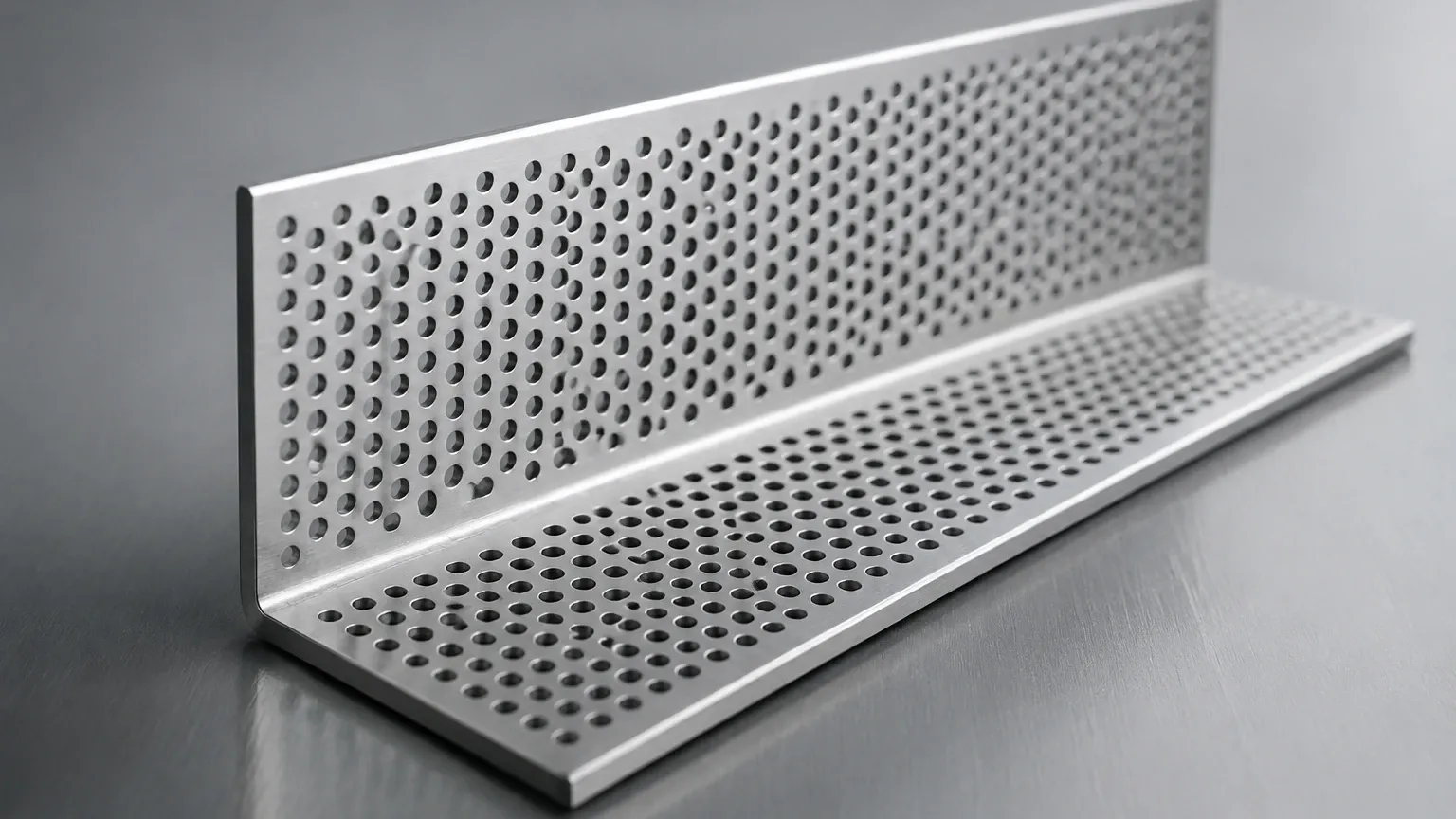
In industrial filtration and structural engineering, the geometry of a component is often as critical as the material properties themselves. L shaped perforated metal represents a specialized category of fabricated components where precision-punched metal sheets are formed into a 90-degree angular profile. This configuration serves dual purposes: providing the necessary open area for fluid or gas passage while offering the structural rigidity required for high-pressure or heavy-load environments. For engineers and procurement specialists, understanding the technical nuances of these components—from hole pattern selection to the mechanical implications of the bending process—is essential for optimizing system performance and longevity.
Engineering Fundamentals of L Shaped Perforated Metal
The production of Perforated & Expanded Metal in an L-shape begins with a flat sheet that undergoes a systematic punching process. Once the desired hole pattern is established, the sheet is moved to a press brake or a specialized rolling machine to achieve the L-profile. This secondary fabrication step introduces several engineering considerations that are absent in standard flat sheets.
Material Integrity and the Bending Process
When a perforated sheet is bent into an L-shape, the material along the bend line undergoes significant stress. Unlike solid metal, perforated metal has a reduced cross-sectional area, which affects how the material stretches and compresses during forming. Engineers must calculate the "K-factor" specifically for perforated materials to ensure that the final dimensions are accurate. If the bend line passes through a row of holes, the structural integrity of the corner may be compromised. Therefore, it is often recommended to design the layout so that the bend occurs on a solid "land" area between the perforations.
Hole Pattern Selection and Open Area
The performance of l shaped perforated metal in filtration applications is primarily dictated by its open area percentage. The open area is the ratio of the total area of the holes to the total area of the sheet. For an L-shaped component, this calculation must account for both the vertical and horizontal flanges. Common patterns include:
* Round Holes: The most versatile and common pattern, offering a balance of strength and high open area. Staggered patterns (usually at 60 degrees) provide the highest efficiency for fluid flow.
* Square Holes: Often selected for applications requiring a higher open area or a specific aesthetic, though they can result in lower structural rigidity compared to round holes.
* Slotted Holes: Ideal for filtering elongated particles or for use in drainage and sorting processes where directional flow is a priority.
Material Selection for Industrial Environments
The choice of alloy for l shaped perforated metal is determined by the chemical, thermal, and mechanical demands of the application. As a manufacturer specializing in stainless steel solutions, Kaifil emphasizes the use of high-grade alloys to ensure durability in harsh industrial settings.
Stainless Steel 304 and 304L
Grade 304 is the standard "18/8" stainless steel. It provides excellent corrosion resistance and is easily formed into L-profiles. It is widely used in food processing, architectural applications, and general industrial filtration. The "L" variant (304L) is preferred if the component requires welding, as it minimizes carbide precipitation that can lead to intergranular corrosion.
Stainless Steel 316 and 316L
For more demanding environments, such as marine applications, chemical processing plants, or pharmaceutical manufacturing, Grade 316 is the industry standard. The addition of molybdenum enhances resistance to pitting and crevice corrosion, particularly in chloride-rich environments. For L-shaped components used as support cages in high-purity filtration, 316L is often mandated to ensure maximum chemical stability.
Specialized Alloys
In high-temperature or highly acidic environments, exotic alloys like Monel, Inconel, or Hastelloy may be required. These materials maintain their mechanical strength and oxidation resistance at temperatures where standard stainless steels would fail. When forming these into L-shapes, specialized tooling is often required due to the higher work-hardening rates of these alloys.
Applications in Industrial Filtration and Support
L shaped perforated metal is rarely a standalone filter medium; instead, it typically functions as a critical support or housing component within a complex filtration system. Its primary role is to provide a rigid framework that can withstand differential pressures while allowing the primary filter media (such as fine wire mesh) to perform its task.
Support Cages and Frames
In many industrial filter housings, the filter element is subjected to high outward or inward pressure. An L-shaped perforated frame can be used to reinforce the corners of rectangular filter banks or to act as a mounting flange for cylindrical cartridges. The L-profile provides a natural seat for gaskets and seals, ensuring a leak-proof interface between the filter and the housing.
Edge Protection and Reinforcement
Filter panels used in heavy-duty vibrating screens or large-scale water intake systems often experience mechanical wear at the edges. Welding an L-shaped perforated strip along the perimeter of a flat screen adds significant torsional stiffness. This prevents the screen from sagging or warping under the weight of the processed material, thereby maintaining a consistent filtration gap.
Flow Diversion and Baffles
In large tanks or chemical reactors, L-shaped perforated components are used as internal baffles. Their geometry allows them to be bolted or welded directly to the tank walls. They serve to break up laminar flow, promote turbulence for better mixing, or protect sensitive internal sensors from the direct impact of high-velocity fluid streams.
Technical Specifications and Customization
When specifying l shaped perforated metal for a project, engineers must provide detailed technical data to ensure the component meets the application's requirements. At Kaifil, we focus on the following parameters to deliver precision-engineered solutions:
1. Gauge/Thickness: Typical thicknesses range from 0.5mm to 10mm. Thicker materials offer more strength but require larger bend radii to prevent cracking.
2. Hole Size and Pitch: The diameter of the holes and the distance between their centers (pitch) determine the filtration rating and the structural strength.
3. Flange Dimensions: The lengths of the two sides of the "L" must be specified. These can be equal (equal leg) or unequal (unequal leg) depending on the mounting requirements.
4. Tolerances: Industrial applications often require tight tolerances on the bend angle (typically +/- 1 degree) and the overall dimensions to ensure proper fitment in assemblies.
5. Surface Finish: Options include mill finish, pickled and passivated (for maximum corrosion resistance), electropolished (for pharmaceutical/food grade), or powder-coated (for architectural or identification purposes).
Evaluating Quality and Avoiding Common Risks
Procuring l shaped perforated metal involves more than just checking dimensions. Several quality factors can influence the total cost of ownership and the safety of the industrial process.
Burr Removal and Edge Quality
The punching process naturally creates burrs on the exit side of the hole. In filtration, these burrs can trap contaminants, impede flow, or even break off and contaminate the downstream fluid. High-quality L-shaped components should undergo deburring processes, such as vibratory finishing or manual grinding, especially on the interior of the bend where access is more difficult.
Stress Corrosion Cracking (SCC)
If the bending process is too aggressive or if the material is not properly annealed, residual stresses can accumulate at the corner of the L-shape. In the presence of certain chemicals, this can lead to stress corrosion cracking. Specifying the correct bend radius—usually a multiple of the material thickness—is a critical preventative measure.
Consistency of Perforation
In low-quality manufacturing, the perforation pattern may become distorted near the bend line. This not only affects the aesthetic but can also create uneven flow distribution and localized pressure points. Advanced CNC punching and forming equipment ensures that the hole geometry remains consistent across the entire profile.
Conclusion: Selecting the Right Solution
L shaped perforated metal is a vital component for engineers seeking to combine filtration capability with structural integrity. Whether used as a support frame in a chemical reactor or a protective guard in a food processing line, the success of the component depends on precise material selection, accurate geometric calculations, and high-quality fabrication.
Before finalizing a design, it is recommended to confirm the compatibility of the chosen alloy with the process fluid and to verify that the open area meets the required flow rates. Working with a specialized manufacturer like Kaifil allows for the customization of hole patterns and profiles to meet exact project specifications. For more information on available materials and technical capabilities, you can Review product options and application support to ensure your filtration system operates at peak efficiency.
