


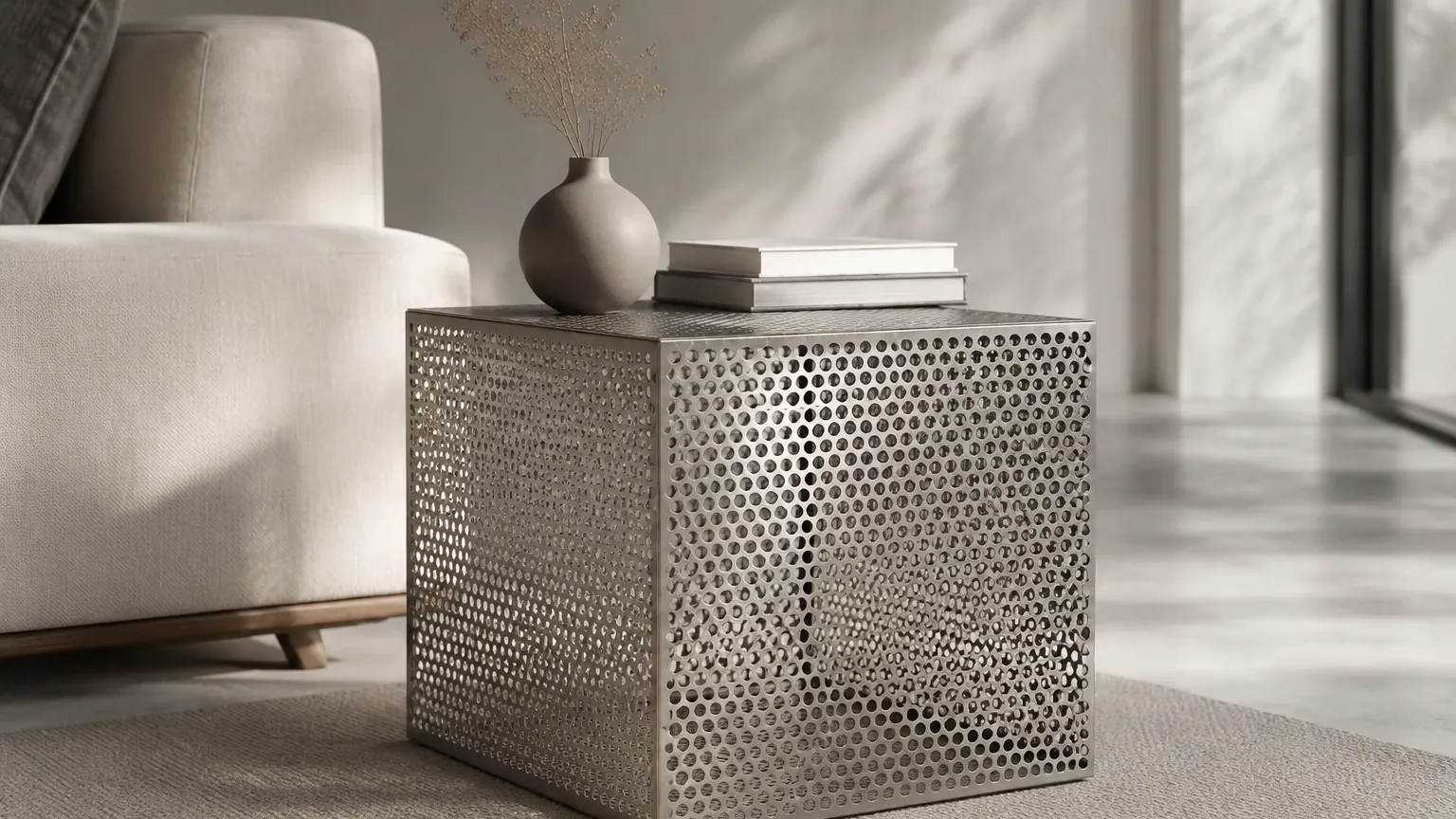
Perforated Metal End Table
In industrial design and high-end furniture manufacturing, the selection of materials determines not only the aesthetic appeal but also the structural longevity and functional performance of the product. The use of Perforated & Expanded Metal in the construction of a perforated metal end table represents a convergence of industrial utility and modern engineering. While often associated with filtration and ventilation, these materials offer unique mechanical advantages for structural components, including high strength-to-weight ratios, transparency for airflow, and customizable surface textures.
For engineers and procurement teams sourcing components for industrial furniture or architectural fixtures, understanding the technical nuances of metal perforation and expansion is critical. This guide examines the material science, manufacturing tolerances, and selection criteria necessary to produce high-quality metal components for structural applications.
The Structural Utility of Perforated Metal in Modern Design
Perforated metal is produced by mechanically punching or laser-cutting a series of holes into a solid metal sheet. When applied to a perforated metal end table, this material serves both a decorative and a functional purpose. From an engineering perspective, the primary benefit is the reduction of weight without a proportional loss in structural integrity.
In industrial environments, furniture must often withstand heavy use, chemical exposure, or frequent cleaning. Perforated sheets allow for the passage of air and light, preventing the accumulation of dust and moisture—a critical factor in pharmaceutical or food-service settings. Furthermore, the "open area" of the metal can be precisely calculated to meet specific load-bearing requirements while maintaining a lightweight profile for ease of transport and assembly.
Material Selection: Why Stainless Steel is the Industrial Standard
When specifying materials for a perforated metal end table, the choice of alloy is the most significant factor in determining the product's lifespan. At Kaifil, we emphasize the use of stainless steel for its superior mechanical properties and resistance to environmental degradation.
Grade 304 Stainless Steel
Grade 304 is the most common stainless steel used in industrial and commercial applications. It contains approximately 18% chromium and 8% nickel, providing excellent corrosion resistance against oxidation and most organic chemicals. For interior end tables or standard industrial office furniture, 304 offers a cost-effective balance of durability and workability.
Grade 316 Stainless Steel
For applications in more demanding environments—such as laboratories, coastal facilities, or medical centers—Grade 316 is the preferred choice. The addition of molybdenum (usually 2-3%) significantly enhances its resistance to chlorides and pitting. If a perforated metal end table is intended for outdoor use or exposure to harsh cleaning agents, 316 ensures the surface remains free of rust and structural weakening over time.
Carbon Steel and Aluminum
While carbon steel is more economical, it requires secondary coatings like powder coating or galvanization to prevent rust. Aluminum, on the other hand, offers extreme weight savings and natural corrosion resistance but lacks the high tensile strength of stainless steel, which may necessitate thicker gauges to prevent deformation under load.
Understanding Perforation Patterns and Open Area Calculations
The performance of a perforated metal end table is largely dictated by its hole pattern and the resulting "percentage of open area." This calculation is vital for engineers to determine the material's transparency and its ability to support weight.
Common Hole Patterns
1. Round Holes (Staggered): This is the most popular pattern due to its aesthetic versatility and structural strength. A 60-degree staggered pattern provides the highest degree of rigidity across the sheet.
2. Square Holes: These offer a high open area percentage and a modern, geometric look. However, square holes can create stress concentration points at the corners, which must be accounted for in load-bearing designs.
3. Slotted Holes: Often used for drainage or specific directional airflow, slotted patterns provide a unique visual texture but may have different bending strengths along the X and Y axes.
Calculating Open Area
For a standard staggered round hole pattern, the open area (OA) is calculated using the following formula:
OA% = (D² × 90.69) / P²
* D = Hole Diameter
* P = Pitch (Center-to-center distance between holes)
For a perforated metal end table, an open area between 30% and 50% is typically ideal. This range provides sufficient transparency for design purposes while retaining enough solid metal to prevent the surface from sagging under the weight of books, equipment, or other items.
Expanded Metal: An Alternative for High-Strength Applications
While perforated metal involves removing material, expanded metal is created by slitting and stretching a single sheet of metal simultaneously. This process results in a diamond-shaped mesh that is incredibly strong and produces zero waste during manufacturing.
Structural Advantages of Expanded Metal
Expanded metal is often used for the base or support structure of a perforated metal end table. Because the metal is "expanded" rather than punched, the strands are set at an angle to the plane of the sheet. This creates a natural truss-like structure that enhances the material's rigidity.
* Raised vs. Flattened: Expanded metal can be left "raised" for maximum grip and strength, or "flattened" through a cold-rolling process to create a smooth surface suitable for a tabletop. Flattened expanded metal is particularly useful for industrial furniture where a level surface is required but the strength of the expanded structure is still desired.
Manufacturing Precision: Tolerances and Edge Treatments
In B2B procurement, the quality of a perforated metal end table is defined by the precision of its fabrication. Engineers must specify tolerances to ensure that components fit together perfectly during final assembly.
Edge Margins
One of the most critical specifications is the "margin." This refers to the solid area around the perimeter of the perforated sheet. For a furniture application, having a "safe side" or a finished margin is essential for welding the top to the frame. Without specified margins, the perforation pattern might run off the edge, resulting in sharp, jagged points that are unsafe and difficult to finish.
Leveling and Flatness
The perforation process involves high-pressure punching, which can introduce internal stresses into the metal, causing it to curl or bow. To ensure a flat surface for an end table, the material must undergo a leveling process. Precision roller leveling restores the flatness of the sheet, ensuring that the final product does not wobble or tilt.
Finishing Processes for Industrial-Grade Furniture Components
The finish of a perforated metal end table determines its tactile quality and its resistance to wear. Since these items are frequently touched, the finish must be smooth and free of burrs.
1. Deburring: The punching process often leaves small burrs on the underside of the holes. Mechanical deburring or electropolishing is necessary to remove these sharp edges, ensuring the table is safe for users.
2. Electropolishing: Particularly for stainless steel, electropolishing removes a microscopic layer of material, resulting in a bright, mirror-like finish and enhanced corrosion resistance. It also smooths out the interior of the perforated holes.
3. Powder Coating: For carbon steel or aluminum components, powder coating provides a durable, thick protective layer available in various colors. This is a common choice for industrial office furniture where brand-specific colors are required.
4. Passivation: For stainless steel components, passivation is a chemical treatment that removes free iron from the surface, reinforcing the protective chromium oxide layer and preventing tea-staining or surface rust.
Engineering Considerations for Load-Bearing Surfaces
When designing a perforated metal end table for an industrial or laboratory setting, engineers must consider the "Deflection Under Load." Because the material has been perforated, its moment of inertia is lower than that of a solid sheet of the same thickness.
To compensate for this, designers can:
* Increase the Gauge: Using a thicker sheet (e.g., 14-gauge instead of 18-gauge) significantly increases the load capacity.
* Reduce the Pitch: By increasing the distance between holes (reducing the open area), the amount of solid metal is increased, thereby strengthening the sheet.
* Structural Ribbing: Adding a solid metal frame or under-table supports can prevent the perforated surface from flexing.
Sourcing Custom Perforated Components for OEM Projects
For manufacturers looking to integrate Perforated & Expanded Metal into their product lines, partnering with a specialized manufacturer like Kaifil provides access to advanced customization. Industrial-scale production of a perforated metal end table requires more than just standard sheets; it requires precision-cut components that are ready for assembly.
Customization Options
* Variable Perforation: Patterns can be designed to be denser in high-stress areas and more open in decorative areas.
* Complex Geometries: Advanced CNC punching and laser cutting allow for non-rectangular shapes, integrated mounting holes, and custom logos to be perforated directly into the metal.
* Material Certification: For industries with strict compliance requirements, such as pharmaceuticals or aerospace, sourcing materials with full MTR (Mill Test Report) traceability is essential to verify the alloy composition and strength.
Conclusion
A perforated metal end table is more than a simple piece of furniture; it is a highly engineered component that requires careful consideration of material science, hole geometry, and finishing techniques. By selecting the appropriate grade of stainless steel and calculating the optimal open area, engineers can create products that are durable, functional, and aesthetically aligned with modern industrial standards. Whether for a cleanroom, a high-traffic office, or a specialized laboratory, the use of precision perforated and expanded metal ensures a product that stands up to the rigors of professional use.
