


Perforated Metal Gate Design
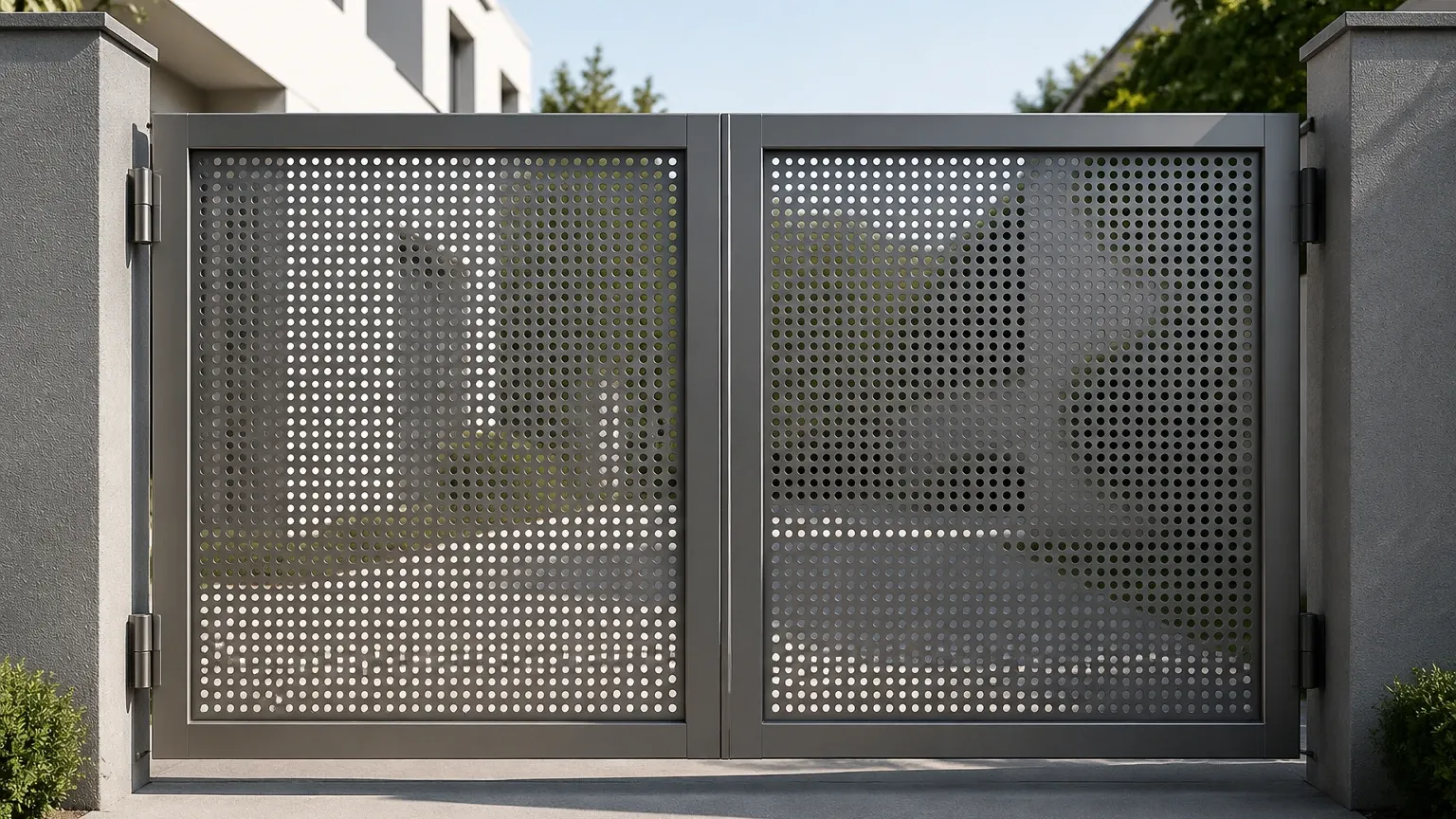
In industrial and commercial infrastructure, the selection of materials for access control systems requires a balance between structural integrity, environmental resistance, and functional transparency. Perforated metal gate design has emerged as a preferred solution for engineers and facility managers who require robust security without sacrificing airflow or visibility. Unlike solid sheet metal or traditional chain-link fencing, perforated panels offer a customizable engineering profile that can be tailored to specific site requirements, ranging from high-security chemical processing plants to architectural commercial entrances.
Designing an effective perforated metal gate involves more than aesthetic choices; it requires a deep understanding of metallurgy, open area calculations, and wind load physics. This guide examines the technical considerations essential for specifying perforated metal components in gate applications, ensuring long-term performance and safety.
Material Selection for Industrial Gate Environments
The foundation of any perforated metal gate design is the base material. The choice of metal dictates the gate’s lifespan, maintenance requirements, and resistance to environmental stressors. In industrial filtration and containment environments, where Kaifil specializes, material performance is non-negotiable.
Stainless Steel (304 and 316 Grades)
Stainless steel is the gold standard for gates in harsh environments. Grade 304 offers excellent corrosion resistance for standard industrial use, while Grade 316, containing molybdenum, is essential for coastal installations or chemical processing facilities where exposure to chlorides and acids is frequent. Stainless steel’s high strength-to-weight ratio allows for thinner gauges without compromising security.
Aluminum
For applications where weight is a primary concern—such as large cantilever gates or automated sliding systems—aluminum is often the material of choice. It is naturally corrosion-resistant due to its oxide layer and can be powder-coated for additional protection and visual integration. However, designers must account for aluminum’s lower tensile strength compared to steel by increasing the material thickness (gauge).
Carbon Steel
Carbon steel provides a cost-effective solution for interior industrial partitions or dry environments. To prevent oxidation, carbon steel gates must be galvanized or high-performance powder-coated. While more economical upfront, the total cost of ownership may increase over time due to the need for periodic recoating in outdoor settings.
Engineering Considerations: Open Area and Wind Loading
One of the most critical technical aspects of perforated metal gate design is the "Open Area" percentage. This refers to the ratio of the total area of the holes to the total area of the sheet. For gate applications, the open area serves two primary functions: visibility and wind permeability.
Calculating Open Area
The open area is determined by the hole diameter (D) and the pitch (P), which is the center-to-center distance between holes. For a standard 60-degree staggered round hole pattern, the formula is:
Open Area % = (D² × 90.69) / P²
In gate design, an open area between 30% and 50% is typical. This range provides sufficient transparency for security personnel to monitor the perimeter while maintaining the structural rigidity of the panel.
Wind Load Management
Solid gates act as sails, catching wind and exerting massive pressure on hinges, motors, and support posts. In high-wind regions, a solid gate may require significantly oversized structural supports. Perforated metal mitigates this by allowing air to pass through the surface. Engineers must calculate the "Drag Coefficient" based on the perforated pattern to ensure the gate hardware can withstand peak wind gusts without mechanical failure.
Comparing Perforated and Expanded Metal Patterns
When specifying materials for gates, designers often choose between perforated sheets and expanded metal. While both provide ventilation and security, their manufacturing processes and physical properties differ significantly.
* Perforated Metal: Created by punching holes into a solid sheet. This process allows for extremely precise hole placement and varied shapes (round, square, slotted, or custom). It offers a smooth surface and allows for "blank margins"—solid borders around the edge of the panel—which simplify welding and installation into gate frames.
* Expanded Metal: Produced by simultaneously slitting and stretching the metal. This results in a diamond-shaped mesh. Because no material is lost during production, expanded metal is often more cost-effective and provides a high strength-to-weight ratio. However, it typically has a more textured, "directional" surface that can be harder to clean and may have sharp edges if not properly deburred.
For those evaluating these options for specific industrial projects, reviewing Perforated & Expanded Metal specifications is essential to determine which material behavior aligns with the mechanical requirements of the gate system.
Hole Patterns and Security Specifications
The geometry of the perforations directly impacts the gate's security level and anti-climb capabilities. In industrial settings, security is often prioritized alongside filtration or ventilation needs.
Round vs. Square Holes
Round holes are the most common due to their structural stability and ease of manufacturing. They offer the best resistance to tearing and are generally more aesthetically neutral. Square holes provide a higher open area for a given hole size but can create stress concentration points at the corners, which may lead to cracking under heavy vibration or repeated mechanical stress.
Anti-Climb Features
For high-security perimeters, the hole size should be small enough to prevent a person from gaining a foothold or fingerhold. Typically, holes smaller than 10mm (0.4 inches) are considered anti-climb. Slotted patterns can also be used to provide visibility while making it nearly impossible to scale the gate without specialized equipment.
Pitch and Orientation
A staggered pitch (usually 60 degrees) is preferred over a straight-row pattern because it provides higher strength and a more uniform distribution of the load across the metal sheet. This is particularly important for gates that will be subjected to frequent movement or impact.
Integration and Fabrication Requirements
A successful perforated metal gate design requires careful attention to how the perforated infill panels are integrated into the primary gate frame. Failure to account for fabrication nuances can lead to premature structural failure or corrosion.
Welding and Margins
When ordering perforated panels, it is vital to specify "margins." Margins are the unperforated solid areas around the edges of the sheet. Solid margins provide a clean surface for welding the panel to the gate's tubular or angle-iron frame. Welding directly onto the perforated area is difficult and often results in weak joints and unsightly burn-through.
Gauge and Rigidity
For most industrial gates, a thickness of 10 to 14 gauge (approximately 2.0mm to 3.5mm) is recommended. Thinner gauges may vibrate or "oil-can" (pop in and out) when the gate moves, while excessively thick gauges add unnecessary weight and cost. If a large span is required, designers may add intermediate horizontal or vertical support bars to the frame to prevent the perforated sheet from flexing.
Finishing and Coating
After fabrication, the gate should be treated to ensure longevity. For stainless steel, passivation or electropolishing is recommended to remove surface contaminants and enhance the protective oxide layer. For carbon steel and aluminum, powder coating provides a durable finish that can resist UV exposure and physical abrasion. It is important to ensure the coating penetrates the inside of the perforated holes to prevent "edge creep" corrosion.
Maintenance and Long-Term Performance
One of the primary advantages of perforated metal in gate design is its low maintenance profile, especially when compared to wood or chain-link. However, in industrial environments, specific maintenance protocols should be followed:
1. Debris Clearance: In facilities with high particulate matter or organic debris, the perforations can become clogged, reducing airflow and increasing wind load. Periodic pressure washing is usually sufficient to clear the openings.
2. Hardware Inspection: Because perforated gates are often lighter than solid gates, they can be operated by smaller, more efficient motors. However, the vibration from high-frequency use can loosen fasteners. Regular inspection of the mounting points between the perforated panel and the frame is necessary.
3. Corrosion Monitoring: In chemical or saltwater environments, even stainless steel should be rinsed periodically to prevent the buildup of corrosive deposits (pitting corrosion).
Conclusion for Engineering and Procurement
Specifying a perforated metal gate requires a holistic approach that considers the environment, the required security level, and the mechanical limits of the materials. By selecting the appropriate material grade, calculating the necessary open area for wind permeability, and ensuring proper fabrication margins, engineers can create a gate system that is both functional and durable.
For procurement teams, the total cost of ownership should be the guiding metric. While aluminum or stainless steel may have a higher initial material cost, their resistance to corrosion and reduced maintenance requirements often make them more economical over a 10-to-20-year lifecycle compared to coated carbon steel. Partnering with a manufacturer like Kaifil, which understands the nuances of precision metal fabrication and industrial filtration requirements, ensures that the perforated components meet the exact tolerances required for high-performance gate systems.
