


Perforated Metal vs Expanded Metal
In industrial engineering and filtration design, selecting the appropriate media is critical to the efficiency, longevity, and structural integrity of the final product. Two of the most common materials used for filtration support, protective screening, and architectural components are perforated metal and expanded metal. While they may appear similar at a glance, their manufacturing processes, mechanical properties, and performance characteristics differ significantly.
For engineers and procurement specialists, understanding the nuances of perforated metal vs expanded metal is essential for optimizing system performance and managing costs. This guide provides a technical analysis of both materials to support informed decision-making in demanding industrial environments.
Defining the Core Technologies
Both materials belong to the category of Perforated & Expanded Metal, yet they are produced using fundamentally different methods.
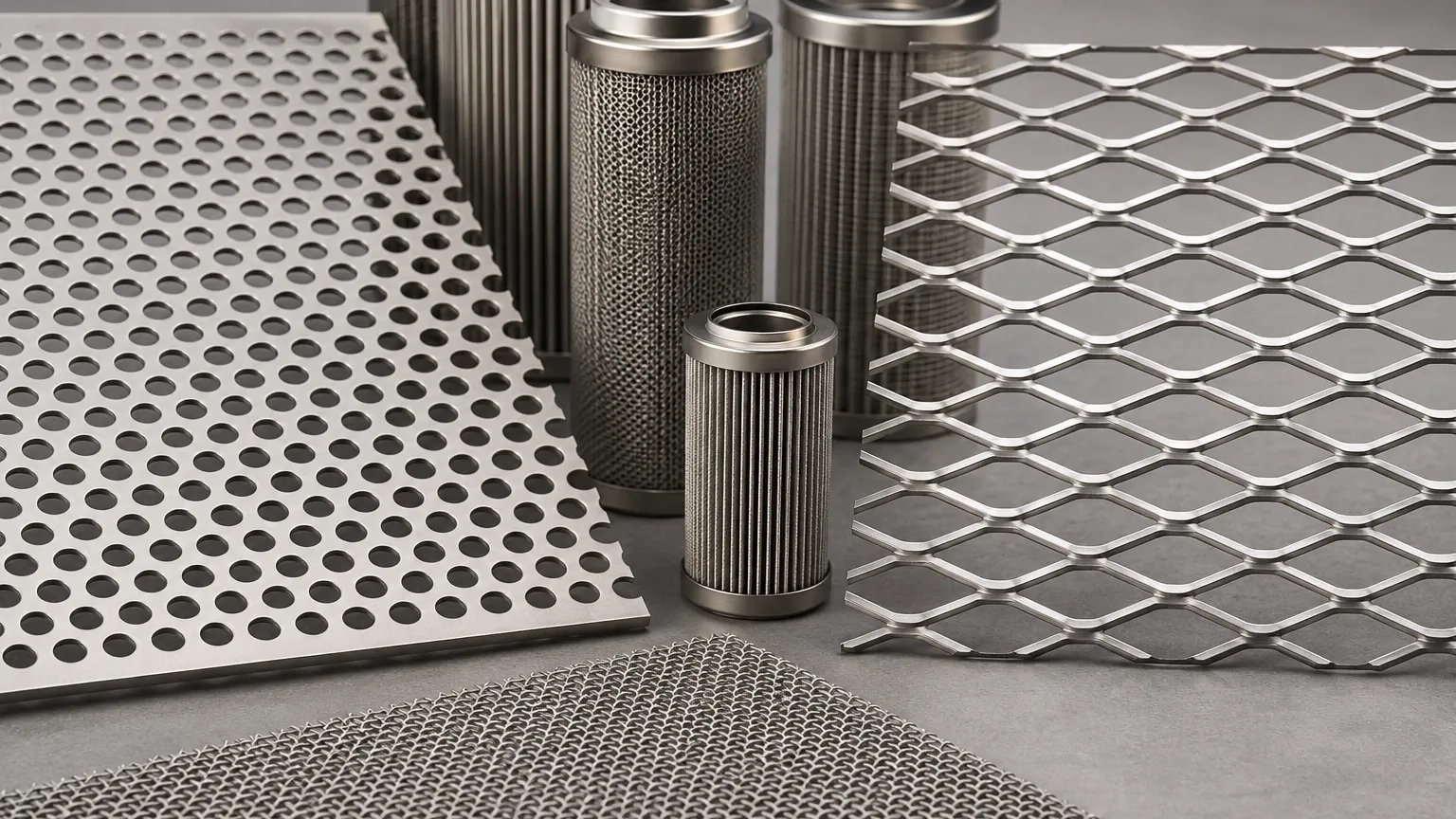
Perforated metal is created by punching a series of holes into a solid sheet of material. This process uses a CNC press or a rotary pinned perforation roller to remove "slugs" of metal, leaving a pattern of openings. The precision of this method allows for highly specific hole sizes, shapes, and arrangements.
Expanded metal is produced through a simultaneous slitting and stretching process. A solid metal sheet is fed through a machine that cuts staggered slits while pulling the material apart. This expands the slits into diamond-shaped openings. Because the material is stretched rather than punched, no metal is lost during production, resulting in a continuous, jointless mesh.
Manufacturing Processes and Material Efficiency
One of the primary distinctions between perforated metal vs expanded metal lies in material utilization and waste management.
Perforated Metal Production
In the perforation process, the metal removed to create the holes (the slugs) is typically collected and recycled. However, the cost of the raw material must still account for the initial full weight of the sheet. Perforation allows for "margins"—solid areas at the edges of the sheet—which provide additional structural strength and ease of welding. This level of customization is a significant advantage for custom filter cartridges where specific mounting points are required.
Expanded Metal Production
Expanded metal is often considered more resource-efficient because it generates zero waste. The stretching process can increase the area of the original sheet by up to ten times, depending on the strand width and opening size. This makes expanded metal a cost-effective choice for large-scale applications where high open-area percentages are needed without the premium cost of high-volume material removal.
Technical Comparison: Perforated Metal vs Expanded Metal
When evaluating these materials for industrial applications, engineers must consider several key performance indicators (KPIs).
| Feature | Perforated Metal | Expanded Metal |
| :— | :— | :— |
| Hole Geometry | Round, square, slotted, or custom shapes. | Primarily diamond-shaped. |
| Material Waste | High (slugs are removed). | Zero (material is stretched). |
| Strength-to-Weight | High, but depends on the hole pattern. | Excellent; the truss-like structure adds rigidity. |
| Open Area | Highly customizable (up to 80%+). | Determined by the degree of expansion. |
| Surface Texture | Flat and smooth. | Raised (standard) or flattened. |
| Customization | High (precise hole placement). | Limited to standard expansion patterns. |
Structural Rigidity
Expanded metal possesses an inherent structural advantage due to its "truss-like" configuration. The strands and bonds (where the strands intersect) are angled to the plane of the sheet, providing greater directional strength than a flat perforated sheet of the same weight. However, perforated metal offers more predictable mechanical properties under uniform loading, especially when using thicker gauges of stainless steel.
Filtration Performance and Engineering Specifications
In the context of industrial filtration, the choice between perforated metal vs expanded metal often comes down to flow dynamics and particle retention requirements.
Precision and Micron Ratings
Perforated metal is the preferred choice for applications requiring precise filtration accuracy. Because the hole size can be controlled down to fractions of a millimeter, it is ideal for primary filtration stages or as a support core for fine wire mesh. Engineers can calculate the exact pressure drop across a perforated plate using standard fluid dynamics formulas, as the open area is consistent and measurable.
Flow Dynamics
Expanded metal, particularly in its "raised" form, creates more turbulence in fluid flow. While this may be undesirable in some hydraulic applications, it can be beneficial in certain chemical processing environments where mixing or heat dissipation is required. Flattened expanded metal is often used when a smoother profile is necessary to prevent flow restriction or to protect delicate filter media layered against it.
Material Selection and Compatibility
At Kaifil, we emphasize the importance of material grade in ensuring the longevity of filtration components. Both perforated and expanded metals are available in a variety of alloys, including:
* Stainless Steel 304/304L: The industry standard for general corrosion resistance in food and beverage or water treatment applications.
* Stainless Steel 316/316L: Enhanced resistance to chlorides and acids, essential for chemical processing and marine environments.
* Specialty Alloys: For high-temperature or highly corrosive environments, materials like Monel, Inconel, or Hastelloy may be used in perforated formats.
Selecting the right alloy is as important as selecting the right physical structure. For instance, a 316L perforated stainless steel core provides the chemical stability and mechanical strength required for high-pressure hydraulic filters.
Selection Criteria for Industrial Applications
To determine the best material for a specific project, engineers should answer the following questions:
1. What is the required filtration accuracy? If precise hole sizing is mandatory, perforated metal is the logical choice.
2. Is weight a critical factor? Expanded metal provides higher strength-to-weight ratios, making it ideal for large protective screens or lightweight partitions.
3. Will the material be subjected to high pressure? Perforated metal cores are generally better suited for high-differential pressure environments due to their uniform wall thickness.
4. What is the budget for raw materials? If the application allows for diamond-shaped openings, expanded metal can significantly reduce material costs.
5. Does the application require a flat surface? Perforated metal is naturally flat, whereas expanded metal must undergo an additional flattening process to achieve a similar profile.
Industrial Use Cases
Filtration and Separation
In the production of stainless steel filter cartridges, perforated metal often serves as the inner support tube. Its ability to withstand collapse under high pressure makes it indispensable. Expanded metal is frequently used as an outer guard to protect the pleats of a filter element from mechanical damage during handling or installation.
Chemical Processing
Perforated plates are used in distillation columns and centrifuges where precise flow control and chemical resistance are paramount. The smooth surface of perforated stainless steel also facilitates easier cleaning and sterilization, a critical requirement in pharmaceutical manufacturing.
Protective Barriers and Grating
Expanded metal is widely used for safety guards, walkways, and ventilation grilles. Its slip-resistant surface (in the raised format) and ability to allow light and air passage while maintaining security make it a versatile industrial material.
Maintenance and Total Cost of Ownership
When comparing perforated metal vs expanded metal, it is vital to look beyond the initial purchase price. Total cost of ownership includes maintenance, cleaning, and replacement frequency.
* Cleanability: Perforated metal, with its smooth surfaces and round holes, is generally easier to clean via backwashing or ultrasonic cleaning. Expanded metal has more "nooks and crannies" where debris can become lodged, potentially leading to shorter service intervals in high-fouling applications.
* Durability: Both materials are highly durable when specified in the correct stainless steel grade. However, the lack of welds in expanded metal means there are no points of potential stress corrosion cracking or weld failure, which can be an advantage in vibrating machinery.
* Replacement Cycles: In filtration systems, the replacement cycle is often dictated by the pressure drop. If a material is prone to clogging and cannot be effectively cleaned, the operational costs will rise. Engineers must balance the lower initial cost of expanded metal against the potentially superior cleanability of perforated solutions.
Engineering Support and Customization
Choosing between these two materials involves balancing mechanical requirements with economic constraints. At Kaifil, we provide technical expertise to help engineers navigate these choices. Whether you require a custom-punched perforated core for a high-viscosity chemical filter or a flattened expanded metal wrap for a hydraulic element, the focus remains on precision and reliability.
For those in the design phase of a project, confirming the exact mechanical loads, flow rates, and chemical exposures will allow for a more accurate recommendation. Customization options, such as specific margins for welding or specialized surface treatments (like electropolishing), can further enhance the performance of both perforated and expanded metal components.
By carefully evaluating the trade-offs of perforated metal vs expanded metal, purchasing teams can ensure they receive a product that meets the rigorous demands of industrial service while optimizing the overall project budget.
