


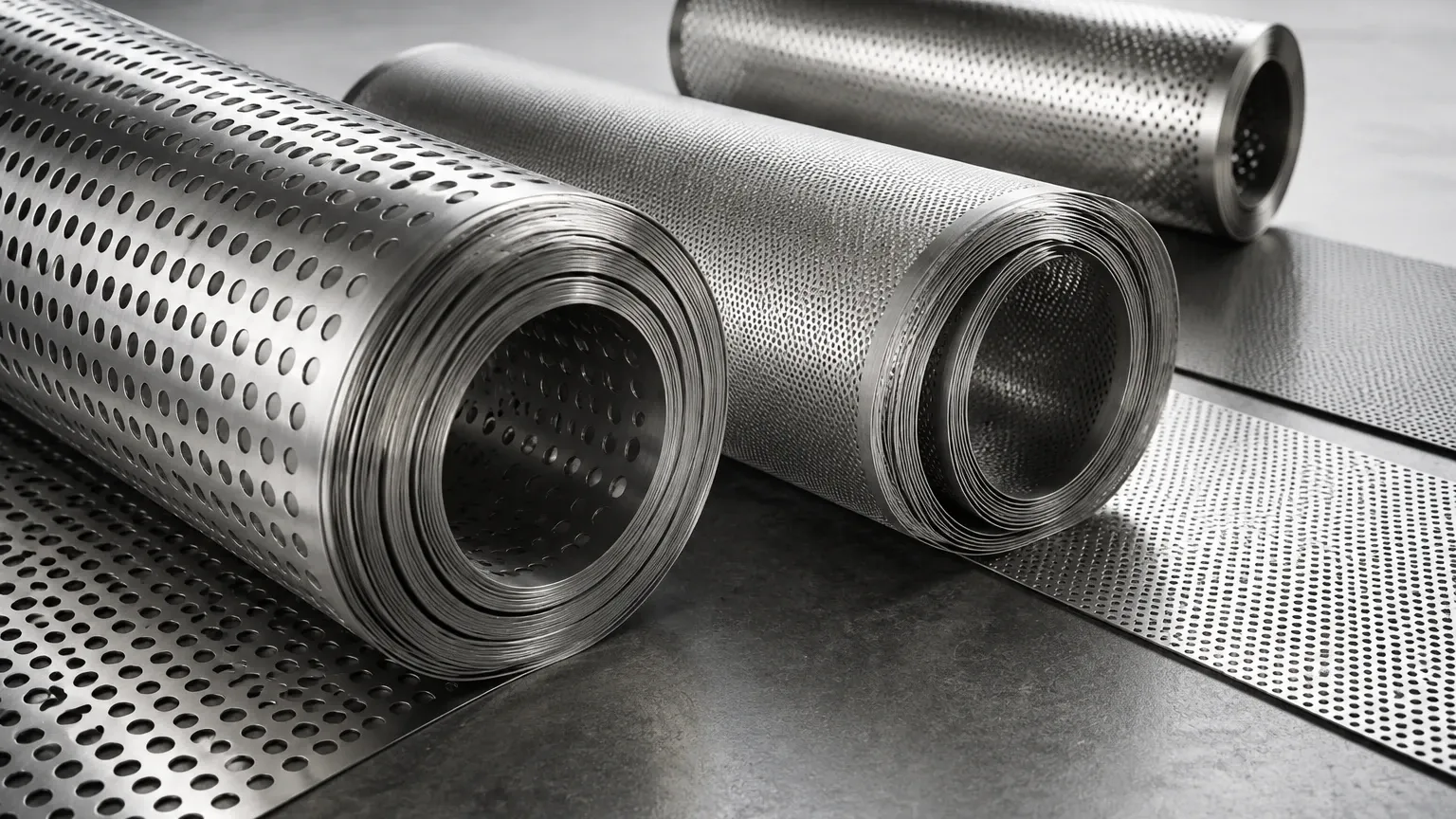
Roll of Perforated Metal
In industrial manufacturing and filtration engineering, the format in which raw materials are supplied significantly impacts production efficiency, waste reduction, and the structural integrity of the final product. A roll of perforated metal is a continuous length of metal sheet that has been mechanically punched or stamped to create a pattern of holes, slots, or decorative shapes, then coiled for transport and automated processing. Unlike individual sheets, rolls allow for high-speed, continuous feeding into secondary fabrication equipment, making them an essential component in the production of filter cartridges, acoustic panels, and architectural elements.
Selecting the correct specification for Perforated & Expanded Metal requires a deep understanding of material science, mechanical tolerances, and the specific fluid dynamics of the intended application. For engineers and procurement teams, the transition from flat sheets to rolls often represents a strategic shift toward optimizing total cost of ownership (TCO) and manufacturing throughput.
The Fundamentals of Roll-Form Perforated Metal
The production of a roll of perforated metal involves high-precision CNC punching presses or rotary perforating equipment. The process begins with a master coil of solid metal—typically stainless steel, carbon steel, or aluminum—which is fed through a series of dies. These dies punch out the desired pattern while maintaining the structural tension required to recoil the material.
One of the primary technical advantages of the roll format is the ability to maintain consistent hole alignment over long distances. This is critical for applications such as spiral-welded filter tubes or large-scale screening systems where any deviation in the pattern can lead to structural weaknesses or bypasses in the filtration media.
Material Selection for Industrial Environments
For industrial filtration and chemical processing, material selection is the first line of defense against premature failure. Kaifil specializes in high-performance alloys that withstand corrosive environments and high-pressure differentials:
* Stainless Steel 304/304L: The industry standard for general-purpose filtration, offering excellent formability and resistance to oxidation.
* Stainless Steel 316/316L: Enhanced with molybdenum, this grade is essential for marine environments, pharmaceutical processing, and applications involving chlorides or high acidity.
* Specialty Alloys: For extreme temperatures or highly aggressive chemical media, materials like Monel, Inconel, or Duplex stainless steel may be specified in roll form to ensure long-term durability.
Engineering Specifications: Patterns and Open Area
The performance of a roll of perforated metal is defined by its geometric configuration. Engineers must balance the need for high flow rates (high open area) with the requirement for mechanical strength (low open area).
Hole Patterns and Geometry
* Round Holes: The most common and versatile pattern. Round holes offer the best structural strength-to-weight ratio and are the easiest to clean in filtration applications. They are typically arranged in a 60-degree staggered pattern, which maximizes open area and provides uniform strength in all directions.
* Square Holes: Often used when a higher open area is required for airflow or visibility, though they may have lower structural stability under high-pressure liquid flow compared to round holes.
* Slotted Holes: Ideal for sorting or filtering elongated particles. In roll form, slots can be oriented parallel or perpendicular to the length of the coil, depending on the fabrication requirements of the final component.
Calculating Open Area
The open area is the percentage of the total surface area that consists of holes. For a standard 60-degree staggered round hole pattern, the calculation is:
Open Area % = (D² × 90.69) / P²
Where D is the hole diameter and P is the pitch (the distance from the center of one hole to the center of the adjacent hole). Accurate calculation is vital because it directly influences the pressure drop across the filter and the velocity of the fluid passing through the media.
Perforated vs. Expanded Metal in Rolls
While often grouped together, perforated and expanded metals are manufactured through different processes, resulting in distinct physical properties. When sourcing from a Perforated & Expanded Metal specialist, it is important to distinguish which is better suited for the specific mechanical load.
Perforated Metal
Perforated metal is created by removing material. This results in a flat, smooth surface that is ideal for precision filtration where the thickness of the media must remain constant. It allows for highly customizable margins (solid edges) on the roll, which simplifies welding and assembly.
Expanded Metal
Expanded metal is produced by slitting and stretching the metal simultaneously. This process creates a diamond-shaped mesh without any material waste. In roll form, expanded metal provides a three-dimensional structure that can act as a high-surface-area support for finer wire mesh layers. However, because the process involves stretching, the resulting roll is typically thicker than the original base material, which must be accounted for in housing designs.
Technical Advantages of the Roll Format for OEMs
For Original Equipment Manufacturers (OEMs), purchasing a roll of perforated metal offers several logistical and technical benefits over pre-cut sheets:
1. Continuous Fabrication: Rolls are compatible with automated decoiling and shearing systems. This reduces the labor costs associated with manual handling and positioning of individual sheets.
2. Waste Minimization: By using a continuous roll, manufacturers can optimize their cutting patterns to minimize "off-cuts." This is particularly important when working with expensive alloys like 316L stainless steel.
3. Consistency in Tension and Flatness: High-quality industrial rolls undergo leveling processes to ensure they remain flat when decoiled. This prevents "oil-canning" or bowing, which can interfere with precision welding or forming processes.
4. Custom Widths and Margins: Rolls can be slit to the exact width required for a specific production line, and unperforated margins can be maintained along the edges to provide a clean surface for longitudinal welding in filter tube production.
Applications in Industrial Filtration
A roll of perforated metal serves as the backbone for many complex filtration systems. Its primary role is often structural, providing the necessary rigidity to withstand high differential pressures that would otherwise collapse finer filtration media.
* Support Cores for Cartridges: In hydraulic and chemical filtration, a perforated metal roll is rolled into a cylinder and welded to form the inner core or outer guard of a filter cartridge. This core supports the pleated wire mesh or fiberglass media.
* Strainer Elements: Heavy-duty basket strainers used in water treatment and oil and gas often utilize thicker gauge perforated metal rolls to capture large debris before it can damage downstream pumps.
* Centrifuge Screens: In the food and beverage industry, specifically in sugar and starch processing, perforated rolls are used to create high-speed centrifuge liners that require precise hole diameters and smooth surfaces to prevent particle entrapment.
* Acoustic Damping: Beyond filtration, perforated rolls are used in industrial silencers and engine exhausts, where the hole pattern is engineered to dissipate sound energy.
Quality Control and Procurement Checklist
When specifying a roll of perforated metal for a technical project, engineers should confirm several critical parameters with the manufacturer to ensure the material performs as expected in the field.
Tolerance and Precision
Industrial applications often require tight tolerances on hole diameters (typically +/- 0.05mm to 0.1mm) and pitch. Furthermore, the "camber" of the roll—the deviation of the edge from a straight line—must be minimized to ensure the material tracks correctly through automated machinery.
Burr Levels and Surface Finish
The punching process naturally creates a "die side" and a "punch side." The punch side may have slight burrs. For filtration applications involving delicate synthetic fibers or high-purity chemicals, these burrs must be removed through vibratory finishing or electropolishing to prevent media damage or contamination.
Flatness and Stress Relief
Metal that has been perforated and coiled retains internal stresses. If not properly leveled, the material may curl or twist when cut. Specifying "leveling" or "stress-relieving" ensures that the decoiled metal remains flat during secondary fabrication.
Confirmation Checklist for RFQs:
* Material Grade: (e.g., SS316L)
* Thickness: (e.g., 0.5mm to 3.0mm)
* Hole Diameter and Pitch: (e.g., 2.0mm holes on a 3.5mm staggered pitch)
* Roll Width and Total Length: (Standard or custom widths)
* Margin Requirements: (Size of the solid borders on the sides and ends)
* Surface Treatment: (e.g., Degreasing, pickling, or passivating)
Conclusion
The selection of a roll of perforated metal is a critical decision that bridges the gap between raw material sourcing and finished product performance. Whether used as a structural support in a high-pressure hydraulic filter or as a precision screen in a pharmaceutical centrifuge, the quality of the perforation, the accuracy of the open area, and the integrity of the base alloy are paramount.
By partnering with a manufacturer like Kaifil that understands the nuances of Perforated & Expanded Metal, engineering teams can ensure they receive a product that is not only built to specification but also optimized for their specific manufacturing workflow. From material selection to custom margin configurations, the right roll format provides the foundation for reliable, durable, and cost-effective industrial filtration solutions.
