


What Is Expanded Metal
In the realm of industrial materials and filtration components, expanded metal stands as one of the most versatile and cost-effective solutions available to engineers. Unlike other mesh or sheet products, expanded metal is defined by its unique manufacturing process, which transforms a solid sheet of metal into a rigid, interconnected lattice without the loss of material. For procurement teams and design engineers, understanding the nuances of this material—from its structural properties to its role in complex filtration systems—is essential for optimizing performance and project budgets.
At its core, expanded metal is a form of metal stock that has been slit and stretched into a diamond-shaped pattern. This process creates a product that is stronger, lighter, and more rigid than the original base sheet, making it a staple in industries ranging from chemical processing to heavy equipment manufacturing.
Understanding the Manufacturing Process of Expanded Metal
The production of expanded metal is a cold-forming process that distinguishes it from woven wire or perforated sheets. To understand what is expanded metal, one must first look at the mechanical action of the expanding press.
A solid metal sheet or coil is fed through a machine equipped with a specialized knife. This knife performs two simultaneous actions: it slits the metal and then stretches it. The pattern is created by the reciprocating motion of the knife, which offsets the slits to form a continuous, diamond-shaped mesh.
Because the metal is stretched rather than punched, there is zero material waste. In contrast, perforated metal requires the removal of "slugs" to create holes, which can account for a significant percentage of the raw material cost. This "no-waste" characteristic makes expanded metal an environmentally friendly and economically efficient choice for large-scale industrial applications. Furthermore, the strands and bonds of the expanded metal are set at a sharp angle to the plane of the sheet, which adds structural rigidity and allows the material to maintain its shape even when cut into irregular sizes.
Technical Terminology and Dimensions
When specifying Perforated & Expanded Metal for a project, engineers must use precise terminology to ensure the resulting component meets the application's mechanical and flow requirements. The geometry of expanded metal is defined by several key measurements:
* SWD (Short Way of Design): The distance from the center of a bond to the center of the next bond across the short diamond diagonal.
* LWD (Long Way of Design): The distance from the center of a bond to the center of the next bond across the long diamond diagonal.
* SWO (Short Way of Opening): The actual width of the opening, measured from the inside of one bond to the inside of the opposite bond.
* LWO (Long Way of Opening): The actual length of the opening, measured from the inside of one bond to the inside of the opposite bond.
* Strand Width: The amount of metal fed into the machine between the slitting and stretching strokes.
* Strand Thickness: The thickness of the original base metal sheet.
* Bond: The intersection where two strands meet, forming the vertex of the diamond.
These dimensions dictate the "open area" percentage, which is a critical factor in filtration and ventilation. A higher open area allows for greater fluid or airflow with lower pressure drops, while a smaller open area provides better structural support and finer particle retention.
Standard vs. Flattened Expanded Metal: Choosing the Right Profile
Expanded metal is typically available in two primary forms: Standard (Raised) and Flattened. Choosing between them depends on whether the application requires a three-dimensional texture or a smooth, flush surface.
Standard (Raised) Expanded Metal
Standard expanded metal is the product as it comes off the expanding press. The strands and bonds are set at a uniform angle to the plane of the sheet. This creates a three-dimensional surface that provides excellent slip resistance and a high strength-to-weight ratio. In industrial filtration, the raised profile can be advantageous for creating turbulence in fluid streams or providing a high-friction surface for mechanical supports.
Flattened Expanded Metal
Flattened expanded metal is produced by passing standard expanded metal through a cold-rolling reducing mill. This process flattens the strands and bonds into a single plane, resulting in a smooth, flat surface. Flattening slightly increases the LWD of the pattern while reducing the thickness of the overall sheet. This profile is often preferred when the metal serves as a support layer for delicate wire mesh or when it must be integrated into a tight assembly where thickness tolerances are critical.
Comparing Perforated & Expanded Metal for Industrial Use
While both materials are used for similar purposes, the choice between perforated and expanded metal often comes down to a trade-off between precision and cost.
Perforated metal offers almost limitless hole shapes (round, square, slotted, or decorative) and allows for precise margins and blank areas on the sheet. This makes it ideal for applications requiring specific aesthetic designs or very high-precision filtration where hole geometry must be strictly controlled. However, as noted previously, the punching process generates scrap, which increases the unit price.
Expanded metal, conversely, is generally more cost-effective because it utilizes 100% of the raw material. It also offers superior strength because the strands are not cut but rather stretched, maintaining the molecular integrity of the metal. For heavy-duty industrial applications, such as machine guards, catwalks, or primary filtration stages, expanded metal often provides the necessary durability at a lower price point.
Material Selection and Corrosion Resistance
The performance of expanded metal is heavily influenced by the alloy from which it is manufactured. In demanding industrial environments, material selection is the primary defense against premature failure due to corrosion or mechanical stress.
* Stainless Steel (304, 316, 316L): This is the gold standard for chemical processing, pharmaceuticals, and food and beverage applications. Stainless steel expanded metal offers exceptional resistance to oxidation and corrosive agents. Grade 316L is particularly valued in marine and high-chloride environments due to its molybdenum content.
* Carbon Steel: Often used for structural applications where the metal is protected by galvanizing or powder coating. It is a cost-effective choice for indoor machinery and safety barriers.
* Aluminum: Lightweight and naturally corrosion-resistant, aluminum expanded metal is frequently used in architectural applications and aerospace components where weight reduction is a priority.
* Specialty Alloys: For extreme temperatures or highly aggressive chemical environments, materials like Monel, Inconel, or Titanium can be expanded to meet specific engineering requirements.
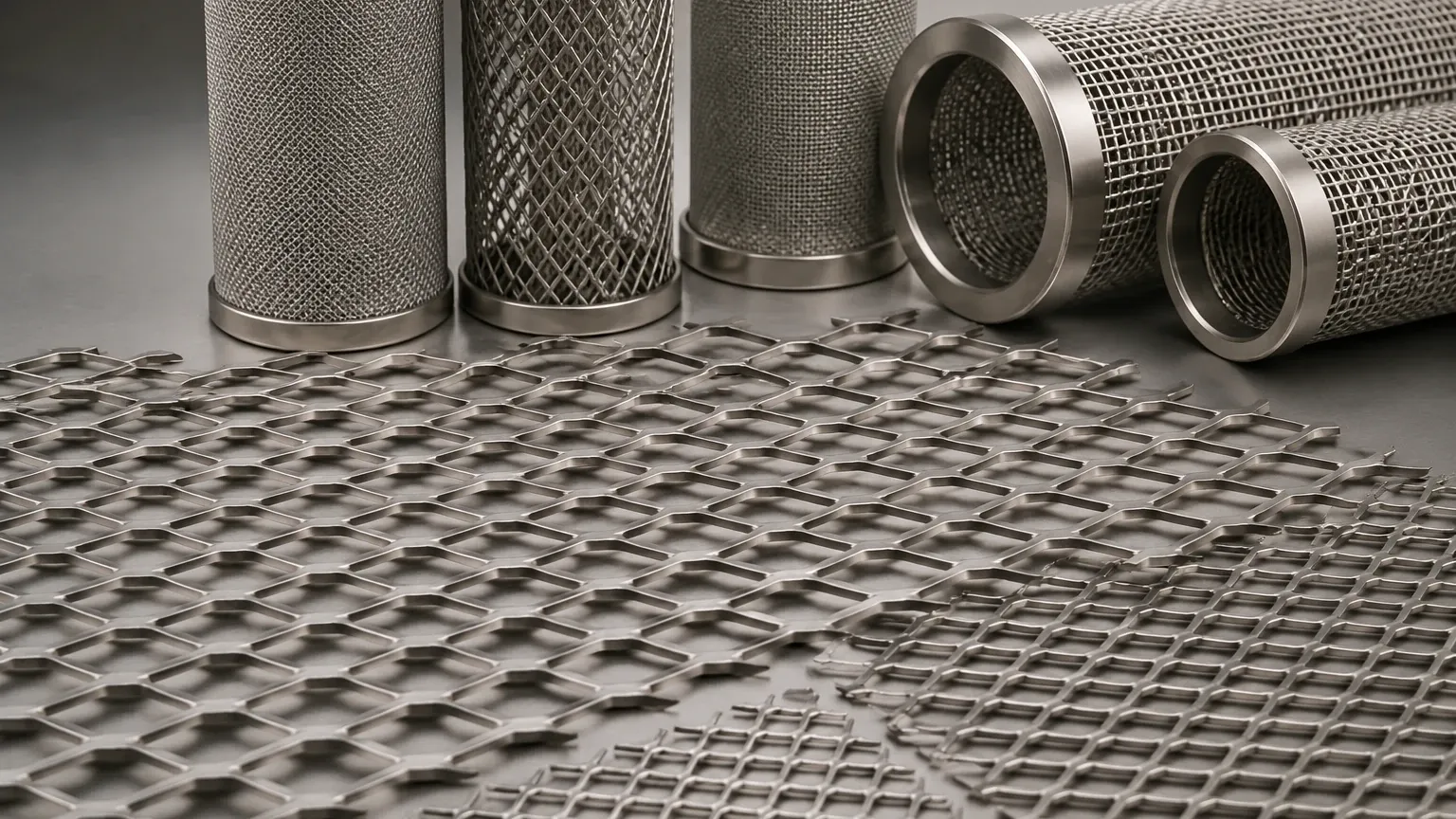
The Role of Expanded Metal in Industrial Filtration
In the context of industrial filtration, expanded metal rarely acts as the primary filter medium for fine particles. Instead, it serves as a critical structural component within a filter cartridge or assembly.
In many high-pressure hydraulic or chemical filtration systems, a fine stainless steel wire mesh is used to achieve the desired micron rating. However, wire mesh is often too flexible to withstand high differential pressures on its own. Expanded metal is used as a support tube (inner core) or an outer protective wrap.
Its diamond-shaped openings provide a high percentage of open area, ensuring that the filter does not restrict flow, while the rigid bonds provide the mechanical strength to prevent the wire mesh from collapsing or bursting under pressure. In multi-stage filtration, coarser expanded metal may also serve as a pre-filter to capture large debris before it reaches the more sensitive secondary stages.
Engineering Evaluation and Selection Criteria
When evaluating expanded metal for a B2B procurement or engineering project, several factors must be confirmed to ensure the component is fit for purpose:
1. Load-Bearing Requirements: Will the material be subjected to static or dynamic loads? Standard expanded metal generally offers higher structural rigidity than flattened versions.
2. Environmental Exposure: What chemicals, temperatures, and moisture levels will the material encounter? This dictates the choice between carbon steel, stainless steel, or specialized coatings.
3. Open Area and Flow Rate: For filtration and ventilation, the ratio of opening to solid metal must be calculated to ensure it meets the system's flow requirements without causing excessive backpressure.
4. Edge Conditions: Expanded metal has sharp edges where the diamonds are cut. Engineers must decide if the edges should be bonded (closed) or left as random cuts, and whether additional framing or U-edging is required for safety and handling.
5. Formability: If the expanded metal needs to be rolled into a cylinder for a filter cartridge, the orientation of the diamonds (LWD vs. SWD) relative to the rolling direction will affect the ease of manufacturing and the roundness of the final product.
Customization and OEM Procurement Considerations
For many industrial applications, off-the-shelf expanded metal sheets are insufficient. Customization is often required to meet specific dimensional tolerances, material grades, or pattern geometries. As a specialized manufacturer, Kaifil provides OEM solutions that integrate expanded metal into complex filtration components.
When working with a manufacturer, it is important to confirm their capabilities in secondary operations. This includes precision shearing, rolling, welding, and surface finishing (such as passivating stainless steel to enhance corrosion resistance). For B2B buyers, the total cost of ownership is often reduced by sourcing a semi-finished or finished component that is ready for immediate installation, rather than purchasing raw sheets that require extensive in-house processing.
Furthermore, technical professionals should seek suppliers who can provide material certifications and quality assurance documentation. In industries like pharmaceuticals or food processing, ensuring that the metal is free from contaminants and meets specific ASTM or ISO standards is a non-negotiable requirement.
Conclusion
Expanded metal is far more than just a sheet of metal with holes. It is an engineered material designed for efficiency, strength, and versatility. By understanding the manufacturing process, the technical terminology, and the performance trade-offs between different styles and materials, engineers can leverage expanded metal to create more durable and cost-effective industrial solutions.
Whether used as a robust support core in a high-pressure filter cartridge or as a safety barrier in a chemical plant, expanded metal provides a unique combination of structural integrity and permeability. For those seeking specialized filtration components, choosing a partner with deep expertise in metal fabrication and application-specific design is the key to achieving optimal system performance.
