


Barrel Strainers
In industrial fluid handling, the protection of downstream equipment—such as pumps, valves, and heat exchangers—is a critical engineering priority. Barrel strainers, a specialized subset of Strainers & Baskets, serve as the primary line of defense against particulate contamination. These components are designed to remove relatively large solids from liquid or gas streams, ensuring that mechanical systems operate within their design parameters without the risk of abrasion, clogging, or catastrophic failure.
Unlike fine-micron filters intended for polishing or sterilization, barrel strainers are engineered for high-capacity debris retention. Their structural integrity and the geometry of the internal basket allow them to handle significant solids loading while maintaining acceptable flow rates. For engineers and procurement teams, selecting the correct barrel strainer involves a deep understanding of fluid dynamics, material compatibility, and the specific mechanical stresses of the application environment.
Understanding the Function of Barrel Strainers in Industrial Systems
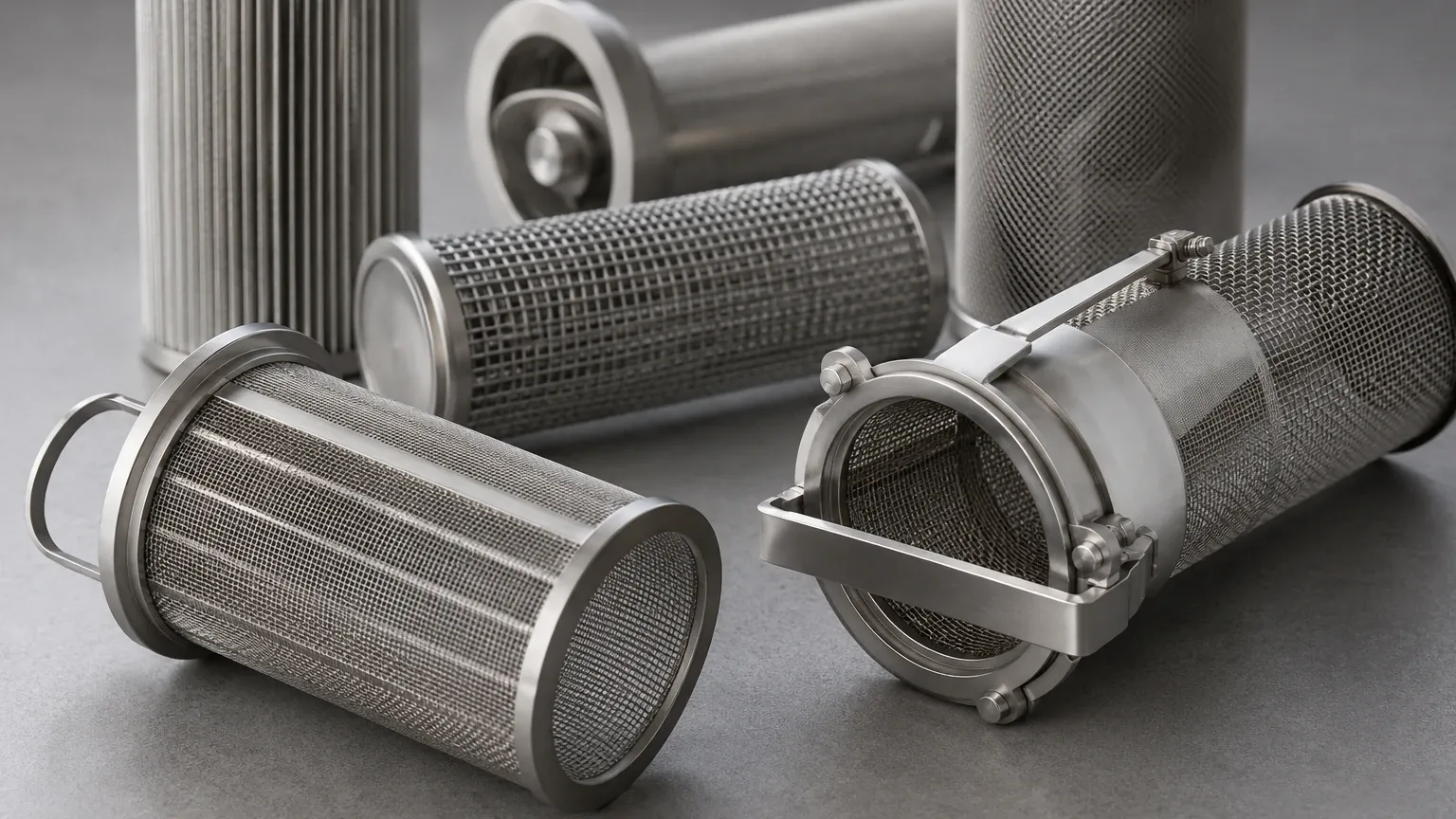
Barrel strainers, often referred to as basket strainers due to their internal configuration, are typically installed in-line within a piping system. The "barrel" refers to the cylindrical housing that contains a removable basket or screen. As fluid enters the housing, it is directed through the basket, which traps particles larger than the mesh or perforation size while allowing the cleaned fluid to pass through the outlet.
One of the defining characteristics of barrel strainers is their high open-area ratio. The internal basket usually has a surface area significantly larger than the cross-sectional area of the inlet pipe. This design choice is intentional; it minimizes the initial pressure drop across the unit and extends the time between cleaning cycles. In industrial contexts where downtime is costly, the ability of a barrel strainer to accumulate a large volume of debris before requiring maintenance is a key performance indicator.
These strainers are categorized by their orientation and accessibility. Simplex barrel strainers are used in batch processes where the flow can be momentarily stopped for cleaning. In contrast, duplex systems utilize two parallel barrels and a diversion valve, allowing one side to be serviced while the other remains in operation, ensuring continuous flow for critical 24/7 processes.
Technical Specifications and Material Selection
The performance and longevity of barrel strainers are heavily dependent on the materials used in their construction. Because they are often exposed to corrosive chemicals, high temperatures, and abrasive particles, selecting the appropriate alloy is the first step in the engineering process.
Stainless Steel 304 and 316
Stainless steel is the industry standard for most industrial filtration components. SS304 offers excellent durability and corrosion resistance for general water treatment, food and beverage, and mild chemical applications. However, for environments involving chlorides or high acidity—common in pharmaceutical and marine applications—SS316 is preferred due to its molybdenum content, which provides superior resistance to pitting and crevice corrosion.
Mesh and Perforation Sizes
The "filtering" element of the barrel strainer is usually a perforated metal sheet, often lined with a finer wire mesh for precision. Perforation sizes typically range from 1/32" to 1/2", while mesh linings can go down to 20 microns or finer. Engineers must balance the need for fine filtration with the risk of rapid clogging. A common rule of thumb is to select a mesh size that is slightly smaller than the smallest particle that could damage downstream equipment, rather than aiming for the finest possible filtration.
Housing and Seal Integrity
The barrel housing must be rated for the maximum operating pressure of the system, including potential pressure spikes. Seals and gaskets—typically made from Viton, EPDM, or PTFE—must be compatible with the process fluid to prevent leaks and bypass. In high-pressure hydraulic or steam systems, the structural thickness of the barrel walls and the type of closure (flanged, threaded, or quick-release) are vital safety considerations.
Engineering Considerations for Flow and Pressure Management
When integrating barrel strainers into a system, the primary engineering challenge is managing the pressure drop ($ΔP$). Every component added to a pipeline introduces resistance, and if the pressure drop is too high, it can lead to cavitation in pumps or insufficient flow to downstream processes.
The Open Area Ratio
The efficiency of a barrel strainer is often measured by its "Open Area Ratio" (OAR). This is the ratio between the total open area of the strainer basket and the internal cross-sectional area of the inlet pipe. A high-quality industrial barrel strainer typically targets an OAR of 6:1 or 8:1. A higher OAR ensures that even as the basket begins to fill with debris, the remaining open area is sufficient to keep the pressure drop within acceptable limits.
Viscosity and Flow Velocity
Fluid viscosity significantly impacts the performance of barrel strainers. High-viscosity fluids, such as heavy oils or syrups, require larger mesh openings or larger housings to maintain flow. Similarly, the velocity of the fluid must be controlled; excessive velocity through the strainer can cause "jetting," where particles are forced through the mesh or the mesh itself is deformed by the kinetic energy of the fluid. Engineers should calculate the clean pressure drop using the manufacturer’s flow coefficient ($Cv$) values to ensure the system remains balanced.
Key Applications Across Industrial Sectors
Barrel strainers are versatile components found in nearly every industry that moves fluids through pipes. Their role varies depending on the specific requirements of the sector:
* Chemical Processing: In these environments, barrel strainers protect expensive flow meters and control valves from scale and undissolved solids. The focus here is on chemical compatibility and the ability to handle aggressive media.
* Food and Beverage: Here, the emphasis is on sanitary design. Barrel strainers used in food processing must be easy to disassemble and clean (CIP/SIP compatible) to prevent bacterial growth. Stainless steel with high-polish finishes is standard.
* Water Treatment: Large-scale barrel strainers are used in intake structures to remove sand, grit, and organic debris before the water reaches membranes or ion-exchange resins. These are often high-volume units designed for long-term outdoor exposure.
* Oil and Gas: In midstream and downstream operations, barrel strainers remove weld slag and pipe scale that could damage turbines or compressors. Given the high pressures involved, these strainers are often built to heavy-duty ASME standards.
* Pharmaceuticals: Precision is paramount in pharma. Barrel strainers are used to protect high-purity systems, often acting as a pre-filter to protect more expensive, single-use cartridge filters used later in the process.
Maintenance Protocols and Performance Longevity
The total cost of ownership (TCO) for barrel strainers is determined more by maintenance and durability than by the initial purchase price. A strainer that is difficult to clean or prone to mesh failure will lead to increased labor costs and system downtime.
Monitoring Pressure Differential
The most effective way to maintain a barrel strainer is to install differential pressure gauges across the inlet and outlet. When the $ΔP$ reaches a predetermined limit (often 5-10 psi above the clean pressure drop), it indicates that the basket is full and requires cleaning. Relying on a fixed schedule for cleaning is often inefficient; sensor-based maintenance ensures the strainer is only serviced when necessary, protecting the mesh from unnecessary handling.
Cleaning Procedures
Cleaning a barrel strainer involves isolating the unit, venting the pressure, and removing the basket. For non-hazardous fluids, manual rinsing or ultrasonic cleaning is common. In applications involving sticky or cohesive solids, specialized cleaning solvents may be required. It is essential to inspect the basket for signs of mechanical fatigue, such as broken wires or distorted frames, during every cleaning cycle. A damaged basket can allow bypass, rendering the strainer useless.
Replacement Cycles
While the barrel housing can last for decades, the internal baskets are wear items. Keeping a stock of replacement baskets is a best practice for minimizing downtime. Engineers should also evaluate the condition of the seals every time the housing is opened, as compressed or brittle gaskets are a common source of bypass and external leakage.
Customization and OEM Solutions for Specialized Requirements
Off-the-shelf barrel strainers may not meet the requirements of highly specialized industrial processes. Customization allows engineers to tailor the strainer to the exact needs of their application, optimizing both performance and space.
Tailored Geometry
In many retrofit projects, space is at a premium. Custom barrel strainers can be designed with offset inlets and outlets, or in compact vertical or horizontal configurations to fit into existing piping footprints without requiring extensive plumbing changes.
Specialized Linings and Coatings
For extremely abrasive or corrosive fluids, standard stainless steel may not be enough. Custom solutions can include specialized coatings or the use of exotic alloys like Hastelloy or Monel. Additionally, reinforcement structures can be added to the baskets to withstand high-pressure surges that would collapse a standard screen.
OEM Integration
For manufacturers of industrial equipment—such as cooling towers, boilers, or hydraulic power units—integrating a custom barrel strainer directly into the machine design can improve the overall reliability of the product. OEM partnerships allow for the development of proprietary filtration components that are optimized for the specific flow rates and contaminant profiles of the equipment.
By focusing on the technical realities of fluid dynamics and material science, engineers can ensure that their choice of barrel strainers provides maximum protection for their infrastructure. Whether it is a standard simplex unit or a highly customized assembly, the goal remains the same: efficient, reliable, and cost-effective removal of particulate matter to maintain the integrity of the industrial process.
