


Bathroom Sink Strainers
In commercial and industrial facility management, the performance of plumbing systems often hinges on the smallest components. While frequently overlooked in residential contexts, bathroom sink strainers serve as the first line of defense in protecting complex drainage networks from debris, sediment, and foreign objects. For engineers, architects, and procurement professionals managing large-scale installations—such as those in hospitals, hotels, laboratories, and industrial plants—selecting the right strainer is a matter of ensuring operational continuity and minimizing long-term maintenance costs.
Industrial-grade bathroom sink strainers are not merely decorative hardware; they are precision-engineered filtration components designed to withstand high-frequency use, aggressive cleaning agents, and varying water chemistries. This guide examines the technical specifications, material considerations, and engineering requirements that define high-performance Strainers & Baskets in professional environments.
The Role of Precision Engineering in Commercial Drainage
In a B2B context, a bathroom sink strainer must do more than prevent a drain from clogging. It must balance two competing physical requirements: maximum debris retention and optimal flow rate. If the mesh or perforation is too fine, the sink may drain too slowly, leading to hygiene issues and standing water. If it is too coarse, it fails to protect the downstream piping from hair, soap scum, and solid particles that can lead to deep-system blockages.
Engineering these components requires a deep understanding of fluid dynamics and particle capture. Commercial bathroom sink strainers are typically integrated into high-traffic restrooms where the cost of a plumbing failure includes not just repair fees, but also facility downtime and potential health code violations. Therefore, the design must account for the specific types of waste common to the environment—whether that includes the biological loads of a healthcare facility or the chemical residues found in industrial washrooms.
Material Specifications: Stainless Steel for High-Traffic Environments
The choice of material is the most critical factor in determining the lifespan and reliability of a strainer. While consumer-grade products often utilize chrome-plated brass or plastic, industrial applications demand the durability of stainless steel. Kaifil specializes in utilizing high-grade alloys to ensure that filtration components remain corrosion-resistant and structurally sound over decades of service.
304 Stainless Steel
Type 304 is the standard for most commercial bathroom applications. It offers excellent resistance to atmospheric corrosion and is highly durable against physical impact. In standard office buildings or hospitality settings, 304 stainless steel provides a cost-effective balance between performance and longevity.
316 Stainless Steel
For environments where the strainer will be exposed to harsh chemicals, saline solutions, or high-grade disinfectants—such as in pharmaceutical laboratories or coastal facilities—316 stainless steel is the preferred choice. The addition of molybdenum enhances its resistance to pitting and crevice corrosion, ensuring the structural integrity of the bathroom sink strainers even under chemical stress.
Structural Variations in Strainers & Baskets
Not all drainage requirements are identical. The geometry of the strainer must match the specific flow characteristics of the sink and the anticipated debris load. Within the broader category of Strainers & Baskets, several structural designs are prevalent in professional specifications:
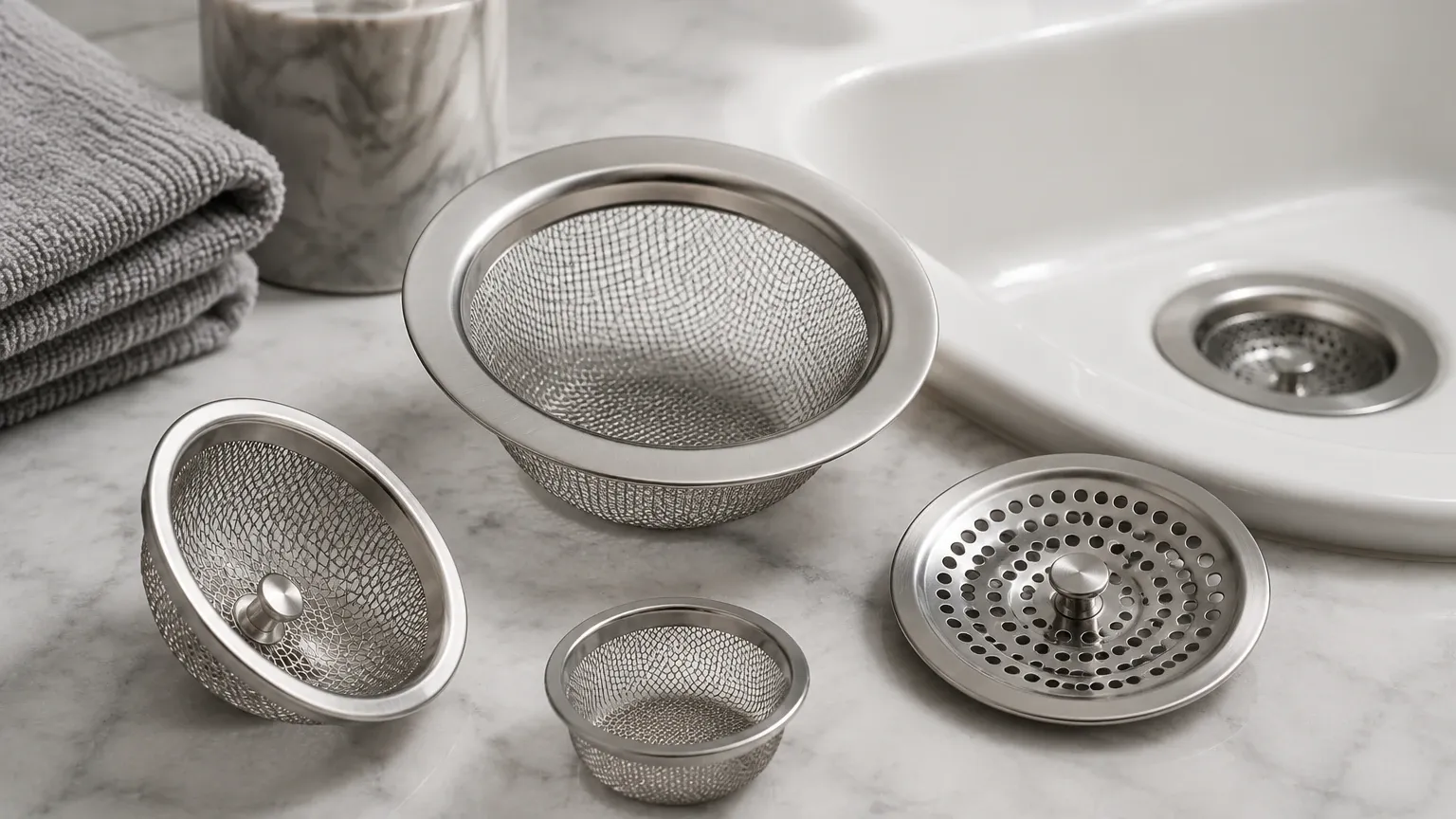
1. Perforated Metal Strainers: These are manufactured by punching holes into a stainless steel sheet. They offer high structural rigidity and are ideal for high-traffic public restrooms where the component might be subjected to heavy use or vandalism.
2. Wire Mesh Baskets: Constructed from woven stainless steel wire, these provide a significantly higher open area percentage. This design is often used in specialized medical or laboratory sinks where rapid drainage is required, and fine particulate matter must be captured.
3. Cross-Bar vs. Open-Grid Designs: Engineers must decide between fixed cross-bar strainers, which are tamper-resistant, and removable basket strainers, which allow for easier cleaning by maintenance staff. In high-security environments or schools, fixed designs are often mandated to prevent the removal of the component.
Filtration Efficiency and Flow Rate Dynamics
When specifying bathroom sink strainers for a large project, engineers must calculate the required flow rate (typically measured in gallons per minute or liters per second) against the effective open area of the strainer. The effective open area is the total area of the holes or mesh openings through which water can pass.
If a strainer has a 40% open area, it will offer more resistance than one with a 60% open area. However, a higher open area often means thinner structural "bridges" between the holes, which can reduce the component's lifespan. Precision manufacturing ensures that the perforation pattern is optimized to maintain structural strength while preventing "vortexing" or air-binding, which can slow down drainage even when no debris is present.
Furthermore, the depth of the basket plays a role in capacity. A deeper basket allows for more debris accumulation before the flow rate is significantly impacted, extending the interval between required cleanings—a vital consideration for facility managers looking to optimize labor costs.
Custom OEM Solutions for Specialized Plumbing Applications
Standard off-the-shelf products often fail to meet the rigorous demands of specialized industrial equipment or unique architectural designs. This is where custom manufacturing becomes essential. For OEMs (Original Equipment Manufacturers) building integrated hand-washing stations, laboratory modules, or industrial decontamination units, custom-designed bathroom sink strainers are often required to fit non-standard drain diameters or to meet specific filtration micron ratings.
Customization options include:
* Bespoke Dimensions: Manufacturing strainers to fit proprietary drain housings.
* Specialized Finishes: Electropolishing to enhance corrosion resistance and reduce bacterial adhesion (crucial for healthcare settings).
* Integrated Seals: Adding high-performance gaskets (such as EPDM or Viton) directly to the strainer assembly to ensure a leak-proof fit.
* Reinforced Structures: Adding support ribs or thicker gauges for heavy-duty industrial use.
By working with a manufacturer like Kaifil, procurement teams can ensure that their Strainers & Baskets are engineered to the exact tolerances required for their specific application, rather than settling for generic components that may lead to premature failure.
Evaluating Total Cost of Ownership and Maintenance Cycles
In B2B purchasing, the initial unit price of a bathroom sink strainer is often less important than the Total Cost of Ownership (TCO). A low-cost, low-quality strainer may require replacement every 12 to 24 months due to corrosion, stripping of threads, or physical deformation. In a facility with 500 sinks, the labor cost of frequent replacements far outweighs the savings on the initial purchase.
High-quality stainless steel strainers offer a much lower TCO because they:
* Reduce Emergency Plumbing Calls: By effectively capturing debris, they prevent expensive main-line clogs.
* Simplify Maintenance: Stainless steel is easy to sanitize and does not harbor biofilm as readily as porous materials or plastics.
* Provide Decades of Service: A well-engineered 316 stainless steel strainer can last the entire lifecycle of the plumbing fixture.
Facility managers should also consider the ease of cleaning. Strainers designed with smooth interior surfaces and no sharp edges allow maintenance staff to clear debris quickly without the risk of injury or the need for specialized tools.
Conclusion
While the bathroom sink strainer is a small component in the grand scheme of industrial engineering, its impact on facility hygiene, maintenance efficiency, and plumbing system longevity is significant. By prioritizing high-grade materials like stainless steel and selecting the appropriate structural design for the specific debris load and flow requirements, engineers can ensure a reliable and cost-effective solution.
For those seeking precision-manufactured filtration components, exploring the full range of Strainers & Baskets is the first step toward optimizing commercial plumbing performance. Whether you require standard dimensions or a fully customized OEM solution, focusing on technical excellence and material integrity will yield the best long-term results for any large-scale project.
