


Basket Strainer Grabcad
In the realm of industrial piping design and fluid handling systems, engineers frequently turn to digital repositories to streamline their workflow. Searching for a "basket strainer grabcad" model is a common first step for mechanical engineers and system designers who need to integrate filtration components into a larger 3D assembly. While CAD models provide the geometric foundation for spatial planning, the transition from a digital file to a high-performance physical component requires a deep understanding of filtration mechanics, material science, and manufacturing tolerances.
Industrial basket strainers are critical components designed to protect downstream equipment—such as pumps, valves, and flow meters—from damage caused by particulate matter. Whether the application involves chemical processing, water treatment, or food and beverage production, the selection of the right Strainers & Baskets is a decision that impacts the long-term reliability and efficiency of the entire system.
Understanding the Intent Behind Searching for Basket Strainer Grabcad Models
When a technical professional searches for a "basket strainer grabcad" file, the primary objective is usually to verify spatial constraints within a piping layout. These models allow designers to check for flange alignment, clearance for basket removal, and the overall footprint of the filtration unit. However, a generic CAD model downloaded from a community platform often lacks the granular technical data required for actual procurement and installation.
Engineers use these models to:
* Visualize Piping Layouts: Ensuring that the inlet and outlet ports of the strainer align perfectly with existing or planned piping.
* Assess Maintenance Access: Determining if there is sufficient overhead or side clearance to lift the basket out of the housing for cleaning.
* Check Structural Interferences: Identifying potential collisions with support beams, electrical conduits, or other process equipment.
While these digital assets are invaluable for the design phase, they rarely account for the internal specifications of the filter media, the specific pressure ratings of the housing, or the custom modifications required for specialized industrial environments.
Technical Fundamentals of Industrial Strainers & Baskets
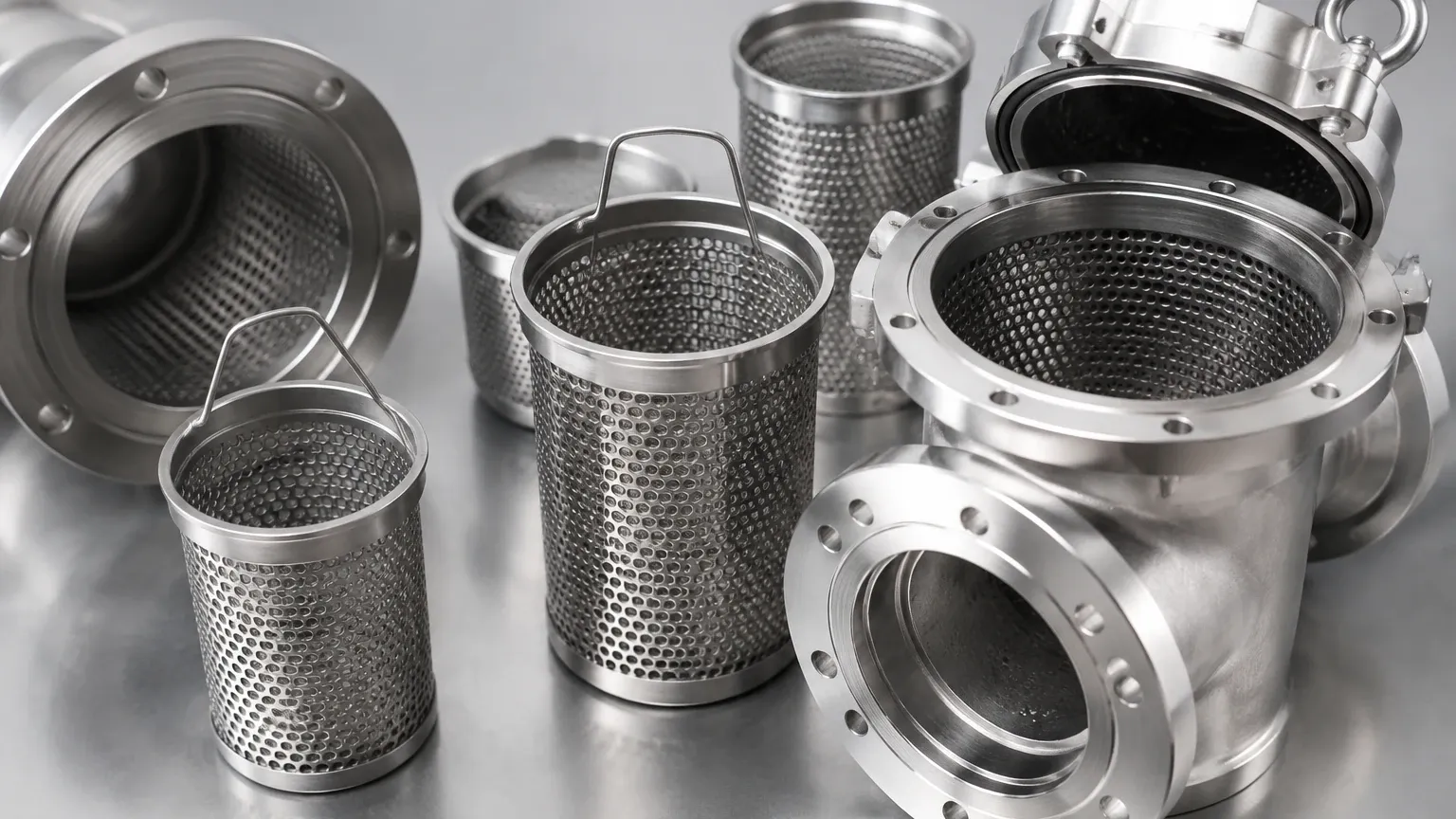
To move beyond a basic 3D model, it is essential to understand the mechanical construction of industrial strainers. A basket strainer is essentially a closed vessel with a removable screen or basket that intercepts solids from a flowing liquid. Unlike Y-strainers, which are often used for smaller debris and less frequent cleaning, basket strainers are designed for systems where high flow rates and significant solids loading are expected.
Simplex vs. Duplex Configurations
Simplex basket strainers are used in batch processes or systems that can be shut down temporarily for basket cleaning. If the process requires continuous flow, a duplex strainer—which consists of two separate strainer chambers connected by a diverting valve—is necessary. This allows one side to be cleaned while the other remains in operation.
Material Selection
Material compatibility is a primary engineering consideration. Stainless steel (specifically SS304 and SS316) is the industry standard for most demanding applications due to its corrosion resistance and structural integrity. In chemical processing, the specific grade of stainless steel must be chosen based on the pH, temperature, and chemical composition of the fluid to prevent pitting or stress corrosion cracking.
Critical Engineering Parameters Beyond the 3D Model
A "basket strainer grabcad" file provides the "envelope" of the component, but it does not define the performance characteristics. When specifying a strainer for a project, engineers must calculate several key parameters that a CAD model cannot provide.
Pressure Drop (ΔP)
Every filtration component introduces a restriction to the flow, resulting in a pressure drop. This is influenced by the fluid's viscosity, the flow velocity, and the open area of the basket. Engineers must ensure that the clean pressure drop is within acceptable limits (typically less than 2 PSI) to avoid overworking pumps. As the basket collects debris, the pressure drop increases, necessitating a cleaning cycle.
Open Area Ratio (OAR)
The Open Area Ratio is the relationship between the internal cross-sectional area of the inlet pipe and the total open area of the holes in the strainer basket. A high-quality industrial basket should ideally have an OAR of at least 6:1. A higher OAR means the strainer can operate longer between cleanings and will have a lower initial pressure drop.
Micron Rating and Mesh Selection
The CAD model does not specify the filtration accuracy. This is determined by the mesh or perforation size of the internal basket. Selection depends on the size of the smallest particle that needs to be removed to protect downstream components. Options range from coarse perforated plates for large debris to fine wire mesh liners for microscopic particulate removal.
Risks of Relying Solely on Generic CAD Files
While platforms like GrabCAD are excellent for collaborative design, relying solely on a generic model for a critical industrial component carries several risks:
1. Dimensional Inaccuracies: Generic models may not adhere to specific manufacturing standards (such as ASME or DIN), leading to misalignment during the physical installation phase.
2. Internal Detail Deficit: Most community-sourced models are "hollow shells." They do not show the internal basket support structure, the sealing mechanism (O-rings or gaskets), or the specific closure type (bolted vs. quick-opening).
3. Material Weight Discrepancies: For structural calculations and shipping logistics, accurate weight data is required. Generic models often have incorrect density settings, leading to significant errors in total system weight estimates.
4. Lack of Certification Data: Industrial applications often require components to meet specific regulatory standards (FDA for food, PED for pressure vessels). A downloaded CAD file carries no such guarantees.
Customizing Filtration Solutions for Demanding Applications
In many industrial scenarios, a standard off-the-shelf strainer is insufficient. This is where custom manufacturing expertise becomes vital. Manufacturers like Kaifil specialize in taking the basic requirements found in a design draft and turning them into precision-engineered Strainers & Baskets tailored to specific process conditions.
Customization options often include:
* Reinforced Baskets: For high-pressure applications where a standard mesh might collapse under the force of the flow.
* Specialized Coatings: Adding protective layers for extreme chemical resistance.
* Unique Inlet/Outlet Orientations: Modifying the housing to fit into tight spaces where standard configurations won't work.
* Magnetic Inserts: Adding magnetic rods to the basket to capture fine ferrous particles that might pass through the mesh.
Key Evaluation Criteria for Purchasing Industrial Strainers
Before moving from the "basket strainer grabcad" design phase to procurement, purchasing teams and engineers should evaluate potential suppliers based on several technical criteria:
Sealing Integrity
How is the basket sealed within the housing? A poor seal allows "bypass," where unfiltered fluid escapes around the edges of the basket. High-performance strainers use precision-machined seats and high-quality elastomers to ensure 100% of the fluid passes through the filter media.
Ease of Maintenance
In a B2B environment, downtime is expensive. Evaluate the closure mechanism of the strainer. Bolted covers are secure but slow to open. Quick-opening swing bolts or clamp covers can significantly reduce the time required for basket servicing, leading to lower operational costs.
Structural Durability
The basket itself is subject to constant hydraulic forces. It must be constructed with heavy-duty materials and proper welding techniques to prevent fatigue. A failed basket can send metal fragments downstream, causing catastrophic damage to expensive machinery.
Maintenance and Operational Longevity
The total cost of ownership (TCO) of a basket strainer is not just the purchase price; it includes the cost of maintenance and the frequency of replacement. Engineers should confirm the expected replacement cycles for both the baskets and the seals.
* Cleaning Protocols: Can the basket be cleaned via ultrasonic bath, or does it require manual pressure washing? The durability of the wire mesh determines how many cleaning cycles it can withstand before the weave begins to distort.
* Spare Parts Availability: Ensure that replacement baskets and seals are readily available. Using non-OEM parts can lead to fitment issues and bypass problems.
Conclusion: From Digital Model to Industrial Reality
A search for "basket strainer grabcad" is an excellent starting point for any engineering project, providing the visual context needed to begin a system layout. However, the success of an industrial filtration system depends on the technical specifications that lie beneath the surface of the 3D model.
By focusing on critical factors such as material compatibility, pressure drop calculations, and custom manufacturing capabilities, engineers can ensure that their filtration solution performs reliably in the field. When it comes to protecting high-value industrial assets, the transition from a digital placeholder to a precision-manufactured component is the most critical step in the engineering process. For those seeking reliable, high-performance filtration components, exploring professional Strainers & Baskets ensures that the final installation meets the rigorous demands of modern industrial processing.
