


Kitchen Sink Strainers
In the context of commercial food service, industrial food processing, and large-scale hospitality, the humble kitchen sink strainer is far more than a simple hardware accessory. For engineers, facility managers, and procurement professionals, selecting the correct Strainers & Baskets is a critical decision that impacts plumbing integrity, waste management efficiency, and operational uptime. While residential-grade components may suffice for home use, industrial environments demand a higher level of material durability, filtration precision, and structural engineering.
At Kaifil, we recognize that the term kitchen sink strainers encompasses a broad range of products, from standard drain stoppers to sophisticated multi-stage filtration baskets used in high-volume industrial kitchens. This guide explores the technical considerations, material science, and engineering factors that define high-performance straining solutions in professional settings.
The Engineering Role of Strainers and Baskets
The primary function of a strainer is the mechanical separation of solids from a liquid stream. In a commercial kitchen or food processing facility, this serves two vital purposes: protecting the downstream piping from clogs and preventing prohibited solids from entering the municipal wastewater system. Unlike residential units, industrial strainers must handle significant flow rates and high volumes of debris without causing excessive pressure drops or drainage backups.
Effective straining requires a balance between flow capacity and filtration fineness. If the mesh or perforation is too coarse, debris passes through and risks damaging pumps or clogging grease traps. If it is too fine, the strainer will require constant cleaning, leading to labor inefficiencies and potential overflows. Professional-grade strainers are engineered with specific open-area ratios to ensure that even as the basket fills with debris, liquid can still pass through the side walls or the center of the unit.
Material Selection: Why Stainless Steel Dominates
When evaluating kitchen sink strainers for industrial or commercial use, material selection is the most significant factor in determining the total cost of ownership. While plastic or chrome-plated brass may be common in consumer markets, stainless steel is the industry standard for professional applications due to its unique physical properties.
Corrosion Resistance and Longevity
Commercial kitchen environments are chemically aggressive. Exposure to acidic food waste, high-temperature water, and caustic cleaning agents can quickly degrade inferior metals. Kaifil utilizes high-grade stainless steel (typically Grade 304 or 316) because of its chromium-rich oxide layer, which provides exceptional resistance to pitting and crevice corrosion. Grade 316, in particular, is recommended for environments involving high salt concentrations or harsh chemical disinfectants, as it contains molybdenum for enhanced protection.
Structural Integrity under Thermal Stress
Industrial sinks often process boiling water followed by cold rinses. This thermal cycling can cause thermal expansion and contraction, leading to cracks or seal failures in composite materials. Stainless steel strainers maintain their structural integrity across a wide temperature range, ensuring that the seal between the strainer body and the sink remains watertight over years of service.
Technical Design Variations in Industrial Strainers
Not all kitchen sink strainers are designed for the same task. Depending on the specific application—whether it is a vegetable washing station, a heavy-duty pot sink, or a pre-rinse station for a commercial dishwasher—the design of the basket and the strainer body must vary.
Perforated Metal vs. Wire Mesh
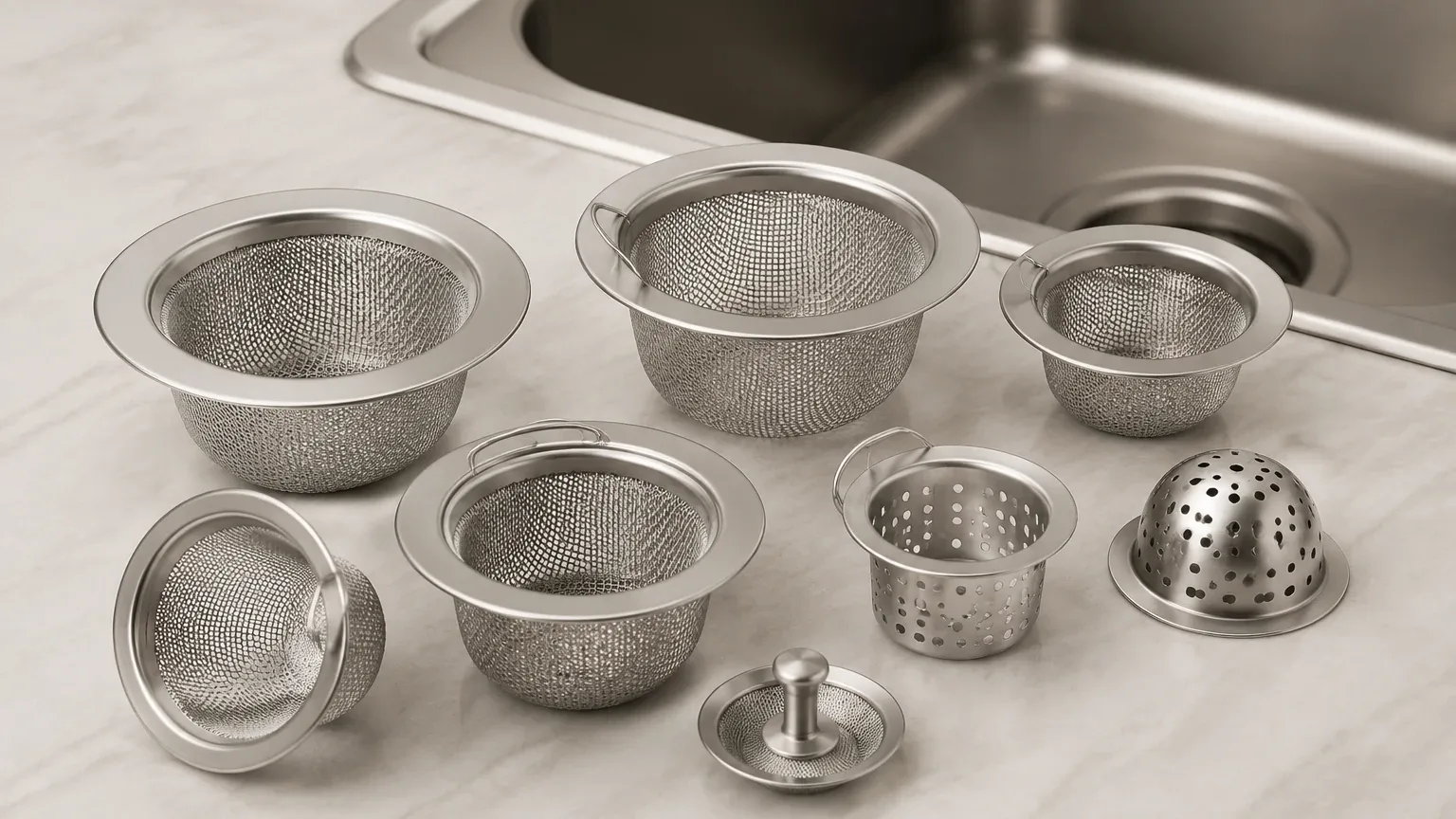
* Perforated Metal Baskets: These are typically used for primary straining where large food particles or heavy debris are present. The holes are punched into a solid sheet of stainless steel, providing a rigid and durable structure that can withstand mechanical impact from dropped utensils or heavy waste.
* Wire Mesh Filters: For finer filtration requirements, woven wire mesh is utilized. This allows for much smaller micron ratings, capturing fine seeds, coffee grounds, or small fibers. In many industrial designs, a wire mesh lining is combined with a perforated metal support basket to provide both filtration precision and structural strength.
Deep-Well Baskets and Sediment Traps
In high-volume environments, standard shallow strainers are inefficient. Deep-well baskets increase the surface area available for filtration, allowing the system to operate longer between cleaning cycles. Some advanced designs incorporate a sediment trap at the bottom of the basket, which captures heavy particles like sand or grit that might otherwise bypass a standard flat strainer.
Key Evaluation Criteria for Procurement Teams
When sourcing strainers and baskets for a project, technical professionals should evaluate products based on several performance-driven criteria rather than unit price alone.
1. Flow Rate Capacity: The strainer must be able to handle the maximum discharge rate of the connected equipment. Engineers should look for the "effective open area" specification, which indicates the total area of the holes or mesh openings relative to the total surface area of the basket.
2. Micron Rating and Particle Retention: Determine the smallest particle size that must be captured. For general kitchen use, 1/8-inch or 1/16-inch perforations are common, but specialized food processing may require mesh as fine as 100 microns.
3. Ease of Maintenance: In a B2B context, labor is a significant cost. Strainers should be designed for rapid removal, cleaning, and re-insertion. Features like ergonomic handles, non-stick surfaces, and drop-in designs reduce the time staff spends on maintenance.
4. Compatibility with Plumbing Standards: Ensure the strainer body matches the standard drain diameters (typically 3.5 inches for commercial sinks) and accommodates the specific tailpiece requirements of the facility's plumbing system.
Common Risks and Failure Points in Filtration
Failure to specify the correct industrial strainer can lead to costly operational disruptions. One of the most common risks is "bypass," where debris escapes around the edges of the strainer basket because of a poor fit between the basket and the strainer body. This often occurs in low-quality OEM parts where tolerances are not strictly controlled.
Another risk is material fatigue. In high-use environments, the mechanism used to open and close the drain (such as a lever handle or a twist-lock post) is a frequent point of failure. Professional-grade units use reinforced linkages and heavy-duty seals to prevent leaks and ensure the drain can be reliably closed when needed.
Furthermore, improper sizing can lead to "blinding," a condition where the strainer surface becomes completely covered by a thin layer of debris, stopping all flow. This is particularly common in applications involving fats, oils, and grease (FOG). Specifying a strainer with a larger surface area or a specialized non-clogging perforation pattern can mitigate this risk.
Customization and OEM Solutions
In many industrial applications, off-the-shelf kitchen sink strainers do not meet the specific requirements of a unique piece of equipment or a specialized manufacturing process. This is where custom manufacturing becomes essential. Engineers often require bespoke solutions that include:
* Custom Dimensions: Non-standard diameters or depths to fit proprietary equipment.
* Specialized Finishes: Electropolishing for pharmaceutical-grade cleanliness or non-stick coatings for high-viscosity food products.
* Integrated Sensors: Advanced systems may require strainers that can signal when they are full or when flow rates drop below a certain threshold.
Kaifil specializes in these types of custom stainless steel filtration solutions. By working closely with global customers, we develop high-performance components that integrate seamlessly into complex industrial systems, providing reliable performance in demanding environments.
Conclusion: Confirming Technical Requirements
Before proceeding with a bulk purchase or a custom order of strainers and baskets, it is vital to confirm the specific environmental and operational variables of your application. Consider the following checklist:
* What is the chemical composition of the fluid being drained?
* What is the peak flow rate the strainer must accommodate?
* What is the specific gravity and size of the solids being captured?
* Are there regulatory requirements (such as NSF or local health codes) that must be met?
By focusing on these technical details, procurement teams can ensure they select a solution that offers the best balance of performance and longevity. For more information on high-performance filtration components, we invite you to Review product options and application support to find the ideal match for your industrial or commercial needs.
