


Cocktail Strainers
In the specialized field of liquid processing and beverage equipment manufacturing, the efficiency of filtration components determines the quality of the final output. While often categorized under hospitality tools, cocktail strainers are, at their core, precision-engineered metal filters designed to manage solid-liquid separation under specific flow conditions. For original equipment manufacturers (OEMs), industrial designers, and high-volume procurement teams, understanding the technical nuances of these components is essential for ensuring durability, hygiene compliance, and consistent performance.
As a professional manufacturer of stainless steel filtration solutions, Kaifil approaches the production of Strainers & Baskets with an emphasis on material integrity and filtration accuracy. This guide examines the engineering principles behind cocktail strainers, the material science involved in their construction, and the critical selection criteria for industrial-scale applications.
The Engineering Principles of Cocktail Filtration
Filtration in a commercial or industrial beverage environment is defined by the need to remove specific particulates—ranging from large ice shards to fine fruit pulp and botanical fragments—without impeding the flow rate or altering the chemical profile of the liquid. Cocktail strainers achieve this through various mechanical designs, each optimized for a specific stage of the separation process.
Mechanical Separation and Particle Retention
In technical terms, a strainer acts as a surface filter. The efficiency of the strainer is determined by its "open area" and the geometry of its apertures. In high-volume commercial settings, the strainer must withstand repeated mechanical stress while maintaining its structural integrity. The primary objective is to achieve a balance between high-velocity throughput and the retention of unwanted solids.
Flow Dynamics and Turbulence
When liquid passes through a strainer, the design of the apertures (whether perforated holes or wire mesh) influences the turbulence of the stream. For engineers designing beverage dispensing systems or high-end barware, minimizing aeration or controlling the pour pattern is often a priority. The spacing of the coils in a Hawthorne-style strainer or the mesh count in a conical strainer directly affects these fluid dynamics.
Technical Classifications of Cocktail Strainers
From a manufacturing perspective, cocktail strainers are categorized by their construction method and the specific filtration task they perform. For bulk procurement and custom OEM projects, identifying the correct classification is the first step in the specification process.
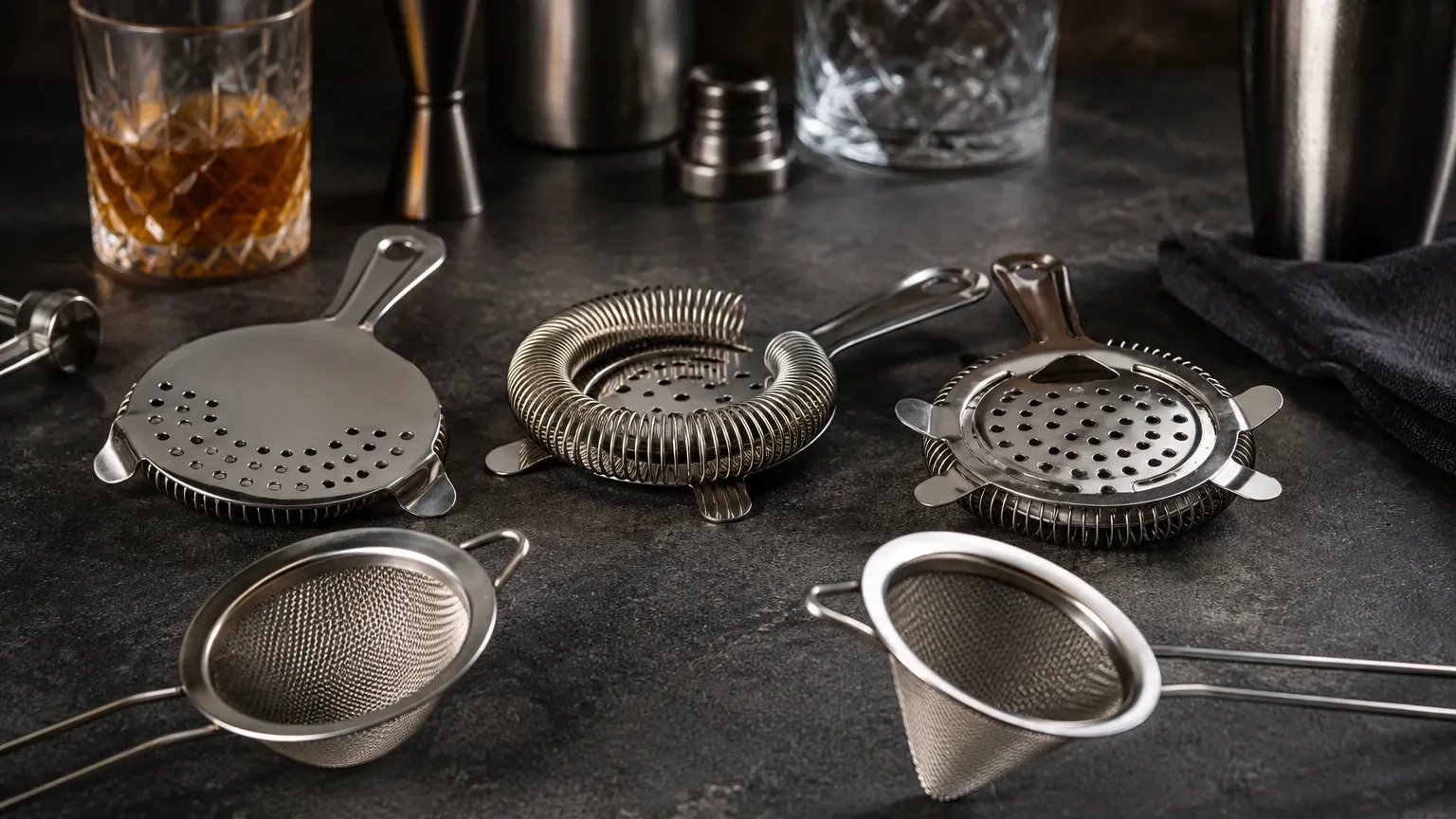
1. Hawthorne Strainers: Variable Aperture Filtration
The Hawthorne strainer is characterized by a flexible tension spring attached to a flat, perforated metal disc. This design is unique because it allows for variable filtration. By adjusting the tension of the spring against the rim of a mixing vessel, the user can narrow or widen the gaps between the coils.
* Engineering Focus: The quality of the spring is paramount. It must be made from high-tensile stainless steel to prevent permanent deformation after repeated compression. The coil density (number of wraps per inch) determines the baseline filtration fineness.
2. Julep Strainers: Perforated Plate Design
Julep strainers are typically bowl-shaped perforated plates. These are used primarily for straining liquids from mixing glasses where only large ice cubes need to be retained.
* Engineering Focus: The hole pattern and diameter are the critical variables here. Precision CNC punching or chemical etching is used to ensure uniform hole distribution, which prevents clogging and ensures a predictable flow rate.
3. Fine Mesh Strainers: High-Density Wire Mesh
Often used as a secondary filtration layer (double straining), fine mesh cocktail strainers utilize woven wire cloth. These are designed to catch minute particles, such as citrus vesicles or small ice chips (shards), that pass through Hawthorne or Julep strainers.
* Engineering Focus: The mesh count (the number of wires per linear inch) and the wire diameter are the primary specifications. For professional applications, a high-grade 304 or 316 stainless steel mesh is required to ensure the screen does not fray or puncture under pressure.
Material Selection: Why Stainless Steel is the Standard
In the production of industrial-grade cocktail strainers, material selection is not merely a matter of aesthetics; it is a requirement for food safety and longevity. Kaifil utilizes high-performance alloys to meet the rigorous demands of the beverage industry.
Grade 304 Stainless Steel
Grade 304 is the most common material used for high-quality strainers. It offers excellent corrosion resistance to most organic acids found in fruits and alcohols. It is highly formable, allowing for the creation of complex shapes like the deep-drawn bowls of conical strainers.
Grade 316 Stainless Steel
For environments where the strainer will be exposed to high-salinity solutions or more aggressive cleaning agents, Grade 316 is recommended. The addition of molybdenum provides superior resistance to pitting and crevice corrosion, making it the ideal choice for long-term durability in harsh industrial wash cycles.
Surface Finish and Passivation
The surface finish of a cocktail strainer is critical for hygiene. A smooth, polished surface (often achieved through electropolishing) reduces the ability of bacteria and organic residue to adhere to the metal. Furthermore, the passivation process ensures that a protective chromium oxide layer is maintained, preventing rust even after years of use in high-moisture environments.
Customization and OEM Capabilities
For businesses looking to integrate filtration components into larger systems or develop a proprietary line of barware, customization is key. As a manufacturer specializing in Strainers & Baskets, Kaifil provides extensive OEM support to meet specific engineering requirements.
Dimensional Adjustments
Strainers can be customized in terms of diameter, handle length, and bowl depth. For industrial beverage equipment, this might involve designing a strainer that fits a specific vessel size with micron-level tolerances to prevent bypass.
Mesh and Perforation Specifications
Depending on the intended application, the filtration media can be tailored. This includes:
* Varying Mesh Counts: From coarse screens for rapid flow to ultra-fine meshes for high-clarity liquids.
* Custom Hole Patterns: Utilizing laser cutting or precision stamping to create unique flow characteristics or branding elements within the perforated plate.
Structural Reinforcement
In high-volume commercial use, the junction between the handle and the strainer head is a common point of failure. OEM designs often incorporate reinforced welding techniques, such as laser welding or heavy-duty spot welding, to ensure the component can withstand the rigors of a fast-paced professional environment.
Evaluating Quality: A Buyer’s Checklist
When sourcing cocktail strainers for B2B applications, engineers and purchasing managers should evaluate the following technical factors to ensure they are investing in a reliable product:
1. Weld Integrity: Inspect the joints between the mesh and the frame. There should be no sharp edges, gaps, or signs of oxidation around the welds.
2. Spring Tension (for Hawthorne types): The spring should be tightly wound and fit snugly against the rim of the intended vessel. It should return to its original shape immediately after compression.
3. Mesh Stability: In fine mesh strainers, the wire cloth should be taut and securely crimped into the frame. Loose mesh can lead to bypass and eventual structural failure.
4. Material Certification: Ensure the manufacturer can provide material mill certificates (MTRs) confirming the use of 304 or 316 stainless steel, ensuring compliance with food safety standards (such as FDA or NSF requirements).
5. Weight and Balance: A well-engineered strainer should have a balanced weight distribution, which reduces user fatigue in high-volume settings and indicates the use of substantial, high-quality metal rather than thin, stamped sheets.
Maintenance and Longevity in Commercial Settings
The total cost of ownership for filtration components is heavily influenced by their lifespan. Stainless steel cocktail strainers are favored because they are dishwasher safe and resistant to the thermal shock of high-temperature sanitation cycles. However, proper maintenance is required to prevent the buildup of mineral deposits or "beer stone" in the fine apertures of the mesh.
Regular inspection of the wire mesh for signs of fatigue or fraying is recommended. In industrial applications, a scheduled replacement cycle ensures that the filtration quality remains consistent and prevents the risk of metal fragments entering the product stream due to component failure.
Conclusion
Cocktail strainers are essential precision components that bridge the gap between industrial filtration technology and the art of beverage preparation. By focusing on high-grade materials, precise aperture engineering, and robust manufacturing techniques, Kaifil provides filtration solutions that meet the exacting standards of the global hospitality and beverage equipment industries.
Whether you are developing a new product line or seeking reliable components for industrial beverage processing, selecting the right strainer requires a deep understanding of material science and fluid dynamics. For more information on our technical capabilities and to explore our full range of customizable filtration products, Review product options and application support to find the ideal solution for your specific requirements.
