


Coffee Strainers
In the industrial food and beverage sector, the transition from consumer-level brewing to commercial-scale extraction requires a significant upgrade in filtration technology. Coffee strainers, when viewed through an engineering lens, are precision components designed to manage solid-liquid separation under varying temperatures, pressures, and flow rates. For manufacturers of commercial brewing equipment, cold brew systems, and industrial coffee extractors, the selection of filtration media is a critical factor in determining both the final product's sensory profile and the operational efficiency of the production line.
Industrial coffee filtration relies on the mechanical retention of coffee grounds while allowing essential oils and soluble solids to pass through. Unlike paper filters, which are disposable and often absorb flavorful lipids, stainless steel Strainers & Baskets offer a reusable, high-durability solution that maintains consistency across thousands of cycles. This guide examines the technical specifications, material considerations, and engineering challenges associated with high-performance coffee strainers in B2B applications.
The Role of Precision Filtration in Commercial Coffee Production
At the industrial level, coffee filtration is not merely about removing sediment; it is about controlling the extraction curve. The physical structure of a strainer determines the "contact time" between the water and the coffee grounds. If the mesh is too fine, the flow rate decreases, potentially leading to over-extraction and bitterness. Conversely, a mesh that is too coarse allows "fines" (microscopic coffee particles) to pass into the final beverage, resulting in a muddy texture and sediment at the bottom of the container.
In commercial extraction systems, such as those used for bottled ready-to-drink (RTD) coffee or coffee concentrates, the filtration process often occurs in multiple stages. Primary coffee strainers are used to remove the bulk of the spent grounds, while secondary polishing filters refine the liquid to achieve the desired clarity. Engineers must balance the need for high throughput with the requirement for precise particulate retention, often necessitating custom-designed baskets that can withstand the mechanical stresses of large-scale brewing.
Material Science: Why Stainless Steel Dominates Industrial Coffee Strainers
When specifying coffee strainers for industrial use, material selection is the first technical hurdle. While polymer-based meshes exist, stainless steel is the industry standard for several engineering reasons:
1. Thermal Stability: Coffee extraction typically occurs at temperatures between 90°C and 96°C (194°F to 205°F). Stainless steel maintains its structural integrity and pore size at these temperatures, whereas some plastics may warp or leach compounds.
2. Corrosion Resistance: Coffee is naturally acidic, with a pH ranging from 4.85 to 5.10. Over time, this acidity can degrade inferior metals. AISI 304 stainless steel is generally sufficient for most applications, but for high-salinity water environments or specialized cleaning protocols, AISI 316L is preferred due to its superior resistance to pitting and crevice corrosion.
3. Mechanical Strength: In espresso machines or high-pressure extractors, the strainer must withstand significant Delta P (pressure drop). Stainless steel wire mesh, often reinforced with perforated metal backing, provides the necessary rigidity to prevent "ballooning" or bursting under pressure.
4. Food Safety Compliance: Stainless steel is non-reactive and easy to sanitize, meeting stringent FDA and EU food contact regulations. It does not harbor bacteria in the same way porous materials might, provided the weld points and seams are finished to sanitary standards.
Engineering Specifications: Mesh Count and Micron Ratings
For engineers, the most critical specification of coffee strainers is the micron rating. This defines the largest particle that can pass through the mesh. In the coffee industry, the grind size dictates the required filtration level:
* Coarse Grinds (Cold Brew/French Press Style): Typically require filtration in the 100 to 200-micron range. This allows for high flow rates and the passage of oils that contribute to a full-bodied mouthfeel.
* Medium Grinds (Drip/Commercial Brewers): Generally utilize mesh in the 50 to 100-micron range.
* Fine Grinds (Espresso/Concentrates): Require precision filtration down to 20 or 30 microns to prevent sediment from reaching the cup.
Beyond simple micron ratings, the type of weave used in the wire mesh impacts performance. Plain weave is common for standard strainers, offering a high open area and low pressure drop. However, for applications requiring higher strength and finer filtration, Dutch weave or Twilled Dutch weave may be employed. These weaves create a more complex path for the fluid, trapping finer particles while maintaining a robust structure.
Structural Design: Strainers & Baskets for High-Pressure Environments
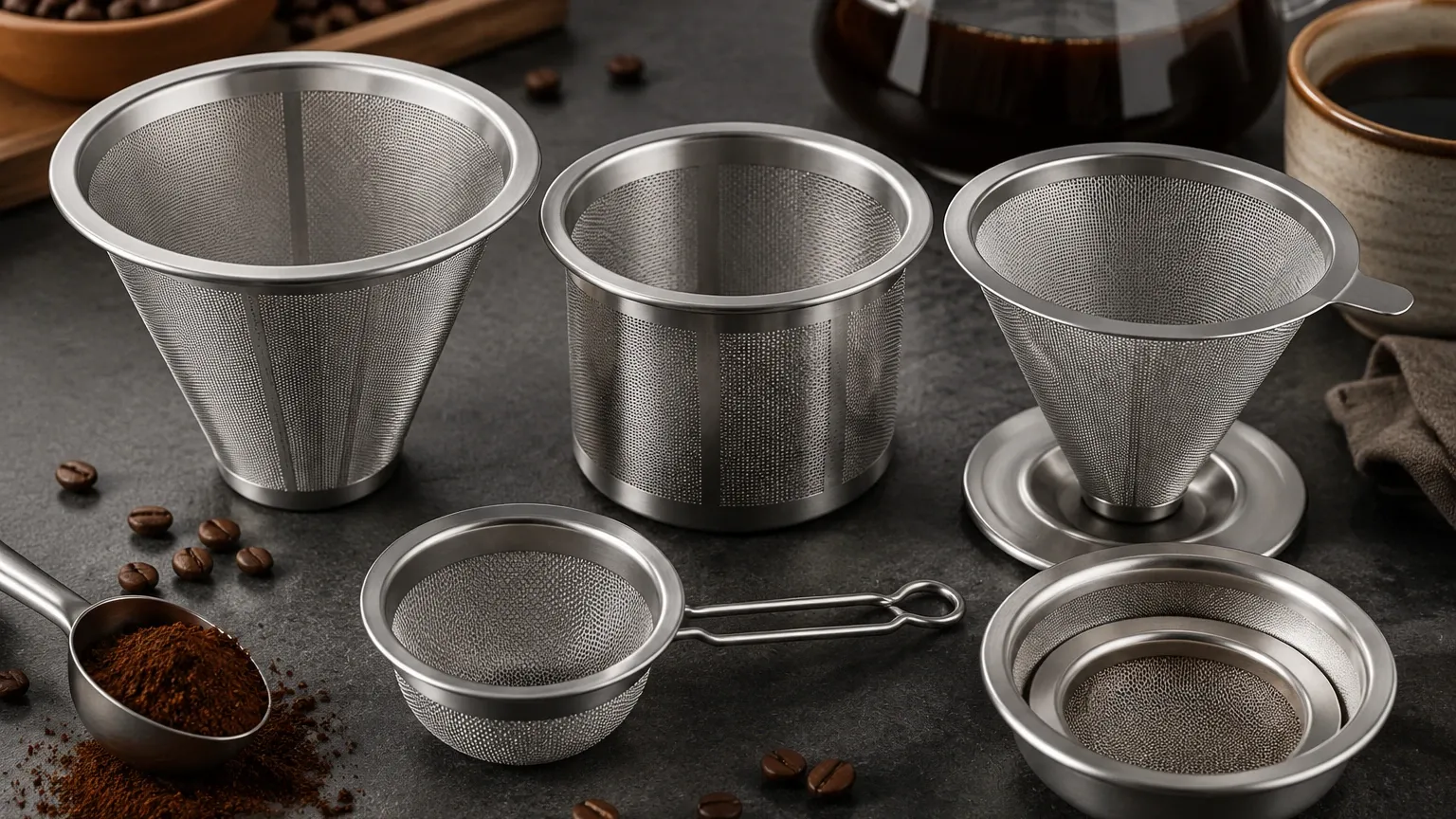
In many B2B applications, the filter is not a flat disc but a three-dimensional component. Strainers & Baskets are engineered to maximize surface area within a confined footprint. A cylindrical or conical basket design increases the filtration area compared to a flat screen, which directly translates to longer run times between cleaning cycles and lower approach velocities.
For industrial equipment, the "basket" often consists of a multi-layer construction:
* The Filtration Layer: A fine stainless steel wire mesh that defines the filtration accuracy.
* The Support Layer: A coarser mesh or a perforated metal plate that provides the structural skeleton. This prevents the fine mesh from deforming under the weight of wet coffee grounds or the force of pumped water.
* The Binding/Frame: A solid metal ring or flange that ensures a bypass-free seal within the brewing chamber. Precision machining of these frames is essential; even a 0.5mm gap can allow significant amounts of coffee grounds to bypass the filter.
Operational Efficiency: Cleaning, Maintenance, and Reusability
One of the primary drivers for switching to stainless steel coffee strainers in a B2B context is the total cost of ownership (TCO). While the initial capital expenditure is higher than disposable filters, the long-term savings in waste disposal and recurring procurement are substantial.
However, reusability introduces the challenge of maintenance. Coffee oils (lipids) and fine particulates can eventually clog the mesh, a phenomenon known as "blinding." In industrial settings, maintenance protocols usually involve:
* Clean-In-Place (CIP): Automated systems that flush the strainers with hot water and food-grade detergents in the reverse direction of the flow (backwashing).
* Ultrasonic Cleaning: For deep cleaning of fine meshes, ultrasonic baths use high-frequency sound waves to dislodge microscopic particles trapped within the weave.
* Chemical Soaking: Periodic use of caustic-based cleaners to dissolve polymerized coffee oils that have hardened on the wire surfaces.
Engineers must consider the ease of removal and the durability of the strainer when subjected to these cleaning cycles. A poorly constructed strainer may suffer from wire fatigue or weld failure after repeated thermal cycling and chemical exposure.
Key Evaluation Criteria for Purchasing Teams
When sourcing coffee strainers for a project, procurement and engineering teams should evaluate suppliers based on several technical benchmarks:
1. Aperture Uniformity: Inconsistent hole sizes in a mesh lead to unpredictable filtration results. High-quality manufacturers use advanced weaving and inspection techniques to ensure every opening meets the specified micron rating.
2. Seam Integrity: In basket-style strainers, the seam where the mesh is joined is often the weakest point. Plasma or laser welding provides a smooth, sanitary, and strong joint compared to traditional soldering or mechanical crimping.
3. Flow Rate vs. Retention: The supplier should provide data on the "open area" percentage. A higher open area allows for faster processing but may compromise the structural strength of the mesh.
4. Customization Capability: Every commercial brewing system has unique dimensions. The ability to customize the diameter, height, and flange configuration of Strainers & Baskets is often more important than off-the-shelf availability.
Common Risks and Mitigation in Industrial Filtration
The most significant risk in industrial coffee filtration is "bypass." This occurs when the fluid finds a path of least resistance around the filter media rather than through it. This is usually caused by poor sealing surfaces or deformation of the strainer frame. To mitigate this, engineers should specify tight tolerances for the mating surfaces and consider the use of food-grade gaskets (such as EPDM or Silicone) integrated into the strainer design.
Another risk is "media migration," where fragments of the filter itself break off and enter the product stream. This is a common failure mode in low-quality wire mesh. Selecting strainers made from high-tensile, burr-free stainless steel wire and ensuring proper sintering or calendering of the mesh can prevent this issue.
Conclusion: Confirming Technical Requirements
Before moving forward with a bulk order or a custom design, technical professionals should confirm several variables with their filtration partner. This includes the exact particle size distribution of the coffee grind being used, the maximum operating pressure of the system, and the specific cleaning chemicals that will be employed.
By focusing on material grade, micron precision, and structural durability, B2B buyers can ensure that their coffee strainers contribute to a consistent, high-quality end product while minimizing downtime and operational costs. Whether for a new espresso machine line or a massive cold brew facility, the engineering of the strainer is the silent guardian of the coffee's quality.
