


Colanders & Food Strainers
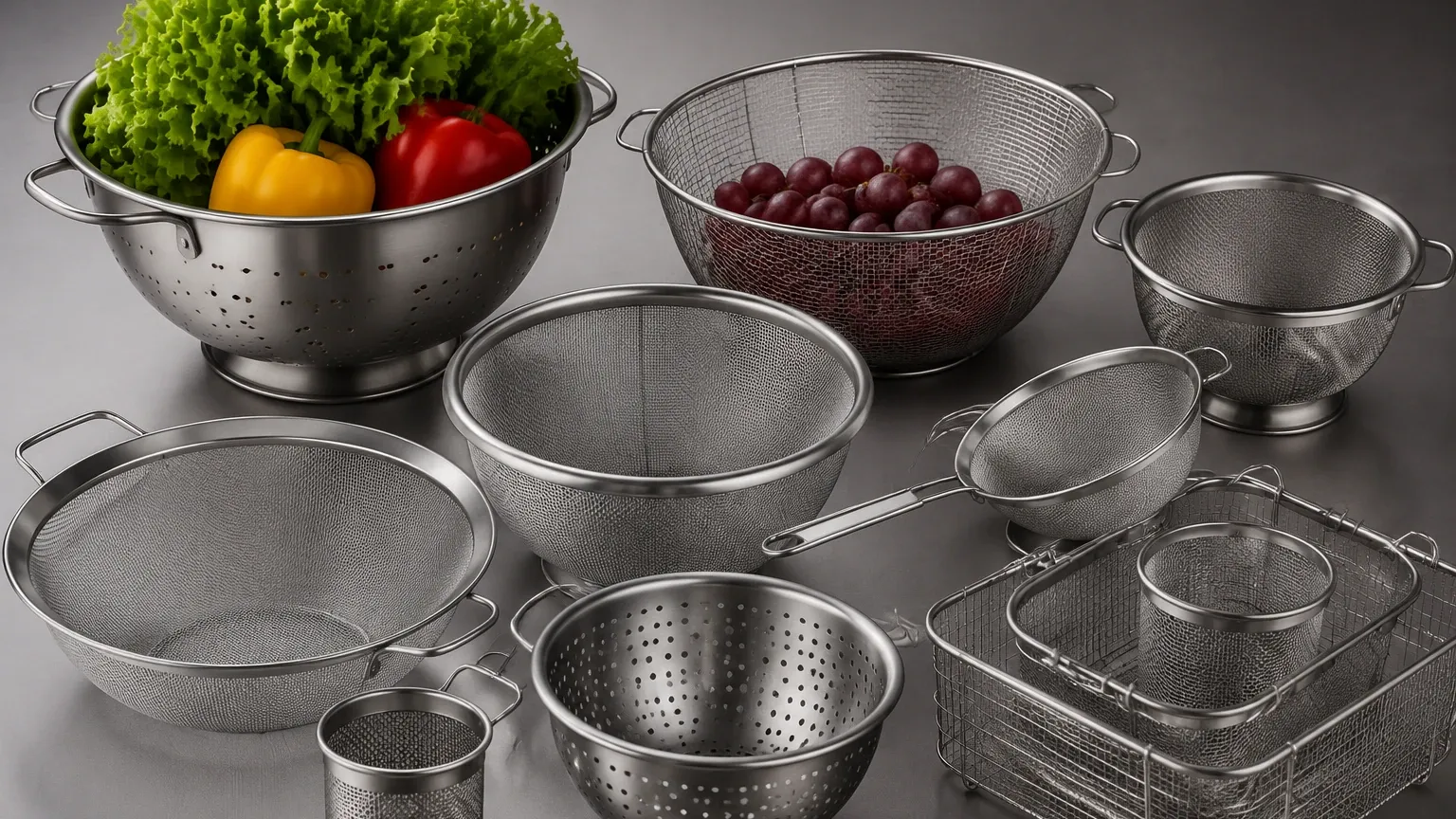
In the context of industrial food processing, the equipment used for separation and drainage must meet significantly higher standards than consumer-grade kitchenware. Industrial colanders & food strainers are critical components within the broader category of Strainers & Baskets, designed to withstand continuous operation, high-volume throughput, and rigorous sanitation protocols. For engineers and procurement specialists in the food and beverage industry, selecting the right filtration component involves a deep understanding of material science, structural engineering, and fluid dynamics.
Kaifil specializes in the manufacture of custom stainless steel filtration solutions, providing precision-engineered baskets that ensure product consistency and operational efficiency. This guide explores the technical requirements and selection criteria for industrial-grade food straining equipment.
Understanding Industrial-Grade Colanders & Food Strainers
While the basic function of a colander—separating solids from liquids—remains the same across all applications, the industrial version is a precision tool. In large-scale food processing, these components are often integrated into automated lines for washing, blanching, cooling, or ingredient recovery.
Industrial colanders & food strainers differ from domestic versions in several key ways:
1. Durability: They are constructed from heavy-gauge stainless steel to prevent deformation under the weight of large batches.
2. Filtration Precision: Unlike standard punched holes, industrial strainers can utilize fine wire mesh or precision-drilled perforations to capture specific particle sizes.
3. Sanitary Design: They must be free of crevices, pits, or sharp internal corners where bacteria can proliferate.
4. Integration: Many industrial baskets are designed with specific mounting brackets, handles, or reinforced rims to interface with centrifuges, hoppers, or conveyor systems.
Material Selection: The Foundation of Food-Grade Filtration
The choice of material is the most critical factor in the longevity and safety of food-grade Strainers & Baskets. Stainless steel is the industry standard due to its corrosion resistance and ability to withstand high temperatures.
AISI 304 Stainless Steel
Grade 304 is the most common material for food processing. It offers excellent resistance to many acidic foods and is highly durable. It is suitable for applications involving dairy, produce washing, and general ingredient handling where chloride exposure is minimal.
AISI 316L Stainless Steel
For more demanding environments, such as those involving high salt concentrations, brines, or highly acidic sauces (like tomato-based products), 316L is preferred. The addition of molybdenum provides superior resistance to pitting and crevice corrosion. The "L" stands for low carbon, which improves weldability and prevents intergranular corrosion in the heat-affected zones of the basket.
Compliance and Certification
All materials used in the production of colanders & food strainers must comply with international food safety standards, such as FDA (U.S. Food and Drug Administration) regulations or EHEDG (European Hygienic Engineering & Design Group) guidelines. This ensures that the metal does not leach harmful substances into the food product and that the surface can be effectively sanitized.
Design Engineering: Balancing Structural Integrity and Flow Rate
When designing a custom strainer basket, engineers must balance the need for structural strength with the requirement for high flow rates. A strainer that is too restrictive will slow down production, while one that is too flimsy will fail under load.
Perforation Patterns and Open Area
The "open area" percentage determines the flow capacity of the strainer. For heavy-duty applications, perforated metal is often used as the primary structure. Common patterns include:
* Round Holes: The most versatile and easiest to clean.
* Square Holes: Offer a higher open area but may be more difficult to sanitize at the corners.
* Slotted Holes: Ideal for elongated products like green beans or pasta, preventing them from passing through while allowing rapid liquid drainage.
Wire Mesh Overlays
When fine filtration is required, a coarse perforated basket can be lined with a fine stainless steel wire mesh. This "multi-layer" approach provides the structural support of the perforated plate with the precision of the mesh. Engineering considerations here include the wire diameter and the weave type (plain, twill, or dutch weave) to ensure the mesh does not blind (clog) prematurely.
Structural Reinforcement
In large-scale colanders & food strainers, reinforcement is necessary. This may include:
* Top Rings: Heavy-duty bars or pipes welded to the rim to prevent the basket from becoming egg-shaped under load.
* Bases/Feet: To keep the bottom of the strainer off the floor of a tank or sink, facilitating 360-degree drainage.
* Internal Ribs: For very large baskets, internal supports may be added, provided they are designed to be hygienic.
Customization Capabilities for Diverse Food Processing Applications
No two food processing lines are identical, which is why customization is a core service at Kaifil. Industrial colanders & food strainers must be tailored to the specific physical properties of the product being processed.
Vegetable and Fruit Processing
In washing and blanching lines, baskets must allow for rapid immersion and drainage. Large open areas are prioritized to ensure that water or steam can reach all surfaces of the produce evenly. Handles are often designed for ergonomic manual lifting or for attachment to overhead hoists.
Dairy and Beverage Production
These applications often require finer filtration to remove pulp, seeds, or curd particles. The strainers must be compatible with Clean-in-Place (CIP) systems, meaning they must withstand high-pressure washdowns and aggressive caustic cleaning agents without degrading.
Meat and Poultry Processing
Durability is paramount here, as the equipment often handles heavy loads and bone fragments. The mesh or perforations must be robust enough to resist abrasion, and the welds must be exceptionally smooth to prevent organic matter from becoming trapped.
Sanitation Standards and Surface Treatment Requirements
In the food industry, the "cleanability" of a component is just as important as its filtration performance. Industrial Strainers & Baskets undergo specific surface treatments to enhance their hygienic properties.
Smooth Welds and Radiused Corners
All welds in a food-grade strainer should be continuous and ground smooth. TIG (Tungsten Inert Gas) welding is typically used to create high-quality, precise joints. Internal corners should have a minimum radius to ensure that cleaning brushes or high-pressure sprays can reach every millimeter of the surface.
Electropolishing
Electropolishing is an electrochemical process that removes a microscopic layer of material from the surface of the stainless steel. This results in a mirror-like finish that is significantly smoother than a mechanical polish. Electropolishing reduces the total surface area, making it harder for bacteria to adhere and easier for cleaning agents to rinse away contaminants.
Passivation
After fabrication, stainless steel components undergo passivation to remove free iron from the surface and enhance the protective chromium oxide layer. This is essential for preventing rust and maintaining the integrity of the colanders & food strainers throughout their service life.
Key Selection Criteria for Purchasing and Engineering Teams
Before ordering custom Strainers & Baskets, technical teams should evaluate the following parameters to ensure the product meets the application's demands:
1. Micron Rating or Hole Size: What is the smallest particle that must be retained? What is the largest particle allowed to pass?
2. Flow Rate Requirements: How many gallons per minute (GPM) or liters per hour must the strainer handle? This will dictate the required open area.
3. Operating Temperature: Will the strainer be used in boiling water, steam, or cryogenic freezing environments?
4. Chemical Environment: What cleaning chemicals are used? What is the pH of the food product? (This determines the choice between 304 and 316L).
5. Mechanical Interface: How will the basket be handled? Does it need to fit into an existing housing or frame?
6. Batch Weight: What is the maximum weight the basket will hold? This influences the gauge of the steel and the need for reinforcement.
Maintenance and Lifecycle Management of Stainless Steel Strainers
While high-quality stainless steel colanders & food strainers are designed for longevity, their lifespan depends on proper maintenance. Industrial environments are harsh, and even the best equipment requires regular inspection.
Inspection Protocols
Operators should regularly check for:
* Mesh Integrity: Look for tears, fraying, or separation from the frame.
* Weld Cracks: Inspect stress points, especially near handles and rims.
* Pitting: Check for signs of corrosion, which can indicate that the cleaning chemicals are too aggressive or the material grade is insufficient for the application.
Cleaning Best Practices
To prevent the buildup of "biofilms," strainers should be cleaned immediately after use. If the product is allowed to dry on the mesh, it becomes significantly harder to remove and can lead to clogging. For fine mesh strainers, ultrasonic cleaning is often the most effective method for removing trapped particles without damaging the delicate wires.
Replacement Cycles
Establishing a replacement cycle based on the intensity of use helps prevent unexpected downtime. In high-volume processing, having spare Strainers & Baskets on hand is essential. Because custom baskets can have lead times for fabrication, procurement teams should plan replacements well in advance of the end-of-life for current components.
Conclusion
Industrial colanders & food strainers are vital to the safety and efficiency of modern food production. By focusing on high-grade materials, precision engineering, and sanitary design, Kaifil provides filtration solutions that withstand the rigors of the industrial environment. Whether for simple drainage or complex separation tasks, selecting the right strainer basket is an investment in product quality and operational reliability. Engineers and purchasing managers are encouraged to provide detailed application data to ensure the final product is perfectly suited to their specific processing needs.
