


Cone Strainers
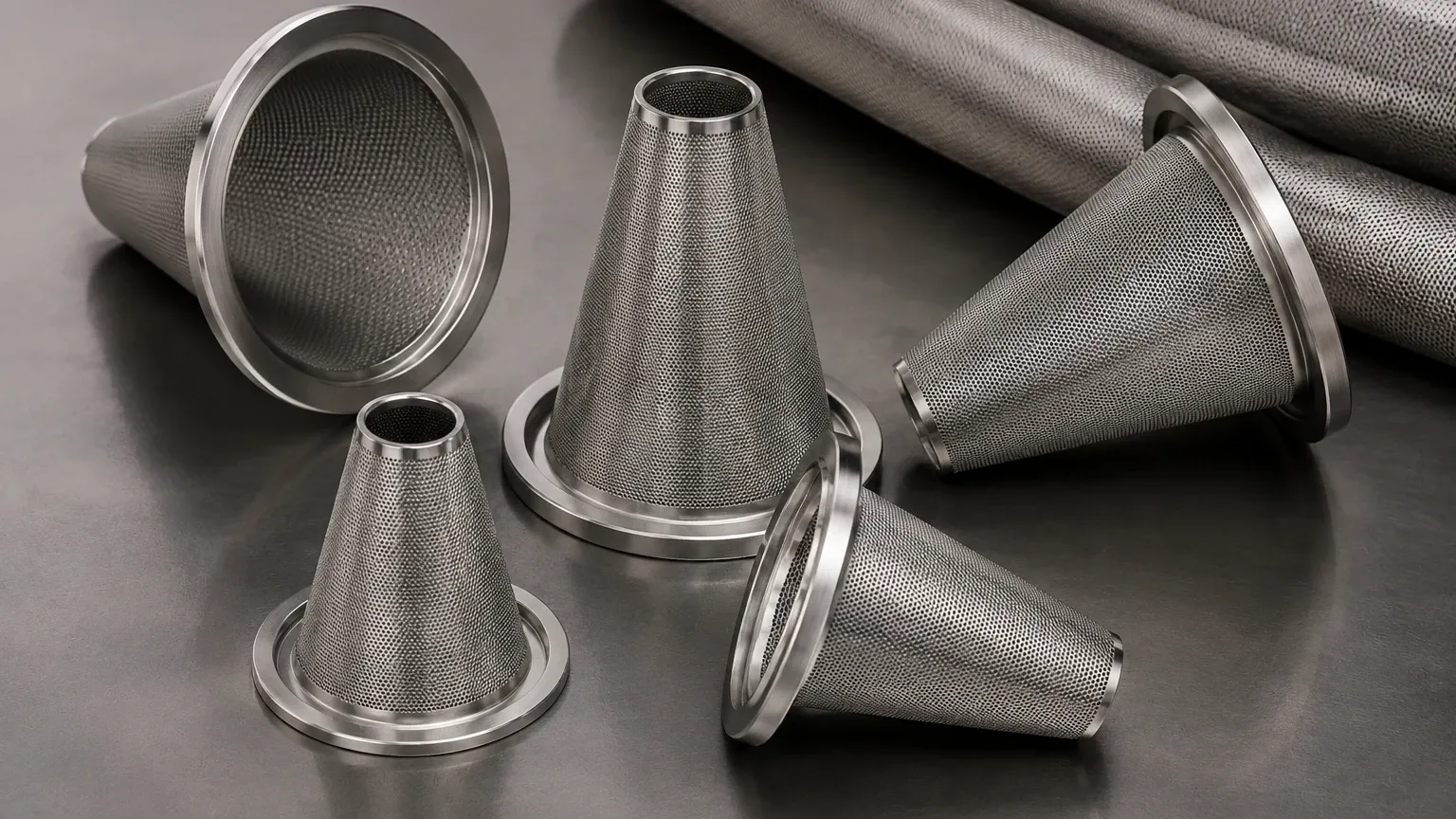
In industrial fluid handling and piping systems, the integrity of downstream equipment such as pumps, valves, and instrumentation is paramount. One of the most effective, albeit often temporary, solutions for protecting these components during the critical phases of startup and commissioning is the use of cone strainers. Often referred to in the industry as "witch’s hats" due to their distinct conical shape, these components serve as a mechanical barrier against large-scale debris, welding slag, and construction remnants that can compromise a system's initial operation.
As a specialized manufacturer of stainless steel filtration solutions, Kaifil understands that while cone strainers are frequently categorized as temporary hardware, their engineering and material composition must meet the same rigorous standards as permanent filtration units. This guide provides a technical overview of cone strainer design, material selection, and hydraulic considerations to assist engineers and procurement teams in selecting the appropriate components for their specific industrial applications.
Engineering Fundamentals of Cone Strainers
The primary function of a cone strainer is to provide a cost-effective means of protecting expensive downstream equipment. Unlike permanent Y-strainers or basket strainers that feature a dedicated housing, cone strainers are designed to be sandwiched between two pipe flanges. This "in-line" installation method makes them exceptionally versatile for systems where space is limited or where filtration is only required during the initial flushing phase of a project.
Geometry and Surface Area
The conical shape is not merely aesthetic; it is a calculated engineering choice. By extending the filter medium into the length of the pipe, the surface area is significantly increased compared to a flat plate strainer. This increased area allows for a higher volume of debris collection before the differential pressure (ΔP) reaches a critical level that could starve a pump or cause structural failure of the mesh.
Standard cone strainers are typically designed with a length-to-diameter (L:D) ratio that dictates the total open area. Common configurations include:
- 100% Open Area: The total open area of the mesh or perforation equals the cross-sectional area of the pipe.
- 150% to 200% Open Area: These designs provide a larger safety margin, extending the time between cleaning cycles and reducing the initial pressure drop across the unit.
Truncated vs. Full Cone Designs
In applications where the piping layout includes short runs or elbows immediately downstream of the flange, a full cone may be too long to fit. In such instances, truncated cone strainers (flat-top cones) are utilized. While truncation reduces the total surface area, it allows for installation in restricted spaces while still providing superior flow characteristics compared to simple temporary plate filters.
Material Selection and Construction Standards
Industrial environments demand materials that can withstand varying temperatures, pressures, and chemical exposures. At Kaifil, the focus is on utilizing high-grade stainless steel to ensure durability and prevent media migration or corrosion-related failures.
Stainless Steel Grades
The choice of material is usually dictated by the process fluid and the operating environment.
- SS304/304L: The industry standard for general-purpose applications, offering excellent corrosion resistance in water treatment, food and beverage, and standard industrial settings.
- SS316/316L: Preferred for chemical processing, pharmaceutical, and marine environments. The addition of molybdenum provides enhanced resistance to pitting and crevice corrosion, particularly in chloride-rich environments.
- Exotic Alloys: For highly specialized applications involving extreme temperatures or aggressive acids, materials like Monel, Hastelloy, or Duplex stainless steel may be required to ensure the structural integrity of the strainer.
Structural Reinforcement
Because cone strainers are often subjected to high-velocity flows and significant pressure differentials as they become loaded with debris, structural reinforcement is critical. A standard construction involves a layer of fine wire mesh supported by a heavier perforated metal plate. The perforated plate provides the mechanical strength to resist collapsing, while the wire mesh determines the filtration precision (micron rating). For high-pressure systems, reinforcement rings or heavy-duty longitudinal ribs may be added to the cone's exterior.
Technical Specifications: Mesh, Perforation, and Micron Ratings
Selecting the right filtration media for cone strainers involves balancing the need for particle retention against the requirement for minimal flow restriction. Engineers must specify both the "retention" (the size of particles to be removed) and the "percent open area."
Wire Mesh vs. Perforated Plate
- Perforated Plate: Typically used for coarse filtration where the goal is to catch large debris like nuts, bolts, and large slag. Hole sizes usually range from 1/16" to 1/4".
- Wire Mesh: Used for finer filtration requirements. Mesh counts can range from 20 mesh (approx. 900 microns) down to 400 mesh (approx. 35 microns). When mesh is used, it is almost always supported by a perforated metal backing to prevent the mesh from tearing under the force of the fluid flow.
The Importance of the Flange Ring
The flange ring (or handle) is the part of the strainer that is compressed between the pipe flanges. It must be precision-machined to ensure a leak-proof seal. In many industrial standards, the flange ring is designed to fit within the bolt circle of standard ANSI/ASME B16.5 flanges. The thickness of the ring must be accounted for when calculating the final dimensions of the piping spool to ensure proper gasket compression and alignment.
Hydraulic Considerations: Pressure Drop and Flow Velocity
One of the most common mistakes in specifying Strainers & Baskets is failing to account for the "dirty" pressure drop. As the strainer captures debris, the available open area decreases, causing the flow velocity through the remaining open pores to increase. This leads to an exponential rise in differential pressure.
Calculating Differential Pressure (ΔP)
Engineers should request or calculate the clean pressure drop based on the fluid's viscosity, specific gravity, and flow rate. A general rule of thumb for temporary cone strainers is to size the unit so that the initial clean pressure drop does not exceed 2 PSI (0.14 bar). If the calculated ΔP is higher, a larger L:D ratio or a coarser mesh may be necessary.
Flow Direction
Cone strainers can be designed for two types of flow direction:
1. Inside-Out Flow: Debris is collected inside the cone. This is the most common configuration as it makes debris removal easier when the strainer is pulled from the line.
2. Outside-In Flow: Debris is collected on the exterior of the cone. This is sometimes used in specific vertical installations or where the internal pipe volume is extremely limited.
It is vital that the strainer is installed in the correct orientation. Installing an inside-out strainer in an outside-in flow path can lead to the structural collapse of the cone, as the mesh and perforated support are not designed to withstand pressure in the reverse direction.
Installation and Maintenance Protocols
Proper installation is as critical as the design of the strainer itself. Since cone strainers are often installed in new piping systems, the presence of gaskets on both sides of the strainer flange is mandatory to prevent external leaks.
Installation Checklist
- Gasket Selection: Ensure that the gaskets used are compatible with the process fluid and the flange rating. Two gaskets are required: one between the upstream flange and the strainer, and one between the strainer and the downstream flange.
- Centering: The strainer must be perfectly centered within the bolt circle to prevent the cone from rubbing against the pipe wall, which can cause vibration and mechanical wear.
- Flow Arrow: Many custom cone strainers include a flow direction arrow stamped on the handle. This must be verified against the actual system flow before the bolts are torqued.
Monitoring and Removal
Because they are often "temporary," cone strainers are frequently forgotten once a plant is operational. This is a significant risk. If a strainer is left in place and becomes fully blinded, it can collapse, sending both the debris and shards of stainless steel into the downstream equipment it was meant to protect.
Differential pressure gauges should be installed upstream and downstream of the strainer location. Once the ΔP reaches a pre-determined limit (typically 10-15 PSI depending on the construction), the system should be shut down, and the strainer should be cleaned or removed. In many cases, after the initial commissioning period (usually 24 to 48 hours of full-flow circulation), the cone strainers are removed entirely and replaced with a spacer ring or a permanent filtration solution.
Custom Engineering for Specialized Applications
While standard sizes are available for common pipe diameters (2" through 24"), many industrial projects require custom-engineered solutions. Kaifil specializes in the OEM manufacture of precision metal filter components, allowing for the customization of every aspect of a cone strainer.
Customization Options for Engineers:
- Variable Lengths: Custom L:D ratios to meet specific ΔP requirements or space constraints.
- Multi-Layer Sintered Mesh: For applications requiring high strength and fine filtration, sintered mesh provides a bonded structure that eliminates the risk of wire migration.
- Reinforced Handles: Long handles or "paddles" that extend beyond the flange insulation, allowing for easy identification of the strainer's location in a complex piping manifold.
- High-Pressure Support: Internal or external cages designed to withstand high differential pressures without deformation.
When procuring Strainers & Baskets, providing the manufacturer with a complete data sheet—including flow rate, fluid properties, operating pressure, and maximum allowable pressure drop—is essential for ensuring the delivered product meets the technical demands of the application.
Conclusion
Cone strainers are a fundamental component in the protection of industrial fluid systems. Their simplicity in design belies the engineering precision required to ensure they perform effectively without becoming a liability. By understanding the nuances of material selection, structural reinforcement, and hydraulic impact, engineers can specify filtration solutions that safeguard their equipment during the most vulnerable stages of operation. Whether for a temporary startup or a specialized industrial process, choosing a manufacturer with deep expertise in stainless steel filtration ensures that these critical components provide the reliability and performance required for demanding industrial environments.
