


Conical Strainers
In industrial fluid handling and pipeline management, the protection of downstream equipment is a primary engineering concern. Among the various mechanical separation tools available, conical strainers—often referred to as "witch's hat" strainers due to their distinct geometric profile—serve as a critical line of defense. These components are categorized under the broader umbrella of Strainers & Baskets and are primarily utilized during the commissioning, startup, or maintenance phases of a piping system to capture construction debris, scale, and other particulate matter that could damage pumps, valves, or instrumentation.
While often viewed as temporary solutions, the engineering requirements for conical strainers are as rigorous as those for permanent filtration systems. Selecting the correct configuration requires an understanding of fluid dynamics, material science, and the specific mechanical constraints of the piping architecture.
Understanding the Role of Conical Strainers in Industrial Piping
Conical strainers are designed to be installed between two pipe flanges. Their primary function is to provide a high-surface-area barrier that traps solids while allowing the fluid—whether liquid, gas, or steam—to pass through with minimal resistance. In most industrial applications, these strainers are deployed during the "blow-down" or initial circulation phase of a new system. During construction, it is common for welding slag, gasket remnants, and metal shavings to remain inside the piping. If these contaminants reach high-speed rotating equipment like centrifugal pumps or sensitive control valves, the resulting mechanical failure can lead to significant downtime and repair costs.
Unlike permanent T-type or Y-type strainers, conical strainers are often removed once the system has reached a steady state of cleanliness. However, in certain low-flow or non-critical applications, they may remain in place as a cost-effective alternative to more complex housing-based filters. Their simplicity is their greatest advantage, but it also necessitates careful selection to ensure they do not become a point of failure themselves.
Design and Construction Specifications
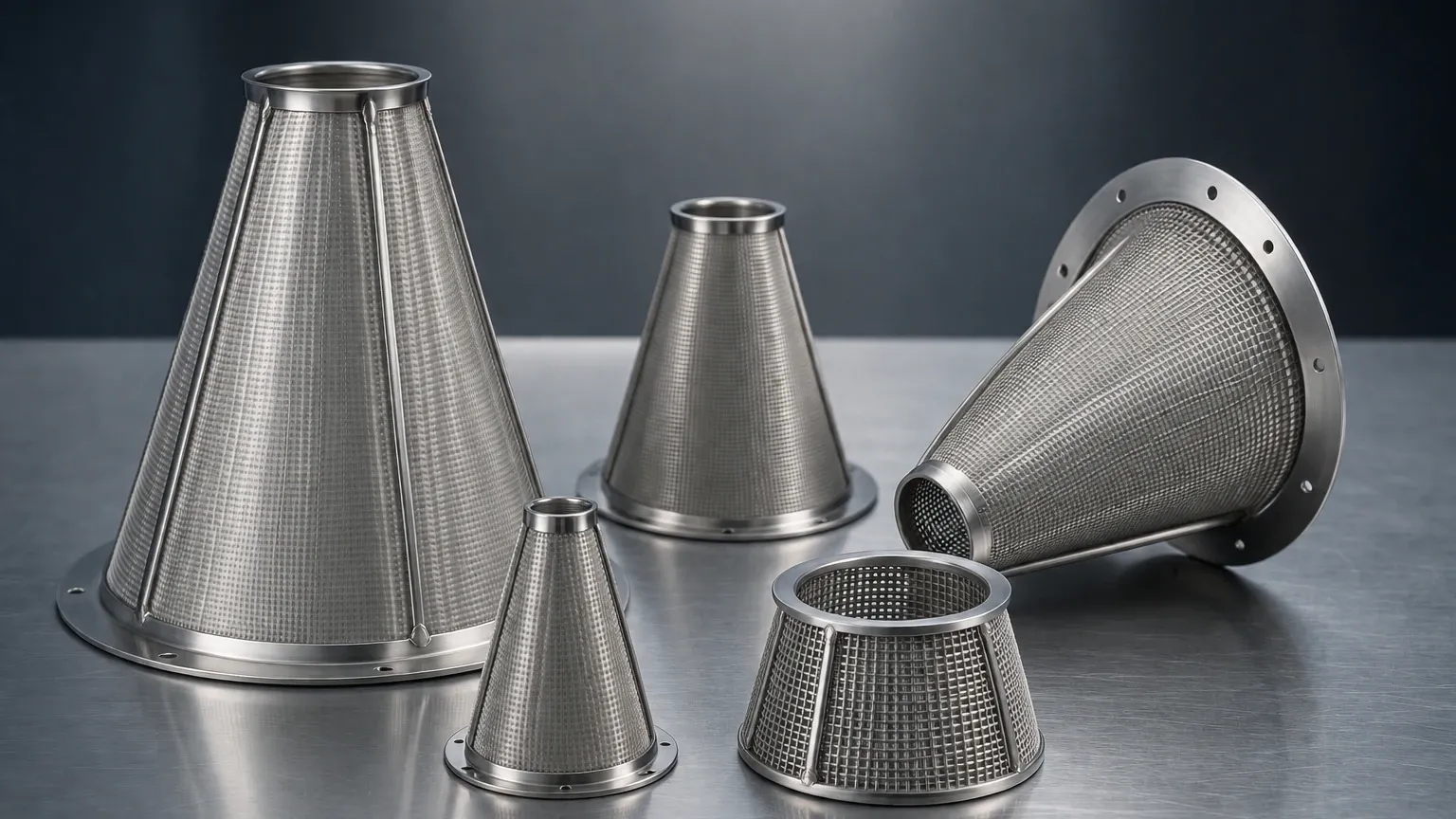
The construction of a conical strainer typically involves a combination of perforated metal and fine wire mesh. The choice of materials and the structural layout are dictated by the required filtration accuracy and the anticipated pressure of the system.
Perforated Metal Support
For most industrial sizes, the strainer body is constructed from a perforated stainless steel sheet. This provides the mechanical strength necessary to withstand the differential pressure (ΔP) created as the strainer accumulates debris. Common perforation patterns include staggered holes, which maximize the open area while maintaining the structural integrity of the cone.
Wire Mesh Lining
When finer filtration is required—typically below the 1/8-inch or 1/16-inch range provided by standard perforations—a layer of stainless steel wire mesh is bonded to the interior or exterior of the perforated cone. The mesh count (the number of openings per linear inch) determines the micron rating. In high-pressure applications, the mesh is usually placed on the upstream side of the perforated metal to ensure the stronger material supports the finer, more delicate mesh against the force of the flow.
The Flange Ring and Handle
The base of the cone is attached to a flat ring, known as the flange ring or gasket face. This ring is sandwiched between two pipe flanges. A critical feature of many conical strainers is the elongated handle or "paddle" that extends beyond the outer diameter of the flange. This handle serves two purposes: it allows for easier installation and removal, and it provides a visible indicator to operators that a temporary strainer is currently installed in the line.
Technical Performance: Pressure Drop and Filtration Area
One of the most important engineering considerations when specifying conical strainers is the "Open Area Ratio." This ratio compares the total unobstructed area of the strainer's openings to the cross-sectional area of the pipe.
Standard industrial designs typically aim for an open area ratio of 150% to 300%. A higher ratio is generally preferred because it results in a lower initial pressure drop and allows the strainer to hold more debris before requiring cleaning. If the open area is too small, the fluid velocity through the remaining openings increases, which can lead to cavitation, increased turbulence, and a rapid rise in differential pressure that might cause the cone to collapse.
Engineers must calculate the expected pressure drop using the fluid's viscosity, density, and flow rate. Since conical strainers are often used in startup scenarios where debris levels are unpredictable, monitoring the differential pressure across the flange connection is essential. If the ΔP exceeds the design limits of the perforated metal, the strainer can buckle, sending both the captured debris and pieces of the strainer itself downstream—the exact scenario the strainer was installed to prevent.
Installation Best Practices and Orientation
The performance of Strainers & Baskets is heavily influenced by how they are oriented within the pipeline. Conical strainers can be installed in either horizontal or vertical runs, but the flow direction must be specified during the design phase.
Flow Direction: Inside-Out vs. Outside-In
* Inside-Out Flow: This is the most common configuration for conical strainers. Debris is collected inside the cone. This makes it easier to remove the debris when the strainer is pulled from the line, as the contaminants are contained within the "basket" of the cone.
* Outside-In Flow: In this setup, debris accumulates on the exterior surface of the cone. This is sometimes used in specific vertical installations, but it carries a higher risk of debris falling back into the upstream piping when the strainer is removed.
Horizontal vs. Vertical Installation
In horizontal piping, the strainer should be oriented so that the cone points downstream. In vertical piping with a downward flow, the cone also points downward. The primary concern in vertical installations is the potential for debris to settle at the bottom of the cone and create a localized blockage, which can lead to uneven pressure distribution.
Material Selection and Chemical Compatibility
Given the demanding environments in chemical processing, pharmaceutical manufacturing, and oil and gas, material selection for conical strainers is non-negotiable. Stainless steel is the industry standard due to its corrosion resistance and mechanical toughness.
1. Type 304 Stainless Steel: Suitable for general-purpose applications, water treatment, and food-grade environments where mild corrosion resistance is required.
2. Type 316/316L Stainless Steel: Preferred for chemical processing and marine environments. The addition of molybdenum provides superior resistance to pitting and crevice corrosion, especially in chloride-rich environments.
3. Specialty Alloys: For highly corrosive or high-temperature applications, strainers can be fabricated from Monel, Hastelloy, or Duplex stainless steel. These are typically reserved for specialized industrial processes where standard stainless steels would fail prematurely.
When selecting materials, engineers must also consider the gasket material used on either side of the strainer's flange ring. The gasket must be compatible with the process fluid and capable of maintaining a seal at the system's operating temperature and pressure.
Maintenance, Cleaning, and Replacement Cycles
Because conical strainers are frequently used as temporary measures, they often lack the sophisticated self-cleaning mechanisms found in automatic backwash filters. Maintenance is manual and requires the depressurization and partial disassembly of the piping system.
Monitoring and Cleaning
The frequency of cleaning depends entirely on the cleanliness of the upstream system. During the first few hours of a plant startup, a strainer may need to be pulled and cleaned multiple times. Operators should look for a steady increase in differential pressure as a signal to perform maintenance. Cleaning typically involves high-pressure water jets or chemical baths, depending on the nature of the contaminants.
Transitioning to Permanent Solutions
A common mistake in industrial operations is leaving a temporary conical strainer in the line indefinitely. Over time, the wire mesh can fatigue due to flow-induced vibration, or the perforated support can corrode. Once the initial startup phase is complete and debris levels have stabilized, engineers should evaluate whether to remove the strainer entirely or replace it with a permanent Strainers & Baskets solution that allows for easier maintenance without breaking the pipe seal.
Customization Options for Specialized Applications
Not every pipeline follows standard dimensions, and off-the-shelf strainers may not meet the specific needs of a complex system. Customization is a key aspect of industrial filtration procurement. Common customization options include:
* Truncated Cones: In systems where there is limited space downstream (such as a short distance between flanges and a 90-degree elbow), a truncated or "flat-top" cone provides the necessary filtration while fitting within the physical constraints of the pipe.
* Reinforced Structures: For high-velocity steam lines, additional longitudinal or circumferential reinforcement bars can be welded to the cone to prevent oscillation and fatigue.
* Specific Micron Ratings: While standard perforations might be 1/8", custom-manufactured strainers can utilize multi-layered sintered mesh to achieve filtration levels down to 5 or 10 microns, providing high-precision protection for sensitive equipment.
Conclusion
Conical strainers are indispensable tools for ensuring the long-term integrity of industrial piping systems. By understanding the nuances of open area ratios, material compatibility, and flow dynamics, engineers can select a filtration solution that minimizes pressure loss while maximizing equipment protection. Whether used as a temporary safeguard during commissioning or a specialized component in a unique process, the quality of the strainer's construction directly impacts the operational safety and efficiency of the entire facility.
