


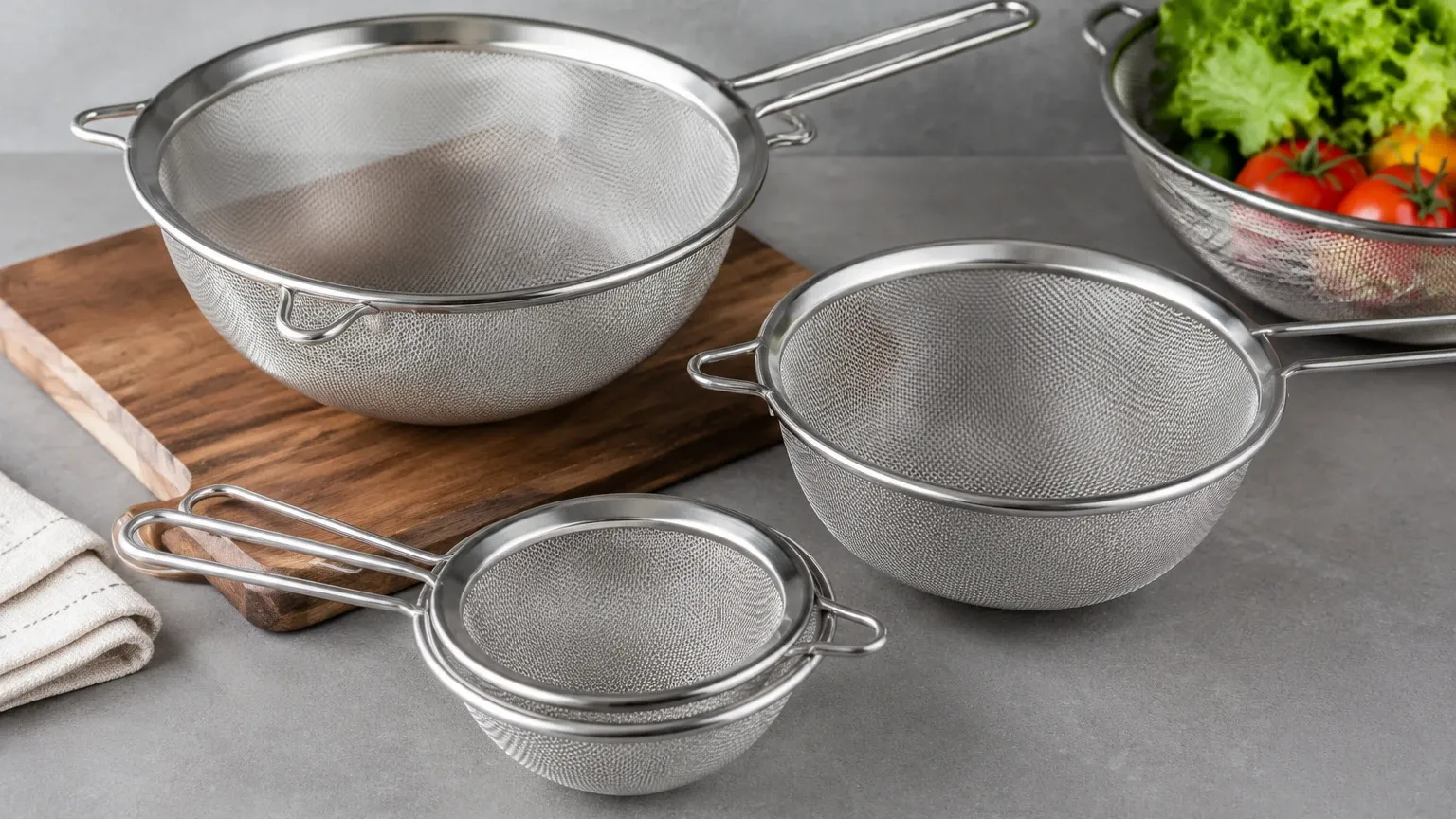
Cuisinart Mesh Strainers
In the realm of fluid handling and particle separation, mesh strainers represent a fundamental technology used across both domestic and industrial environments. While consumer-facing brands like Cuisinart have popularized mesh strainers for culinary and light commercial applications, the engineering principles governing these tools are scalable and critical for large-scale industrial processes. For procurement managers and engineers, understanding the transition from consumer-grade equipment, such as Cuisinart mesh strainers, to heavy-duty industrial Strainers & Baskets is essential for ensuring process efficiency, equipment longevity, and product purity.
Industrial filtration requires a level of precision and structural integrity that far exceeds the demands of a standard kitchen. This article examines the technical specifications, material considerations, and engineering benchmarks that distinguish professional filtration components from consumer hardware, providing a technical framework for selecting the right filtration solution for demanding environments.
Technical Fundamentals of Mesh Strainers
A mesh strainer is defined by its ability to mechanically separate solids from liquids or gases through a porous medium. In industrial contexts, this medium is almost exclusively stainless steel wire mesh. The performance of any strainer—whether it is a handheld unit or a large-scale basket strainer—is determined by three primary factors: the weave type, the mesh count, and the wire diameter.
Weave Types and Their Applications
Industrial-grade strainers utilize various weave patterns to achieve specific filtration goals:
1. Plain Weave: The most common pattern where each warp wire crosses alternately over and under each weft wire. This provides a high open area and low pressure drop, suitable for general-purpose straining.
2. Twill Weave: Used when heavier wire diameters are required for a given mesh count. The wires are woven in a pattern that allows for greater strength and durability under high-pressure loads.
3. Dutch Weave: This involves a combination of different wire diameters in the warp and weft. It creates a tortuous path for the fluid, allowing for much finer filtration (down to micron levels) while maintaining high structural strength.
Mesh Count and Micron Rating
The mesh count refers to the number of openings per linear inch. As the mesh count increases, the size of the openings decreases. In industrial engineering, these openings are often measured in microns (one-millionth of a meter). While Cuisinart mesh strainers are typically categorized as "fine," "medium," or "coarse," industrial specifications require exact micron ratings to ensure compatibility with downstream equipment like pumps, nozzles, and heat exchangers.
Material Selection: Beyond Standard Stainless Steel
One of the most significant differences between consumer-grade strainers and industrial baskets is the metallurgy. While a consumer product may be labeled simply as "stainless steel," industrial applications require specific grades to withstand corrosive environments and thermal cycling.
AISI 304 vs. 316 Stainless Steel
Most high-quality consumer strainers utilize AISI 304 stainless steel, which offers good corrosion resistance for water and food acids. However, in industrial chemical processing or marine environments, 304 may succumb to pitting or stress corrosion cracking. Industrial Strainers & Baskets are frequently fabricated from AISI 316 or 316L. The addition of molybdenum in 316 stainless steel significantly enhances resistance to chlorides and industrial solvents, making it the standard for pharmaceutical and chemical applications.
Durability and Load Capacity
Consumer mesh strainers are designed for manual use with light loads. In contrast, industrial basket strainers must withstand high differential pressures (ΔP). If a strainer becomes clogged, the pressure buildup can cause the mesh to deform or burst. Industrial designs often incorporate a perforated metal backup or a reinforced frame to support the wire mesh, ensuring it can handle the mechanical stresses of high-flow systems without failing.
Engineering Considerations for Industrial Selection
When transitioning from a basic understanding of mesh strainers to specifying industrial components, engineers must evaluate several performance metrics that are rarely considered in consumer contexts.
Flow Rate and Pressure Drop
The "open area" of a strainer is the total area of the holes expressed as a percentage of the total mesh area. A higher open area results in a lower initial pressure drop across the strainer. In industrial system design, maintaining a low pressure drop is critical to reducing energy consumption in pumping systems. Engineers typically aim for a strainer area that is at least 4 to 6 times the cross-sectional area of the inlet pipe to ensure sufficient capacity before cleaning is required.
Filtration Accuracy and Particle Retention
In industrial processes, the goal of a strainer is often to protect sensitive equipment. For example, if a spray nozzle has an orifice of 500 microns, the strainer must be rated at 250 microns or less to prevent clogging. Consumer products like Cuisinart mesh strainers do not provide the certified filtration ratings necessary for these calculations, making them unsuitable for precision industrial tasks.
Connection Types and Housing Integration
Industrial strainers must be integrated into complex piping systems. This requires standardized connections such as NPT threads, flanged ends (ANSI/ASME), or sanitary Tri-Clamp fittings. These connections ensure a leak-proof seal and allow for the high-pressure operation common in hydraulic and water treatment sectors.
Maintenance, Cleaning, and Replacement Cycles
The total cost of ownership (TCO) for filtration components is heavily influenced by how easily they can be cleaned and how long they last before requiring replacement.
Cleaning Methods
While a kitchen strainer is easily rinsed, industrial baskets often require more intensive cleaning protocols:
* Backwashing: Reversing the flow of fluid to dislodge particles from the mesh.
* Ultrasonic Cleaning: Using high-frequency sound waves in a solvent bath to remove fine particles embedded deep within the weave.
* Chemical Cleaning: Using specialized acids or bases to dissolve organic or mineral buildup, a process that requires high-grade 316L stainless steel to avoid material degradation.
Replacement Indicators
In a professional setting, the replacement of a strainer is not dictated by visible damage alone. Instead, it is managed through pressure monitoring. Differential pressure gauges are installed upstream and downstream of the strainer; once the pressure drop exceeds a pre-determined threshold, the basket is removed for cleaning or replacement. This data-driven approach prevents system downtime and protects downstream assets.
Customization and OEM Solutions
One of the primary limitations of off-the-shelf products is the lack of customization. Industrial applications often present unique challenges that cannot be solved by a standard circular strainer. Customization options provided by manufacturers like Kaifil include:
* Custom Geometry: Conical strainers, flat-plate strainers, or multi-layered pleated cartridges designed to fit specific housing dimensions.
* Reinforced Structures: Adding internal skeletons or external shrouds to handle extreme flow velocities.
* Specialized Coatings: Applying PTFE or other fluoropolymer coatings to reduce particle adhesion and improve chemical resistance.
For many OEMs (Original Equipment Manufacturers), the ability to source custom-designed Strainers & Baskets is a competitive advantage, allowing them to optimize their machinery for specific fluid dynamics and filtration requirements.
Common Risks of Using Substandard Strainers in Industrial Settings
Using consumer-grade or low-quality mesh strainers in an industrial environment poses several risks:
1. Media Migration: If the wire mesh is not properly welded or if the wire diameter is too thin, individual wires can break and enter the process stream, contaminating the final product.
2. Bypass: Poorly manufactured strainers may have gaps between the mesh and the frame, allowing unfiltered fluid to bypass the media entirely.
3. Corrosion Contamination: Non-industrial grades of steel may rust, introducing iron oxides into sensitive chemical or food-grade processes.
Conclusion: Making Informed Purchasing Decisions
While the name Cuisinart mesh strainers may be synonymous with quality in a domestic kitchen, the requirements of the industrial sector demand a more rigorous technical approach. Engineers and purchasing teams must look beyond brand recognition and focus on material certifications, micron ratings, and structural load capacities.
When selecting industrial Strainers & Baskets, it is essential to partner with a manufacturer that understands the nuances of wire mesh engineering. By evaluating the specific flow rates, chemical compatibility, and maintenance requirements of an application, professionals can ensure they implement a filtration solution that provides reliable performance, minimizes downtime, and delivers a superior return on investment. Whether for chemical processing, water treatment, or food production, the right strainer is a critical component in maintaining the integrity of the entire industrial system.
