


Large Straining Basket
In industrial fluid handling, the efficiency of a filtration system often hinges on the initial stage of debris removal. A large straining basket serves as a critical component in this process, designed to capture significant volumes of solid contaminants from liquid streams before they can reach sensitive downstream equipment. For engineers and facility managers, selecting the correct basket is not merely a matter of sizing but involves a complex evaluation of material science, fluid dynamics, and structural engineering.
Industrial strainers are utilized across various sectors, including chemical processing, water treatment, and food production. The primary objective is to protect pumps, valves, and nozzles from damage or clogging caused by particulate matter. When dealing with high flow rates or high particulate loads, a standard filter may become overwhelmed, leading to frequent downtime. This is where the specialized design of a large straining basket becomes indispensable.
Understanding the Role of Large Straining Baskets in Industrial Filtration
The fundamental purpose of a straining basket is to provide a high-capacity reservoir for solids while allowing the fluid to pass through with minimal resistance. Unlike fine-micron cartridges that may focus on sub-micron particles, these baskets are typically the first line of defense. They are engineered to handle "macro-filtration," removing everything from scale and rust to organic matter and manufacturing byproducts.
In high-volume applications, the surface area of the basket is the most critical factor. A larger surface area translates to a higher "open area ratio," which is the ratio between the total area of the holes in the basket and the cross-sectional area of the inlet pipe. A well-designed large straining basket should ideally offer an open area ratio of at least 6:1. This ensures that even as the basket begins to fill with debris, the pressure drop (delta P) across the unit remains within acceptable limits, preventing system strain and pump cavitation.
Engineering Specifications and Material Selection
When specifying a large straining basket, material compatibility is the first technical hurdle. Industrial environments often involve corrosive fluids, high temperatures, or strict hygienic requirements. Stainless steel is the industry standard due to its durability and resistance to oxidation.
Grade 304 vs. Grade 316L Stainless Steel
For general-purpose industrial water or non-corrosive chemical applications, Type 304 stainless steel provides excellent strength and cost-effectiveness. However, in environments involving chlorides, acids, or pharmaceutical-grade processing, Type 316L is preferred. The addition of molybdenum in 316L enhances its resistance to pitting and crevice corrosion, ensuring the structural integrity of the basket over a longer service life.
Mesh and Perforation Combinations
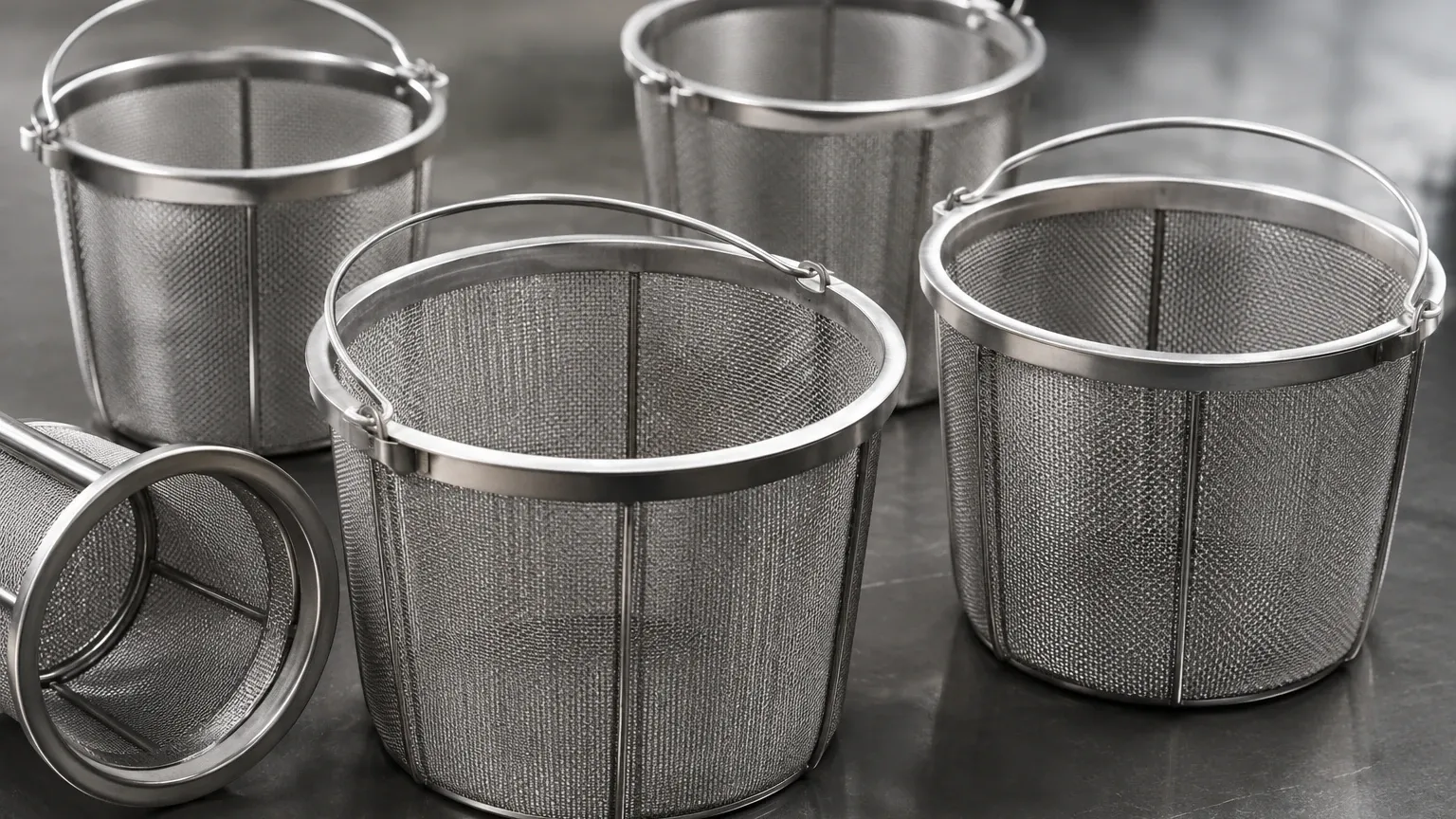
A large straining basket is rarely a single layer of material. To achieve the necessary filtration precision while maintaining structural strength, engineers often use a multi-layered approach:
1. The Support Cylinder: A heavy-gauge perforated metal sheet provides the skeletal strength required to withstand high differential pressures.
2. The Filter Media: A fine wire mesh is lined or wrapped around the perforated cylinder. This mesh determines the actual filtration rating, which can range from coarse 20-mesh (840 microns) to very fine 400-mesh (37 microns).
3. Reinforcement: For exceptionally large baskets or high-pressure systems, external rings or longitudinal ribs are welded to the structure to prevent collapsing under heavy particulate loads.
Flow Rate Dynamics and Pressure Drop Management
One of the most common mistakes in filter selection is undersizing the basket for the intended flow rate. In industrial systems, the flow velocity through the strainer should be kept within specific limits—typically between 5 to 10 feet per second for liquids—to minimize turbulence and pressure loss.
As a large straining basket accumulates debris, the available open area decreases. This leads to an exponential increase in differential pressure. Engineers must calculate the "clean pressure drop" and establish a "terminal pressure drop" at which the basket must be cleaned or replaced. Utilizing a larger basket size allows for a greater "dirt-holding capacity," which directly extends the intervals between maintenance cycles. This is a key consideration for total cost of ownership (TCO), as labor costs and production downtime often far exceed the initial purchase price of the filtration component.
Design Variations for Specific Industrial Needs
Not all large straining baskets are created equal. The geometry and mechanical features must align with the housing and the operational workflow of the plant.
Slant-Top vs. Flat-Bottom Designs
Slant-top baskets are often used in angled strainer housings to facilitate easier removal and to optimize the flow path. Flat-bottom baskets are the standard for vertical basket strainers, providing a stable base and maximum volume for sediment collection.
Handle and Lifting Mechanisms
Because a large straining basket can become quite heavy when filled with wet debris, the design of the handle is a safety and ergonomic consideration. Options include:
* Bail Handles: Standard for smaller to medium baskets.
* Slant Handles: Designed for easy gripping in deep housings.
* Heavy-Duty Lift Lugs: For very large industrial baskets that require mechanical hoists for removal.
Magnetic Inserts
In applications involving metalworking, hydraulic fluids, or cooling towers, ferrous particles can be a major concern. Integrating magnetic rods into the center of the straining basket allows for the capture of fine iron and steel particles that might otherwise pass through the mesh. This provides an additional layer of protection for downstream machinery.
Customization and OEM Solutions
Many industrial systems are legacy installations or highly specialized units that do not conform to standard off-the-shelf dimensions. In these cases, custom manufacturing is required. A custom large straining basket can be engineered to fit specific flange sizes, height constraints, or unique flow patterns.
Customization also extends to the filtration performance. For example, in the food and beverage industry, baskets must be designed with "sanitary" welds—smooth, crevice-free joints that prevent bacterial growth. In the chemical industry, specialized coatings or exotic alloys like Hastelloy may be required for extreme pH levels. Working with a manufacturer that understands these engineering nuances is vital for ensuring the reliability of the Strainers & Baskets integrated into the process line.
Maintenance Protocols and Service Life Extension
The longevity of a large straining basket is determined by how it is maintained. Even the most robust stainless steel basket can fail if subjected to excessive differential pressure or improper cleaning techniques.
Cleaning Procedures
* Manual Cleaning: Baskets should be rinsed with a high-pressure hose from the outside in (backwashing) to dislodge particles trapped in the mesh.
* Ultrasonic Cleaning: For baskets used with resins, oils, or sticky substances, ultrasonic baths can remove microscopic buildup that manual rinsing cannot reach.
* Chemical Soaking: In cases of scale or mineral buildup, a compatible chemical soak may be necessary to restore the open area of the mesh.
Inspection Points
During every cleaning cycle, technicians should inspect the basket for:
* Mesh Blinding: Permanent clogging of the wire mesh openings.
* Structural Deformation: Any bowing or crushing of the perforated support.
* Seal Integrity: If the basket uses an O-ring or gasket to prevent bypass, these must be checked for elasticity and cracks.
Selecting the Right Partner for Filtration Components
Choosing a large straining basket involves more than just matching a part number. It requires an understanding of the specific challenges of your application—whether it is the high viscosity of a chemical polymer, the abrasive nature of wastewater, or the strict purity standards of pharmaceutical manufacturing.
Engineers should look for manufacturers who provide comprehensive technical data, including flow coefficient (Cv) values, material certifications, and pressure rating calculations. By prioritizing quality construction and precise engineering, facilities can ensure continuous operation, protect their capital equipment, and optimize their filtration efficiency. Whether you are replacing an existing component or designing a new system, the right basket strainer is a fundamental investment in the reliability of your industrial process.
