


Tea Strainers for Loose Tea
In the industrial food and beverage sector, the extraction of flavor and active compounds from botanical sources requires high-precision filtration. While the consumer market focuses on the aesthetics of brewing, the B2B landscape views tea strainers for loose tea as essential engineering components. These components must facilitate optimal liquid-to-solid contact while ensuring that even the finest particulates are retained, preventing contamination of the final product or downstream equipment. For manufacturers of commercial brewing systems, pharmaceutical extraction units, and large-scale beverage production lines, selecting the correct filtration media is a matter of both product quality and operational efficiency.
Industrial-grade filtration solutions, such as those found in the category of Strainers & Baskets, are designed to meet rigorous standards for durability, hygiene, and mechanical strength. This guide explores the technical considerations, material requirements, and engineering variables involved in selecting and customizing tea strainers for loose tea in a professional or industrial context.
Material Engineering: Why Stainless Steel is the Standard
When specifying tea strainers for loose tea at an industrial scale, material selection is the primary factor determining the component's lifespan and safety. Stainless steel is the industry standard due to its inert nature and resistance to the chemical compounds found in tea, such as polyphenols and tannins.
Grade 304 vs. Grade 316L
Most industrial strainers are manufactured from AISI 304 or 316L stainless steel.
* Grade 304: This is the most common choice for general food and beverage applications. It offers excellent corrosion resistance and is cost-effective for standard brewing environments where the water quality is controlled.
* Grade 316L: In environments where the tea leaves are highly acidic or where the cleaning agents used in the system are aggressive, 316L is preferred. The addition of molybdenum enhances resistance to pitting and crevice corrosion, particularly in the presence of chlorides. For pharmaceutical-grade tea extractions, 316L is often the mandatory specification.
Thermal Stability and Chemical Inertness
Unlike plastic or low-grade metal alloys, stainless steel does not leach chemicals into the tea at high temperatures. Industrial brewing often occurs at temperatures near boiling (90°C to 100°C), and the filtration media must maintain its structural integrity without warping or degrading. Furthermore, stainless steel does not absorb odors or flavors, ensuring that different batches of loose tea can be processed through the same equipment without cross-contamination.
Technical Specifications of Wire Mesh and Filtration Accuracy
The performance of tea strainers for loose tea is defined by the characteristics of the wire mesh used in their construction. Engineers must balance the need for fine filtration with the requirement for high flow rates.
Mesh Count and Micron Rating
Mesh count refers to the number of openings per linear inch. For tea filtration, the choice of mesh depends on the grade of the tea leaf:
1. Whole Leaf Tea: Requires a lower mesh count (typically 40 to 60 mesh). This allows for rapid water flow and ensures that the large leaves have enough space to expand and release their flavor.
2. Broken Leaf and Fannings: Requires a medium mesh (80 to 120 mesh) to prevent smaller particles from passing into the final beverage.
3. Tea Dust (CTC): Requires high-density mesh (up to 200 mesh or higher) or specialized Dutch weave patterns to capture the finest particulates, which can be as small as 75 microns.
Weave Types
The method of weaving the wire affects the strength and permeability of the strainer.
* Plain Weave: The most common and economical, providing a square opening that is easy to clean.
* Twill Weave: Used for finer filtration, where the wires are woven over and under two wires at a time, allowing for a heavier wire diameter in a fine mesh.
* Dutch Weave: Provides a much higher mechanical strength and is often used in pressurized extraction systems where the strainer must withstand significant differential pressure.
Structural Design: Strainers & Baskets in Industrial Systems
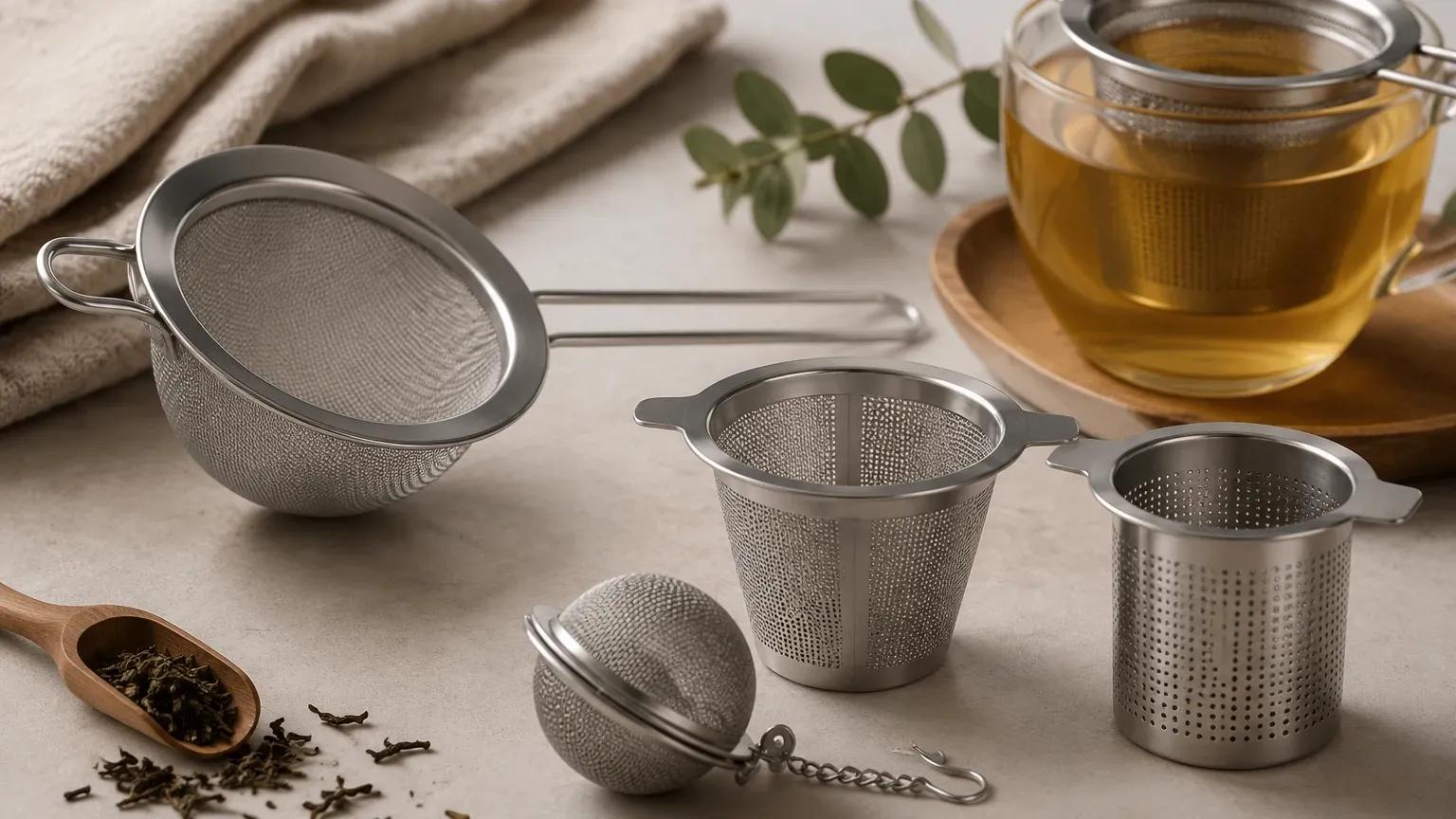
In large-scale applications, tea strainers for loose tea are often integrated into larger assemblies known as basket strainers. These are not standalone items but are part of a housing that manages the flow of liquid.
Basket Geometry and Surface Area
The geometry of the strainer basket is critical for managing the "blinding" effect, where tea leaves cover the surface of the mesh and restrict flow. By using a cylindrical or conical basket design, the surface area is maximized relative to the footprint of the equipment. This ensures that even as the leaves accumulate, there is sufficient open area for the liquid to pass through, maintaining a consistent flow rate throughout the brewing cycle.
Reinforcement and Support Structures
In high-volume industrial brewers, the weight of the saturated tea leaves can be substantial. To prevent the fine mesh from tearing or deforming, tea strainers for loose tea are often designed with a two-layer structure. A fine inner mesh provides the filtration accuracy, while a coarser, heavier perforated metal outer layer provides the necessary mechanical support. This "reinforced basket" design is essential for equipment that undergoes frequent mechanical handling or high-pressure backwashing.
Hygiene, Sanitation, and Maintenance Protocols
For B2B buyers in the food and pharmaceutical sectors, the cleanability of a component is as important as its filtration performance. Tea strainers for loose tea must be designed to eliminate "dead zones" where organic material can collect and foster bacterial growth.
Welding and Surface Finish
High-quality industrial strainers utilize advanced welding techniques, such as TIG (Tungsten Inert Gas) or laser welding, to ensure smooth, seamless joints. Rough welds can trap tea particles and lead to microbial contamination. Furthermore, the surface of the stainless steel is often electropolished. This process removes microscopic peaks and valleys, creating a mirror-like finish that is exceptionally easy to sanitize.
Cleaning-In-Place (CIP) Compatibility
In automated production lines, components are often cleaned without being disassembled. Tea strainers for loose tea must be compatible with CIP systems, meaning they can withstand the high-velocity spray of caustic detergents and acid rinses. The durability of stainless steel ensures that these harsh chemicals do not cause surface degradation over time, which is a common failure point for cheaper, non-industrial alternatives.
Customization Options for OEM Integration
Many manufacturers of brewing equipment require custom-designed tea strainers for loose tea to fit proprietary machine configurations. Customization goes beyond simple dimensions and includes several engineering variables:
* Flange and Connection Types: Strainers can be designed with specialized rims, handles, or threaded connections to ensure a leak-proof fit within the brewing chamber.
* Handle Configurations: For manual systems, ergonomically designed handles that remain cool to the touch are integrated into the basket design.
* Multi-Stage Filtration: Some applications require a single basket with multiple layers of different mesh sizes to provide graduated filtration, capturing large leaves in the first stage and fine sediment in the second.
* Volume Capacity: From small laboratory-scale extractors to massive 5,000-liter industrial vats, the volume of the strainer must be precisely calculated to allow for the expansion of the tea leaves, which can increase in volume by up to 400% when wet.
Total Cost of Ownership and Selection Criteria
When evaluating tea strainers for loose tea, purchasing teams should look past the initial unit price and consider the total cost of ownership (TCO). A low-cost strainer made from inferior mesh or with poor welding will fail prematurely, leading to downtime, potential product recalls, and increased replacement costs.
Key Evaluation Questions for Engineers:
1. What is the specific micron rating required for the tea grade being processed?
2. Does the design allow for the maximum expansion of the tea leaves without restricting flow?
3. Is the component compatible with the existing CIP or SIP (Sterilization-In-Place) protocols?
4. What is the expected lifespan of the mesh under the current mechanical and thermal loads?
5. Are the materials certified for food contact (e.g., FDA or EU food-grade standards)?
By focusing on these technical parameters, engineers can ensure that their filtration systems operate at peak efficiency. High-quality Strainers & Baskets provide the reliability needed for continuous industrial operation, ensuring that the final tea product is clear, consistent, and free of unwanted debris.
Conclusion
Tea strainers for loose tea in the B2B sector are precision-engineered tools that play a vital role in beverage quality and process safety. Whether used in a craft distillery, a large-scale tea bottling plant, or a pharmaceutical extraction facility, these components must be built to withstand the rigors of industrial use. By prioritizing high-grade stainless steel, precise mesh specifications, and hygienic design, manufacturers can optimize their production processes and deliver a superior product to their customers. Investing in robust, customized filtration solutions is the most effective way to ensure long-term operational success in the demanding world of industrial tea processing.
