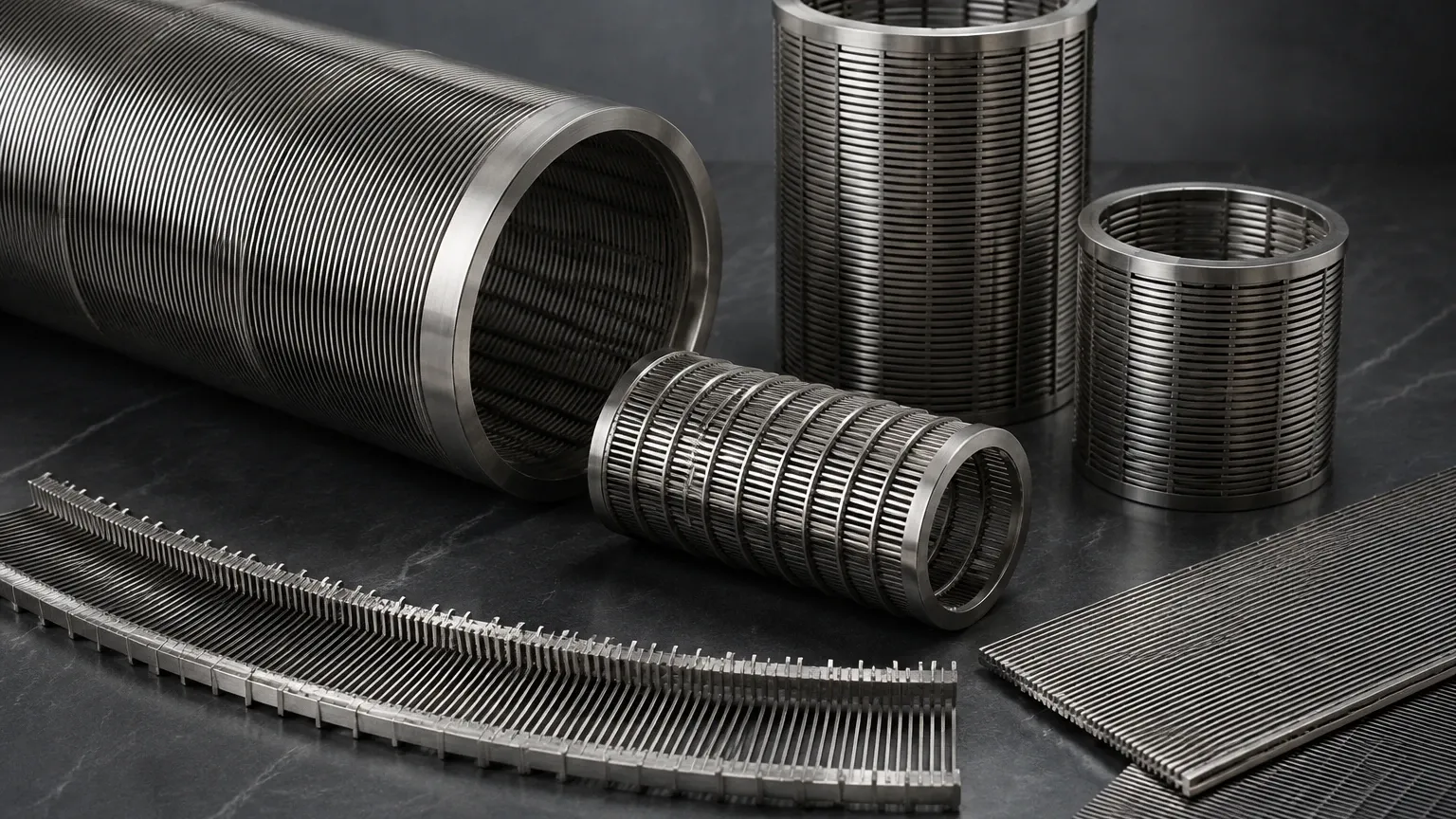
Stainless Steel Wedge Wire Screens
In industrial filtration and separation, the efficiency of a process often hinges on the mechanical integrity and precision of the filter media. Among the various solutions available, stainless steel wedge wire screens have established themselves as a critical component for demanding applications. These screens, characterized by their unique V-shaped profile wire, offer a combination of high strength, precise slot openings, and non-clogging characteristics that standard woven wire mesh or perforated plates often cannot match. For engineers and procurement teams, understanding the technical nuances of these components is essential for optimizing filtration performance and reducing long-term operational costs.
The Engineering Principles of Wedge Wire Screens
At the core of the Wedge Wire Screens design is the V-shaped profile wire, which is resistance-welded onto support rods at each intersection. This construction creates a continuous slot that widens inwardly. This geometry is the primary reason for the screen's superior performance in solid-liquid separation.
When particles pass through the screen, they only encounter two points of contact on the leading edges of the V-wire. If a particle is small enough to pass the initial aperture, it will easily clear the widening gap behind it. In contrast, square-edged or mesh-based filters often trap near-sized particles within the depth of the media, leading to progressive blinding and increased pressure drops. By eliminating these entrapment points, wedge wire ensures a more consistent flow rate and facilitates easier cleaning through backwashing or mechanical scraping.
Material Selection: Why Stainless Steel is Standard
While wedge wire can be manufactured from various alloys, stainless steel remains the industry standard due to its mechanical properties and resistance to environmental degradation. Kaifil utilizes high-grade alloys to ensure that the filtration components can withstand the chemical and thermal stresses of industrial processing.
1. Grade 304 Stainless Steel: This is the most common choice for general industrial applications. It provides excellent strength and good corrosion resistance for water treatment, food processing, and general filtration where high concentrations of chlorides or acids are not present.
2. Grade 316L Stainless Steel: For more aggressive environments, such as chemical processing or marine applications, 316L is preferred. The addition of molybdenum enhances resistance to pitting and crevice corrosion, particularly in chloride-rich environments. The "L" (low carbon) designation is crucial for welded structures like wedge wire screens, as it prevents carbide precipitation during the welding process, maintaining the integrity of the joints.
3. Duplex and Special Alloys: In extreme conditions involving high pressure, high temperatures, or highly corrosive slurries, duplex stainless steels may be employed to provide superior yield strength and stress-corrosion cracking resistance.
Design and Flow Configurations
The versatility of stainless steel wedge wire screens allows them to be fabricated into various shapes, including flat panels, curved sieve bends, and cylindrical cartridges. The direction of flow is a critical engineering consideration that must be defined during the design phase:
* Flow-Out-To-In (FOTI): The filtration occurs on the exterior surface, with the filtrate moving toward the center of the cylinder. This is common in intake screens and well screens.
* Flow-In-To-Out (FITO): The process fluid enters the center of the screen, and solids are captured on the internal surface. This configuration is often used in screw press separators and internal-fed rotary screens.
Beyond flow direction, the orientation of the surface wires—whether they run axially (parallel to the length of the cylinder) or radially (wrapped around the circumference)—affects how solids move across the screen and how cleaning mechanisms, such as internal brushes or scrapers, interact with the surface.
Key Performance Metrics for Engineers
When selecting Wedge Wire Screens for a specific project, engineers must evaluate several technical parameters to ensure the component meets the application's hydraulic and mechanical requirements.
1. Slot Size and Tolerance
Slot sizes can range from as small as 20 microns to several millimeters. The precision of these slots is vital for maintaining the cut-point of the filtration process. In high-precision applications, such as catalyst recovery or fine chemical filtration, maintaining a tight tolerance across the entire surface area of the screen is necessary to prevent the loss of valuable media or the passage of contaminants.
2. Open Area Calculation
The percentage of open area determines the capacity and pressure drop of the screen. It is calculated based on the slot width (S) and the wire width (W) using the formula:
`Open Area % = (S / (S + W)) x 100`
While a larger open area reduces the initial pressure drop and increases flow capacity, it must be balanced against the mechanical strength required to withstand the differential pressure across the screen.
3. Mechanical Load and Collapse Strength
In hydraulic and high-pressure systems, the screen must resist deformation. The strength of the screen is a function of the profile wire size, the support rod spacing, and the material's yield strength. For deep-well applications or high-viscosity filtration, reinforced support structures are often integrated into the design to prevent collapse under extreme differential pressures.
Industrial Applications and Use Cases
Because of their durability and customization options, stainless steel wedge wire screens are utilized across a broad spectrum of industries:
* Water Treatment and Intake: Used in river and sea intake systems to protect pumps and downstream equipment from debris while maintaining low approach velocities to protect aquatic life.
* Food and Beverage Processing: Ideal for sugar refining, starch production, and brewery mash tuns. The smooth, stainless steel surface meets stringent hygiene standards and allows for effective Clean-In-Place (CIP) cycles.
* Pulp and Paper: Essential for fiber recovery, dewatering, and fractionating processes where high-volume throughput and resistance to abrasion are required.
* Mining and Aggregates: Used in vibratory screens and sieve bends for dewatering and sizing minerals. The high impact resistance of stainless steel ensures a longer service life compared to synthetic media.
* Chemical and Petrochemical: Employed in reactor internals, such as center pipes and basket strainers, to retain catalyst beds while allowing the free flow of gases or liquids.
Customization and OEM Capabilities
No two industrial filtration challenges are identical. Kaifil specializes in providing customized filtration solutions that address specific operational constraints. This includes tailoring the wire profile to optimize the balance between wear life and filtration accuracy, as well as designing custom end fittings (flanges, threaded connectors, or reinforced rings) for seamless integration into existing equipment.
When partnering with an OEM manufacturer, engineers should provide detailed process data, including:
* Fluid viscosity and density.
* Particle size distribution and concentration.
* Operating temperature and pressure.
* Chemical composition of the process fluid.
* Cleaning methods (backwash, mechanical, or chemical).
Maintenance and Longevity
The total cost of ownership for stainless steel wedge wire screens is often lower than cheaper alternatives due to their extended service life and reduced maintenance requirements. However, longevity depends on proper sizing and cleaning protocols.
Regular inspection for signs of erosion or mechanical damage is recommended, especially in abrasive slurry applications. Because the screens are made of robust stainless steel, they can often be cleaned using high-pressure water jets or ultrasonic baths without damaging the slot integrity. If the screen is used in a self-cleaning filter system, the alignment of the scraper or brush must be checked periodically to ensure uniform contact and prevent localized wear.
Conclusion
Selecting the right filtration media is a balance of physics, metallurgy, and mechanical engineering. Stainless steel wedge wire screens provide a high-performance solution for industries that cannot afford frequent downtime or filtration failures. By leveraging the non-clogging V-wire design and the inherent strengths of stainless steel, facilities can achieve precise separation, high flow rates, and a durable filtration infrastructure.
For engineers seeking to optimize their systems, consulting with a specialized manufacturer like Kaifil ensures that every aspect of the screen—from alloy selection to slot tolerance—is engineered for the specific demands of the application. Whether for water intake, chemical processing, or food production, the right wedge wire configuration is a foundational element of process efficiency.