


Wedge Wire Johnson Screen
In the field of industrial liquid-solid separation, the wedge wire johnson screen represents a pinnacle of engineering efficiency. Often referred to simply as a Johnson screen or V-wire screen, this component is utilized across diverse sectors including water treatment, petrochemical processing, mining, and food production. Unlike traditional woven wire mesh or perforated plates, the wedge wire structure provides a unique combination of high open area, mechanical strength, and non-clogging characteristics that are essential for continuous industrial processes.
For engineers and procurement professionals, understanding the technical nuances of Wedge Wire Screens is critical for optimizing system performance and reducing long-term maintenance costs. This guide explores the structural mechanics, material considerations, and application-specific selection criteria for these essential filtration components.
Understanding the Engineering Behind Wedge Wire Technology
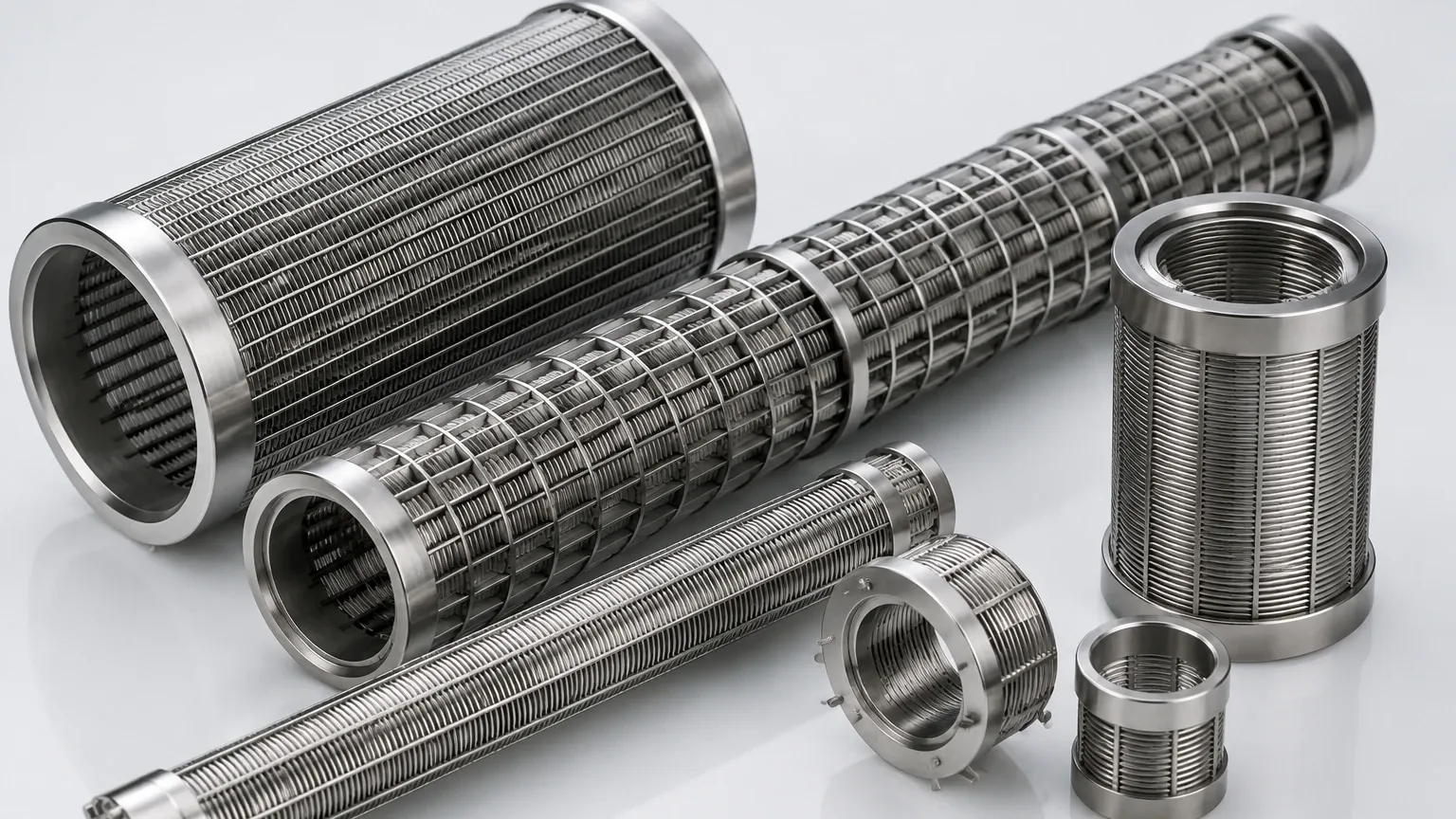
The fundamental design of a wedge wire johnson screen consists of two primary elements: the surface profile wire and the internal support rods. These components are joined using an advanced resistance welding process that creates a high-strength, integral structure.
The profile wire is typically V-shaped or "wedge" shaped. During the manufacturing process, this wire is wrapped around a series of longitudinal support rods. At every intersection where the wire meets a rod, a fusion weld is made. This creates a continuous slot that maintains precise tolerances throughout the length of the screen.
One of the most significant engineering features of this design is the orientation of the V-shaped wire. The widest part of the wedge faces the exterior (the filtration surface), while the narrow part tapers inward. This geometry ensures that any particle small enough to pass through the initial slot opening will continue to move freely through the widening gap, rather than becoming wedged or trapped within the screen media. This "self-cleaning" geometry is the primary reason why Wedge Wire Screens are preferred for high-viscosity fluids or applications with high particle loads.
Key Advantages of the V-Wire Profile in Industrial Filtration
When evaluating filtration media, engineers must balance flow rates against filtration accuracy. The wedge wire johnson screen offers several distinct advantages over alternative technologies:
1. Non-Clogging Surface
The V-shaped profile creates a two-point contact between the particle and the slot. Because the opening widens inwardly, particles that enter the slot are easily flushed through by the fluid flow or during backwashing cycles. This minimizes "blinding" or "pegging," which are common failure modes in woven mesh filters.
2. High Open Area
Because the slot is continuous rather than interrupted by cross-weaves or solid plate sections, wedge wire provides a significantly higher percentage of open area. This translates to lower pressure drops across the filter and higher flow capacities for a given surface area. In practical terms, this allows for smaller equipment footprints or higher throughput in existing systems.
3. Structural Integrity and Durability
The resistance-welded construction makes the screen exceptionally robust. It can withstand high differential pressures and mechanical stresses that would cause woven mesh to deform or tear. This durability is particularly important in high-pressure hydraulic systems and heavy-duty mining applications.
4. Precise Slot Tolerances
Modern manufacturing techniques allow for extremely tight slot tolerances, often down to 20 or 25 microns. This precision ensures consistent filtration performance and reliable particle retention, which is critical in pharmaceutical and food-grade applications.
Material Selection for Corrosive and High-Temperature Environments
The performance of a wedge wire johnson screen is heavily dependent on the metallurgy used. Industrial environments often involve exposure to corrosive chemicals, extreme temperatures, and abrasive materials.
* Stainless Steel 304: The standard choice for general industrial applications, offering good corrosion resistance and mechanical strength at a cost-effective price point.
* Stainless Steel 316L: Preferred for marine environments, chemical processing, and pharmaceutical applications. The addition of molybdenum provides superior resistance to pitting and crevice corrosion, particularly in chloride-rich environments.
* Duplex Stainless Steels: Used in highly demanding applications such as oil and gas or deep-sea water intakes. Duplex steels offer nearly double the yield strength of standard austenitic steels and exceptional resistance to stress corrosion cracking.
* Specialty Alloys: For extreme conditions, alloys like Monel, Hastelloy, or 904L may be specified to handle highly acidic or alkaline process streams.
When selecting a material, engineers must consider the pH levels, temperature fluctuations, and the presence of abrasive solids in the process fluid. Kaifil specializes in custom stainless steel filtration solutions, ensuring that the material grade matches the specific chemical compatibility requirements of the project.
Technical Specifications and Manufacturing Standards
To specify a wedge wire johnson screen correctly, several technical parameters must be defined. These specifications directly impact the mechanical load-bearing capacity and the hydraulic efficiency of the screen.
Slot Size (Aperture)
The slot size is the distance between the widest points of the adjacent profile wires. This is typically measured in millimeters or microns. The choice of slot size is determined by the particle size distribution (PSD) of the solids to be removed. As a general rule, the slot size should be smaller than the smallest particle intended for retention, though in some "cake filtration" applications, the slot may be slightly larger than the particles, relying on the buildup of solids to perform the actual filtration.
Profile Wire and Support Rod Dimensions
The size of the V-wire (width and height) and the diameter/shape of the support rods determine the screen's collapse strength and burst strength. In deep-well applications or high-pressure reactors, heavier wire profiles and more frequent support rod spacing are necessary to prevent structural failure under load.
Flow Direction
Wedge wire screens can be engineered for two types of flow:
1. FOTI (Flow Out-To-In): The filtration occurs on the exterior surface, and the filtrate moves toward the center. This is common in cylindrical cartridges.
2. FITO (Flow In-To-Out): The filtration occurs on the interior surface. This is often used in rotary screens or centrifugal separators where solids are collected on the inside and moved toward an outlet.
Primary Industrial Applications for Johnson-Type Screens
The versatility of the wedge wire johnson screen makes it a staple in numerous industries. Each application requires specific design modifications to handle unique process variables.
Water Well and Geothermal Applications
In water well construction, these screens serve as the primary intake point. They prevent sand and silt from entering the pump while allowing water to flow freely. The high open area reduces the entrance velocity of the water, which minimizes encrustation and corrosion rates, significantly extending the life of the well.
Food and Beverage Processing
In the brewing industry, wedge wire is used for lauter tun false bottoms. The precise slots allow for efficient wort drainage while retaining the grain bed. Similarly, in the sugar industry, these screens are used for juice filtration and centrifugal separation. The stainless steel construction ensures compliance with strict hygiene and food safety standards.
Petrochemical and Refining
Refineries utilize wedge wire for reactor internals, such as center pipes, outer baskets, and support grids. These components must withstand extreme temperatures and catalytic environments. The mechanical rigidity of the welded wedge wire ensures that the catalyst bed remains stable and that flow distribution is uniform across the reactor.
Mineral Processing and Mining
Sieve bends and vibrating screens utilize wedge wire for dewatering and sizing ores. The abrasive nature of mining requires thick profile wires and specialized hardened alloys to resist wear. The non-clogging nature of the V-wire is essential here to prevent the screen from becoming blinded by damp or sticky minerals.
Maintenance, Cleaning, and Longevity Considerations
One of the primary drivers for the total cost of ownership (TCO) in filtration is the frequency and difficulty of cleaning. The wedge wire johnson screen is designed for ease of maintenance.
In many automated systems, backwashing or back-pulsing is used to clean the screen. Because of the inward-widening slots, the reverse flow of fluid or air easily dislodges accumulated debris. In manual systems, the smooth surface of the V-wires allows for easy mechanical cleaning with brushes or scrapers without damaging the filtration media.
Engineers should also consider the replacement cycle. While the initial cost of a stainless steel wedge wire screen may be higher than that of disposable polymer filters or woven mesh, the extended service life—often spanning several years or even decades—results in a lower lifecycle cost. The durability of the welded structure reduces the risk of bypass leaks, which can protect expensive downstream equipment like high-pressure pumps or membranes.
Engineering Selection Guide: Confirming Specifications Before Purchase
When partnering with a manufacturer like Kaifil for custom filtration solutions, providing detailed application data is essential for an optimized design. Engineers should confirm the following before finalizing a purchase order:
1. Fluid Characteristics: What is the viscosity, density, and temperature of the fluid? This affects the pressure drop calculations.
2. Solid Loading: What is the concentration of solids, and what is their particle size distribution? This determines the required slot size and total screen area.
3. Mechanical Loads: What is the maximum expected differential pressure? Does the screen need to support the weight of a catalyst or grain bed?
4. Cleaning Method: Will the screen be cleaned via backwashing, ultrasonic cleaning, or manual scraping? This may influence the choice of wire profile and surface finish.
5. Connection Types: Does the application require standard NPT/BSP threads, flanges, or custom end fittings for OEM integration?
By addressing these technical variables, purchasing teams can ensure they receive a wedge wire johnson screen that is perfectly matched to their operational requirements. Kaifil’s expertise in material selection and precision manufacturing provides the reliability needed for demanding industrial environments, ensuring that filtration systems operate at peak efficiency with minimal downtime.
