


Wedge Wire Screen Basket
In industrial filtration and separation processes, the efficiency of a system often hinges on the mechanical integrity and precision of the filter media. The wedge wire screen basket is a specialized component engineered to handle high-volume solids separation, dewatering, and classification. Unlike traditional woven wire mesh or perforated plates, these baskets utilize a unique V-shaped profile wire that offers distinct advantages in terms of throughput, durability, and resistance to blinding.
As a core component in centrifuges, starch extractors, and chemical reactors, the selection of a wedge wire screen basket requires a deep understanding of fluid dynamics, material science, and mechanical stress. This guide examines the engineering principles, selection criteria, and operational considerations necessary for optimizing industrial filtration performance using Wedge Wire Screens.
Engineering Principles of Wedge Wire Construction
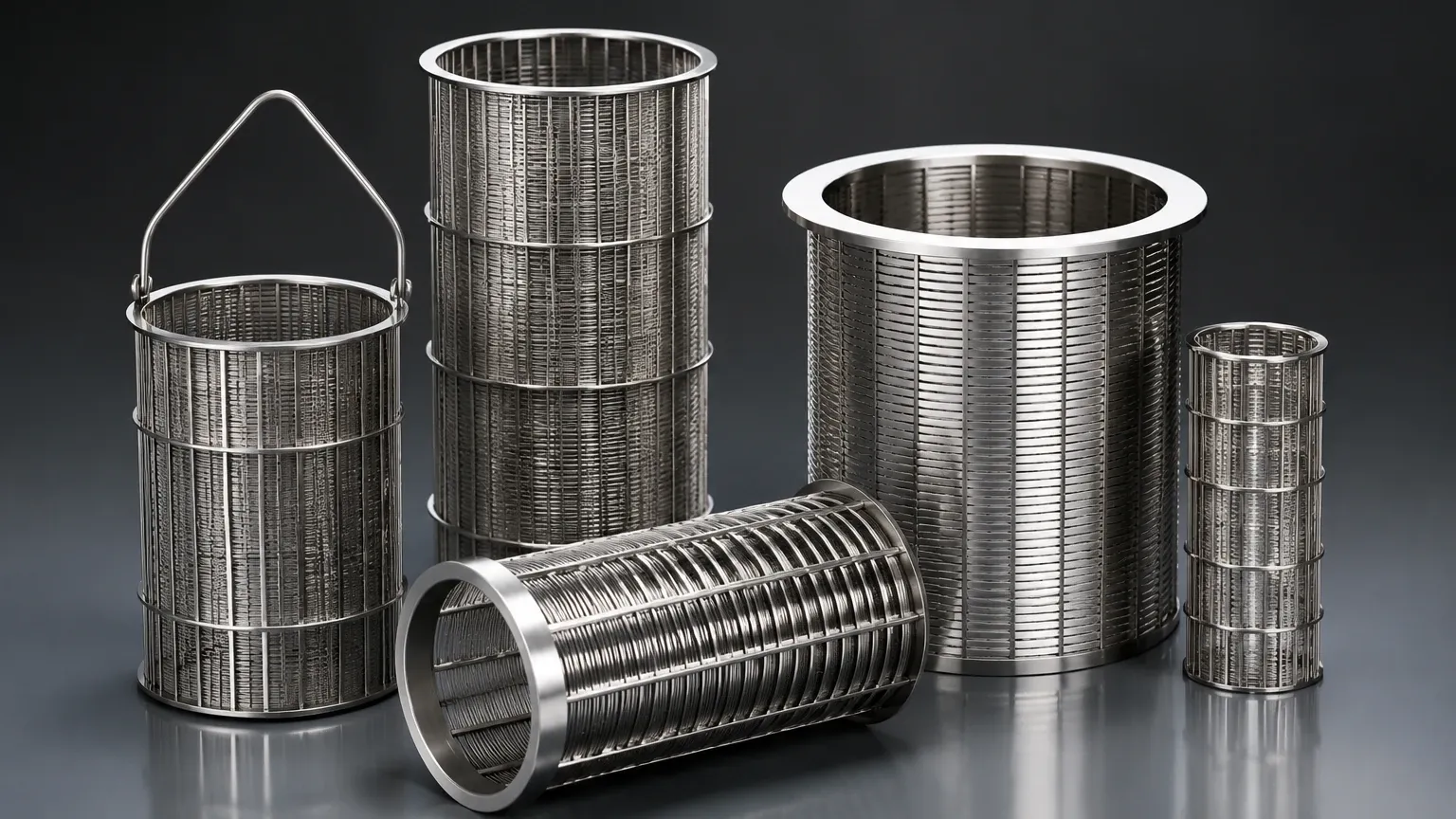
The fundamental advantage of a wedge wire screen basket lies in its construction. It is manufactured by wrapping a continuous profile wire around longitudinal support rods. At every point where the profile wire intersects a support rod, it is fusion-welded using advanced resistance welding techniques. This creates a rigid, one-piece structure that can withstand significant mechanical loads without the risk of wire shifting or mesh deformation.
The V-Wire Profile
The "wedge" or V-shaped profile is the defining feature of this technology. The wire is oriented so that the widest part of the V faces the incoming flow. This creates a slot that narrows at the surface but widens inwardly. In practice, this means that any particle small enough to pass through the initial slot opening will continue through the screen without getting lodged. This "two-point contact" design effectively eliminates blinding and clogging, which are common failure modes in woven mesh filters.
Structural Support Rods
The support rods provide the primary structural framework for the basket. Depending on the application, these rods can be round, rectangular, or even specialized teardrop shapes. The spacing and diameter of the support rods determine the basket's ability to handle pressure differentials and centrifugal forces. In high-speed centrifuge applications, the density of support rods is increased to prevent the basket from deforming under extreme G-forces.
Key Performance Factors for Screen Baskets
When evaluating a wedge wire screen basket for a specific industrial process, engineers must look beyond simple dimensions. Performance is dictated by a combination of slot precision, flow direction, and mechanical reinforcements.
Slot Opening Precision
The slot opening (or aperture) is the distance between adjacent profile wires. In precision manufacturing, these slots can be as small as 20 microns or as large as several millimeters. Maintaining a consistent slot width across the entire surface of the basket is critical for ensuring uniform particle retention. Inconsistent slots lead to "oversize" particles passing through, which can contaminate the filtrate or damage downstream equipment.
Flow Direction Dynamics
Wedge wire baskets are designed for two primary flow patterns:
1. Flow-In-To-Out (FITO): The fluid enters the center of the basket and is forced outward. The V-profile wire is typically welded to the outside of the support rods, with the flat side of the wire facing inward.
2. Flow-Out-To-In (FOTI): The fluid moves from the exterior toward the center. Here, the V-profile is usually on the inside of the support rods, or the rods are external to the wire wrap.
Selecting the correct flow direction is essential for effective cake formation and automated cleaning cycles, such as backwashing or mechanical scraping.
Open Area Calculations
The percentage of open area determines the flow capacity and pressure drop across the screen. While a larger open area reduces the pressure required to move fluid through the basket, it may compromise the mechanical strength of the wire. Engineering a wedge wire screen basket involves balancing the wire width and slot size to achieve the highest possible throughput without sacrificing the structural integrity needed for the operating environment.
Material Selection and Chemical Compatibility
Industrial filtration often occurs in aggressive environments involving corrosive chemicals, high temperatures, or abrasive slurries. The choice of material for a wedge wire screen basket is a primary factor in its service life.
Stainless Steel Grades
* Grade 304/304L: The standard choice for general industrial applications, providing good corrosion resistance and mechanical strength at a cost-effective price point.
* Grade 316/316L: Contains molybdenum, which provides superior resistance to chlorides and pitting. This is the preferred material for pharmaceutical, food and beverage, and marine applications.
* Duplex Stainless Steels: Used in highly corrosive or high-stress environments, such as oil and gas processing or heavy chemical manufacturing. Duplex steels offer higher yield strength and better resistance to stress corrosion cracking than standard austenitic grades.
Surface Treatments
To further enhance performance, baskets can undergo various surface treatments. Electropolishing is frequently used in the food and pharmaceutical industries to create a microscopically smooth surface. This reduces the adhesion of organic materials, making the basket easier to clean and sterilize. Hard chrome plating or tungsten carbide coatings may be applied to the leading edges of the wire in abrasive applications, such as coal dewatering or mineral processing, to extend the wear life of the profile.
Customization Options for Industrial Applications
A wedge wire screen basket is rarely a stand-alone component; it must integrate seamlessly into complex machinery. Customization is often necessary to meet the mechanical requirements of the housing and the operational demands of the process.
Reinforcing Rings and Flanges
In high-pressure or high-RPM environments, standard welding may not be sufficient. Reinforcing rings (also known as stiffening rings) are welded to the exterior of the basket to provide additional hoop strength. Flanges, machined to precise tolerances, are added to the ends of the basket to ensure a leak-proof seal within the filter housing. These flanges can be designed with specialized bolt patterns, O-ring grooves, or lifting handles for easier maintenance.
Conical vs. Cylindrical Geometries
While many baskets are cylindrical, conical wedge wire baskets are common in centrifugal separators. The taper of a conical basket helps facilitate the movement of solids toward the discharge end as the basket spins. Engineering the precise angle of the cone is vital for controlling the "residence time" of the material on the screen, which directly impacts the dryness of the final solid product.
Application-Specific Considerations
The versatility of the wedge wire screen basket makes it a staple in several major industries, each with its own set of technical requirements.
Food and Beverage Processing
In starch extraction and sugar refining, baskets must handle high flow rates of viscous liquids while maintaining strict hygiene standards. The continuous slot design of wedge wire prevents the buildup of organic fibers that would quickly clog a traditional mesh screen. Furthermore, the robust nature of stainless steel allows for frequent Clean-In-Place (CIP) cycles using caustic chemicals and high-temperature steam.
Wastewater and Water Treatment
Wedge wire baskets are used in intake screens and sludge dewatering. In these applications, the primary concern is the removal of inorganic debris and the concentration of solids. The high mechanical strength of the wedge wire allows the basket to withstand the weight of heavy sludge and the torque of mechanical scrapers used to clear the screen surface.
Chemical and Petrochemical Industries
In catalyst recovery and resin traps, the precision of the slot opening is paramount. Losing catalyst material due to a screen failure can result in significant financial losses. Wedge wire baskets provide a reliable barrier that can operate under high temperatures and pressures while resisting the corrosive nature of hydrocarbon processing.
Maintenance, Cleaning, and Replacement Cycles
Even the most robust wedge wire screen basket will eventually require maintenance. Understanding the factors that lead to wear can help engineers predict replacement cycles and minimize unscheduled downtime.
Identifying Wear Patterns
In abrasive applications, the V-profile wire will gradually wear down. As the top of the "V" erodes, the slot opening will technically become wider, leading to a loss of filtration precision. Regular inspections should include measuring the slot width at multiple points around the basket. If the slots have widened beyond the allowable tolerance for the process, the basket must be replaced to maintain product quality.
Cleaning Methodologies
One of the greatest operational benefits of wedge wire is its ease of cleaning. Common methods include:
* Backwashing: Reversing the flow of fluid to push particles out of the slots.
* Mechanical Scraping: A blade or brush moves across the surface of the wires to remove accumulated cake.
* Ultrasonic Cleaning: For baskets used in fine filtration (under 100 microns), ultrasonic baths can remove microscopic particles trapped in the interstices of the welds.
Total Cost of Ownership (TCO)
While the initial cost of a wedge wire screen basket is higher than that of a disposable filter or a simple woven mesh, the TCO is often much lower. The durability of the welded stainless steel construction, combined with the ability to clean and reuse the basket multiple times, results in fewer replacements and lower labor costs over the life of the equipment.
Conclusion: Selecting the Right Solution
Choosing the optimal wedge wire screen basket is a technical decision that impacts the efficiency, purity, and profitability of an industrial process. Engineers must carefully weigh the trade-offs between slot size, open area, and structural reinforcement while ensuring the material composition is compatible with the chemical environment.
By utilizing the inherent advantages of Wedge Wire Screens, facilities can achieve a level of separation precision and mechanical reliability that other filter media simply cannot match. Whether for dewatering minerals, extracting starch, or protecting sensitive downstream pumps, a well-engineered wedge wire basket stands as a critical investment in operational excellence.
