


Engineering Guide to Metal Mesh Filter Cartridges in Industrial Filtration
In industrial process engineering, the selection of filtration media is a critical decision that impacts product purity, equipment longevity, and operational overhead. Among the various options available, the metal mesh filter cartridge stands out as a robust, reusable, and highly precise solution for demanding environments. Unlike polymer-based disposable filters, these stainless steel components are engineered to withstand extreme temperatures, high differential pressures, and aggressive chemical exposures.
For engineers and procurement specialists, understanding the technical nuances of Wire Mesh Filter Cylinders & Tubes is essential for optimizing system performance. This guide explores the engineering principles, material specifications, and selection criteria necessary for implementing high-performance metal filtration solutions.
1. Technical Fundamentals of Metal Mesh Filtration
The primary function of a metal mesh filter cartridge is to remove solid contaminants from a fluid or gas stream through mechanical straining. This is typically achieved via surface filtration, where particles larger than the mesh openings are trapped on the upstream side of the media.
Surface vs. Depth Filtration
While some sintered metal filters offer depth filtration characteristics, standard wire mesh designs primarily utilize surface filtration. This provides a distinct advantage in terms of cleanability. Because the contaminants are captured on the surface, they can be more easily removed through backwashing or ultrasonic cleaning compared to fibrous depth media where particles become embedded within the matrix.
The Role of Wire Diameter and Aperture
The performance of a metal mesh filter cartridge is defined by two geometric factors: wire diameter and aperture (pore size). The relationship between these two determines the "open area" percentage, which directly correlates to the flow capacity and pressure drop across the filter. Engineers must balance the need for a fine micron rating with the requirement for structural integrity; thinner wires allow for finer apertures but may require additional reinforcement to prevent deformation under high-pressure loads.
2. Material Engineering and Chemical Compatibility
Material selection is the most significant factor in determining the service life of industrial filters. Kaifil utilizes high-grade stainless steel alloys to ensure durability in diverse industrial settings.
* AISI 304 Stainless Steel: The standard choice for general industrial applications. It offers excellent strength and basic corrosion resistance, making it suitable for water treatment, hydraulic oils, and non-acidic food processing.
* AISI 316L Stainless Steel: For more demanding environments, 316L is the preferred alloy. The addition of molybdenum provides enhanced resistance to pitting and crevice corrosion, particularly in chloride-rich environments. The "L" denotes low carbon content, which is vital for components that require welding, as it prevents carbide precipitation and maintains corrosion resistance at the weld seams.
* Specialty Alloys: In extreme cases involving high-temperature oxidation or highly concentrated acids, alloys such as Monel, Inconel, or Hastelloy may be specified. These materials ensure that the metal mesh filter cartridge maintains its mechanical properties at temperatures exceeding 500°C.
3. Understanding Mesh Weave Patterns
The performance characteristics of Wire Mesh Filter Cylinders & Tubes are largely dictated by the weave pattern employed during manufacturing. Each weave offers a different balance of filtration accuracy and mechanical strength.
Plain Weave
This is the most common and straightforward weave, where each warp wire crosses over and under each shute wire. It provides a high open area and a predictable pore size, making it ideal for simple straining and high-flow applications.
Twill Weave
In a twill weave, each wire passes over two and under two wires. This allows for the use of heavier wires for a given mesh count, resulting in a more robust filter media that can handle higher mechanical stresses without sacrificing filtration fineness.
Dutch Weave (Plain and Twill)
Dutch weaves utilize different diameters for warp and shute wires. The result is a dense, firm mesh with relatively small openings and high strength. Plain Dutch weave is excellent for high-pressure filtration, while Twill Dutch weave allows for the finest micron ratings (down to 5-10 microns) by creating a tortuous path for the fluid, providing a degree of depth filtration.
4. Structural Design: Cylinders, Tubes, and Reinforcement
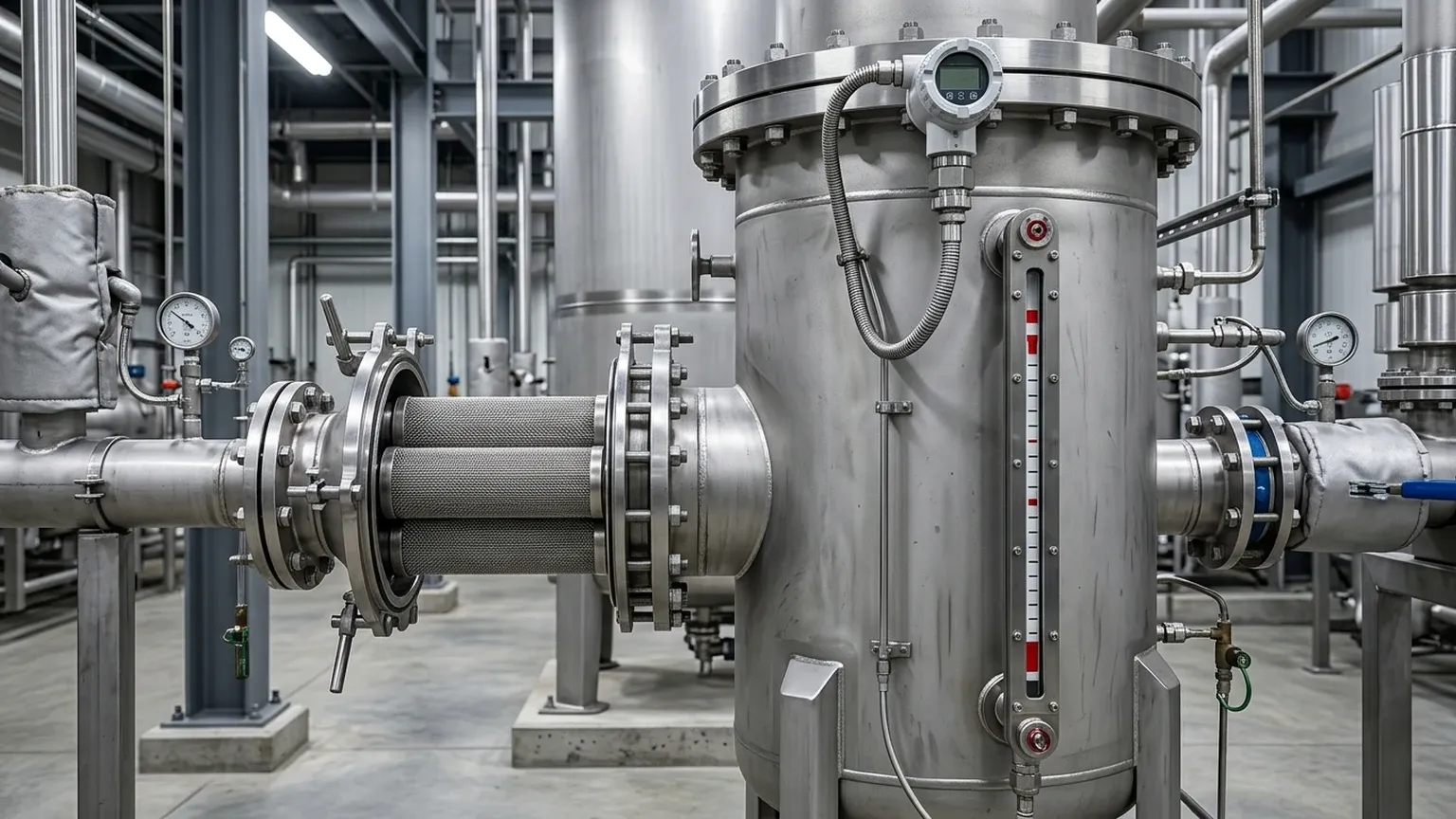
Industrial filtration often involves high-velocity flows and pressure surges. A standalone layer of fine wire mesh is rarely sufficient to withstand these forces. Therefore, the construction of Wire Mesh Filter Cylinders & Tubes involves several layers of reinforcement.
The Perforated Core
Most metal mesh filter cartridges feature an internal support core made of perforated stainless steel. This core provides the primary structural rigidity, preventing the mesh from collapsing under the differential pressure (ΔP) generated as the filter becomes loaded with contaminants.
Pleated vs. Cylindrical Designs
* Cylindrical: Simple, smooth-walled cylinders are easy to clean and ideal for high-viscosity fluids or applications with low solids loading.
* Pleated: By pleating the mesh media, the effective filtration area (EFA) is significantly increased—often by 2 to 4 times compared to a cylindrical design of the same dimensions. This results in lower initial pressure drops, higher dirt-holding capacity, and longer intervals between cleaning cycles.
End Cap Configurations
To ensure a bypass-free seal within the filter housing, various end cap styles are available, including:
* Double Open End (DOE): Requires gaskets at both ends to seal against the housing seats.
* Single Open End (SOE): Often features O-ring seals (e.g., Code 7/226 or Code 3/222) at one end and a closed cap or fin at the other, providing a more secure, leak-proof interface for critical applications.
5. Performance Metrics and Selection Criteria
When specifying a metal mesh filter cartridge, engineers must evaluate several performance metrics to ensure the component is fit for purpose.
Micron Rating: Absolute vs. Nominal
* Nominal Rating: Refers to an approximate pore size where a high percentage (typically 60-90%) of particles of a specific size are retained.
* Absolute Rating: The diameter of the largest hard spherical particle that will pass through the filter under specified test conditions. For critical pharmaceutical or chemical processes, absolute-rated mesh is mandatory to guarantee process consistency.
Differential Pressure (ΔP) and Flow Rate
The "clean" pressure drop is the resistance the filter offers to the fluid flow when it is first installed. As the filter captures debris, the ΔP increases. Engineers must calculate the maximum allowable ΔP before the filter requires cleaning. Exceeding this limit can result in "media migration" or structural failure of the mesh.
Viscosity Considerations
The viscosity of the fluid significantly impacts the flow rate through a metal mesh filter cartridge. High-viscosity fluids (like resins or heavy oils) require larger surface areas and coarser mesh to maintain acceptable throughput without excessive pressure buildup.
6. Cleaning Protocols and Maintenance
One of the primary economic drivers for choosing a stainless steel metal mesh filter cartridge is its reusability. Proper maintenance is key to achieving a low total cost of ownership (TCO).
Backwashing and Backpulsing
In automated systems, a portion of the filtered fluid is directed in the reverse direction through the mesh to dislodge the filter cake. This is highly effective for surface-loading wire mesh.
Ultrasonic Cleaning
For fine Dutch weaves or filters used with sticky contaminants, ultrasonic cleaning is the gold standard. High-frequency sound waves create cavitation bubbles that implode on the mesh surface, removing microscopic particles from within the weave that mechanical backwashing might miss.
Chemical Cleaning
In industries like food and beverage or chemical processing, filters may be soaked in caustic or acidic solutions to dissolve organic buildup or mineral scales. The inherent chemical resistance of 316L stainless steel allows for aggressive CIP (Clean-In-Place) cycles that would destroy synthetic filters.
7. Procurement Checklist for Engineers
To receive an accurate quote and a high-performing product, purchasing teams should provide the following technical data to the manufacturer:
1. Fluid Characteristics: Type of fluid, temperature, viscosity, and chemical composition.
2. Contaminant Profile: Type of solids, particle size distribution, and concentration (ppm).
3. Operating Parameters: Maximum flow rate, operating pressure, and maximum allowable differential pressure.
4. Dimensional Requirements: Overall length, outside diameter (OD), and inside diameter (ID).
5. Connection Type: DOE, SOE (with specific O-ring code), or custom threaded fittings.
6. Certification Needs: Requirements for FDA compliance, material traceability (MTRs), or pressure vessel codes.
Conclusion
The metal mesh filter cartridge represents a sophisticated intersection of metallurgy and fluid dynamics. By moving away from disposable media and toward engineered stainless steel solutions, industrial facilities can achieve higher filtration precision, better thermal stability, and a significantly reduced environmental footprint through reusability.
Whether the application involves protecting high-pressure hydraulic valves, ensuring the clarity of pharmaceutical intermediates, or filtering steam in food production, the correct specification of wire mesh filters is foundational to process reliability. By focusing on material grade, weave geometry, and structural reinforcement, engineers can ensure their filtration systems deliver consistent performance in the most demanding industrial environments.
