


Engineering Precision in Industrial Coffee Extraction: A Guide to Metal Mesh Filtration
In the industrial food and beverage sector, the efficiency of extraction processes directly impacts product consistency, yield, and operational costs. For large-scale coffee processing—ranging from the production of liquid concentrates and instant coffee to high-volume commercial brewing—the choice of filtration media is a critical engineering decision. While paper and polymer-based filters are common in consumer applications, industrial-scale metal mesh filter coffee systems rely on the structural integrity and precise pore geometry of stainless steel components.
Selecting the appropriate filtration hardware requires a deep understanding of fluid dynamics, material science, and the specific chemical properties of the medium being processed. This guide examines the technical considerations for integrating Wire Mesh Filter Cylinders & Tubes into industrial extraction equipment, focusing on performance optimization and long-term durability.
1. The Mechanics of Metal Mesh in Coffee Extraction
Industrial coffee extraction is a complex process involving the separation of soluble solids and aromatic oils from ground coffee beans. Unlike disposable media, metal mesh filters act as a permanent, high-precision barrier that can be engineered to specific micron ratings. The primary function of the mesh in this context is to allow the passage of water and dissolved compounds while retaining insoluble particulates (fines) that can lead to sediment or over-extraction bitterness.
Surface vs. Depth Filtration
In most industrial coffee applications, wire mesh provides surface filtration. The particulates are trapped on the surface of the mesh, forming a "filter cake" that can actually assist in the filtration process until the pressure drop becomes too high. Because the mesh is a single or multi-layer metallic structure, it does not absorb the essential oils (lipids) that contribute to the mouthfeel and flavor profile of the coffee—a significant technical advantage over paper media which often strips these compounds from the extract.
Flow Dynamics and Pressure Management
Engineers must balance the filtration fineness with the required flow rate. A tighter weave (lower micron rating) provides clearer extract but increases the resistance to flow, requiring higher pump pressure. In large-scale systems, the use of metal mesh filter coffee components allows for high-pressure extraction (such as in industrial espresso or concentrated extract production) without the risk of media rupture or bypass common with non-metallic alternatives.
2. Material Engineering: Stainless Steel Standards
For industrial filtration, material selection is dictated by both mechanical requirements and regulatory compliance (such as FDA or EHEDG standards for food contact materials). Kaifil utilizes high-grade stainless steel to ensure that filtration components can withstand the rigorous environment of a processing plant.
304 vs. 316L Stainless Steel
* Grade 304: This is the standard for most food-grade applications, offering excellent strength and basic corrosion resistance. It is suitable for general brewing applications where the cleaning agents are not overly aggressive.
* Grade 316L: For industrial environments where Clean-in-Place (CIP) systems use harsh caustic or acidic chemicals, 316L is preferred. The addition of molybdenum provides superior resistance to pitting and chloride-induced corrosion. Furthermore, 316L is highly resistant to the organic acids naturally present in coffee, which can be surprisingly corrosive over thousands of cycles at high temperatures.
Thermal Stability
Coffee extraction typically occurs at temperatures between 90°C and 96°C, though some industrial processes involve even higher temperatures for rapid extraction. Stainless steel maintains its structural dimensions and mechanical properties across this range, ensuring that the pore size of the Wire Mesh Filter Cylinders & Tubes remains constant, preventing "media migration" or bypass during thermal expansion.
3. Design and Configuration of Filter Cylinders and Tubes
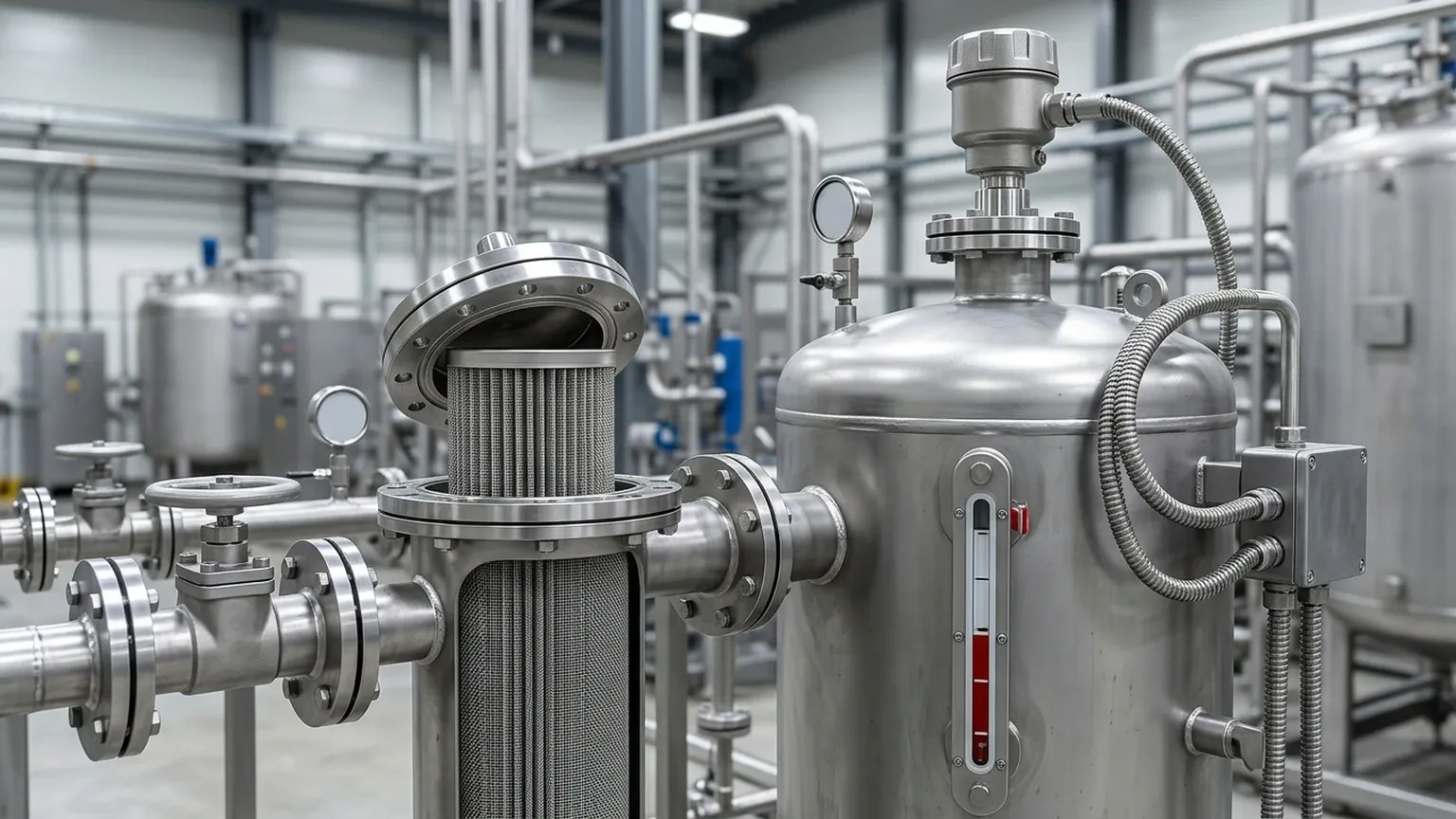
In B2B industrial applications, a filter is rarely a simple sheet of mesh. It is a complex assembly designed to fit into a pressurized vessel or a continuous flow system. The architecture of the filter component is essential for maintaining high throughput.
Structural Reinforcement
Fine wire mesh lacks the structural rigidity to withstand high differential pressures on its own. Consequently, industrial filter cylinders often feature a multi-layer construction:
1. The Filtration Layer: The innermost or outermost layer, depending on the flow direction, which determines the micron rating.
2. Support Layer: A coarser mesh or perforated metal core that provides the necessary mechanical strength to prevent the fine mesh from collapsing or bursting under pressure.
3. Protective Shroud: In some designs, an outer perforated sleeve protects the mesh from mechanical damage during installation or cleaning.
Weave Types and Micron Ratings
The choice of weave—Plain, Twill, or Dutch Weave—determines the particulate retention capability. For industrial coffee applications, micron ratings typically range from 50 to 150 microns. A 100-micron mesh is often the "sweet spot" for commercial extraction, providing a clean cup while allowing for high flow rates and efficient cleaning. Customization allows engineers to specify the exact weave that matches their specific grind size distribution.
4. Operational Performance and Maintenance
The total cost of ownership (TCO) of an industrial filtration system is heavily influenced by the ease of maintenance and the lifespan of the filter media. Metal mesh filters offer a distinct advantage in sustainability and long-term cost-efficiency.
Clean-in-Place (CIP) Compatibility
In a B2B production environment, downtime is a major cost driver. Stainless steel filters are designed for CIP systems, where they can be backflushed with high-pressure water or treated with chemical cleaners without removing them from the production line. The rigidity of the metal mesh filter coffee components ensures they do not deform during high-pressure backwashing, which is essential for dislodging trapped fines and oils.
Ultrasonic Cleaning and Regeneration
Over time, coffee oils and micro-fines can accumulate within the mesh intersections, leading to a gradual increase in baseline pressure. Unlike disposable filters, stainless steel cylinders can be periodically removed and cleaned in an ultrasonic bath. This process uses high-frequency sound waves to create cavitation bubbles that penetrate deep into the mesh weave, effectively regenerating the filter to near-original performance levels.
Durability and Replacement Cycles
While the initial investment in a custom stainless steel filter is higher than disposable alternatives, the lifespan of a well-maintained Kaifil filter can span several years. This reduces the logistical burden of managing filter inventory and significantly lowers the waste footprint of the facility.
5. Technical Selection Criteria for Industrial Buyers
When specifying Wire Mesh Filter Cylinders & Tubes for an industrial project, procurement teams and engineers should provide the following technical parameters to ensure the solution is fit for purpose:
* Micron Rating (Absolute vs. Nominal): Define the maximum particle size allowed to pass through the filter. For coffee, this is usually based on the grind profile used in the extraction equipment.
* Flow Rate and Pressure Drop: Specify the required liters per minute (LPM) and the maximum allowable pressure drop across the filter when clean. This helps determine the necessary surface area of the cylinder.
* Mechanical Dimensions: Precise measurements for length, outer diameter (OD), and inner diameter (ID) are required, along with any specific end-cap configurations (e.g., threaded, flanged, or O-ring seals).
* Operating Environment: Provide details on the maximum operating temperature and the chemical composition of cleaning agents to ensure correct material grade selection.
* Flow Direction: Indicate whether the flow is from "inside-to-outside" or "outside-to-inside." This dictates where the support structure should be placed relative to the filtration mesh.
6. The Role of Customization in OEM Applications
Every industrial coffee extraction system has unique requirements based on the desired final product—whether it is a cold brew concentrate, a spray-dried powder, or a ready-to-drink (RTD) beverage. Standard off-the-shelf filters often fail to meet the specific pressure and flow requirements of proprietary extraction technologies.
As a specialist manufacturer, Kaifil provides OEM solutions that allow equipment designers to integrate filtration directly into their machine architecture. This includes custom end-fitting designs, specialized welding techniques (such as plasma or TIG welding) to ensure smooth, crevice-free joints that prevent bacterial growth, and varying layers of mesh to achieve specific filtration gradients. By collaborating during the design phase, engineers can optimize the filter geometry to maximize the available surface area within a limited footprint, thereby extending the time between cleaning cycles.
Conclusion
In the competitive landscape of industrial coffee processing, the transition to metal mesh filter coffee systems represents a move toward greater precision, sustainability, and process control. By utilizing high-performance Wire Mesh Filter Cylinders & Tubes, facilities can achieve superior extraction results while minimizing operational downtime. Understanding the technical nuances of stainless steel grades, weave types, and structural reinforcements is essential for any engineer tasked with optimizing filtration performance in a B2B environment. With the right specification and quality manufacturing, metal mesh filters provide a reliable, long-term solution for the most demanding industrial extraction applications.
