


Metal Mesh Filter Rangehood: An Engineering Guide to Industrial Grease and Mist Extraction
In industrial and commercial environments, the management of airborne grease, oil mist, and particulate matter is a critical safety and operational requirement. The metal mesh filter rangehood serves as the primary line of defense in exhaust systems, protecting downstream ductwork, fans, and the environment from accumulation that can lead to fire hazards or mechanical failure. For engineers and procurement professionals, selecting the correct filtration component involves a deep understanding of material science, fluid dynamics, and long-term maintenance cycles.
While residential rangehoods often prioritize aesthetics, industrial-grade metal mesh filters are engineered for high-volume airflow and extreme durability. These components are typically constructed from multiple layers of woven wire mesh or expanded metal, designed to maximize surface area while maintaining manageable pressure drops. This guide examines the technical specifications and selection criteria essential for integrating high-performance metal mesh filters into industrial exhaust systems.
1. Operating Principles: The Mechanics of Inertial Impingement
The effectiveness of a metal mesh filter rangehood relies on the principle of inertial impingement. As grease-laden air or industrial mist is drawn through the filter, the air stream is forced to change direction rapidly as it navigates the labyrinthine path created by the overlapping layers of wire mesh.
Because grease droplets and oil particles have more mass and momentum than the surrounding air, they cannot change direction as quickly. Consequently, these particles collide with the wire surfaces. Once they strike the metal, they adhere to the surface and begin to coalesce into larger droplets. Eventually, gravity pulls these accumulated fluids down into a collection trough or grease cup.
For engineers, the challenge is balancing the "tortuous path" required for high capture efficiency with the need for low static pressure. A filter that is too dense will capture more grease but will also require a more powerful (and expensive) fan motor to maintain the required Cubic Feet per Minute (CFM) of airflow.
2. Material Selection: Stainless Steel vs. Aluminum
In the B2B industrial sector, material selection is dictated by the chemical composition of the exhaust and the operating temperature.
Stainless Steel (304 and 316)
Stainless steel is the industry standard for demanding applications. Grade 304 offers excellent corrosion resistance and can withstand the high temperatures found in commercial kitchens and industrial heat-processing zones. For environments involving high salinity or corrosive chemical vapors (such as in pharmaceutical or chemical processing), Grade 316 is preferred due to its added molybdenum content, which provides superior resistance to pitting and chloride-induced corrosion.
Aluminum
Aluminum filters are lightweight and cost-effective for light-duty commercial applications. However, they are generally avoided in heavy industrial settings because they are prone to oxidation when exposed to harsh cleaning chemicals and have a lower melting point, which can be a liability in the event of a flash fire within the exhaust hood.
3. Structural Design and Configuration
Industrial filtration requirements often extend beyond standard flat-panel rangehood filters. Depending on the geometry of the exhaust system and the volume of air being processed, engineers may specify different structural formats.
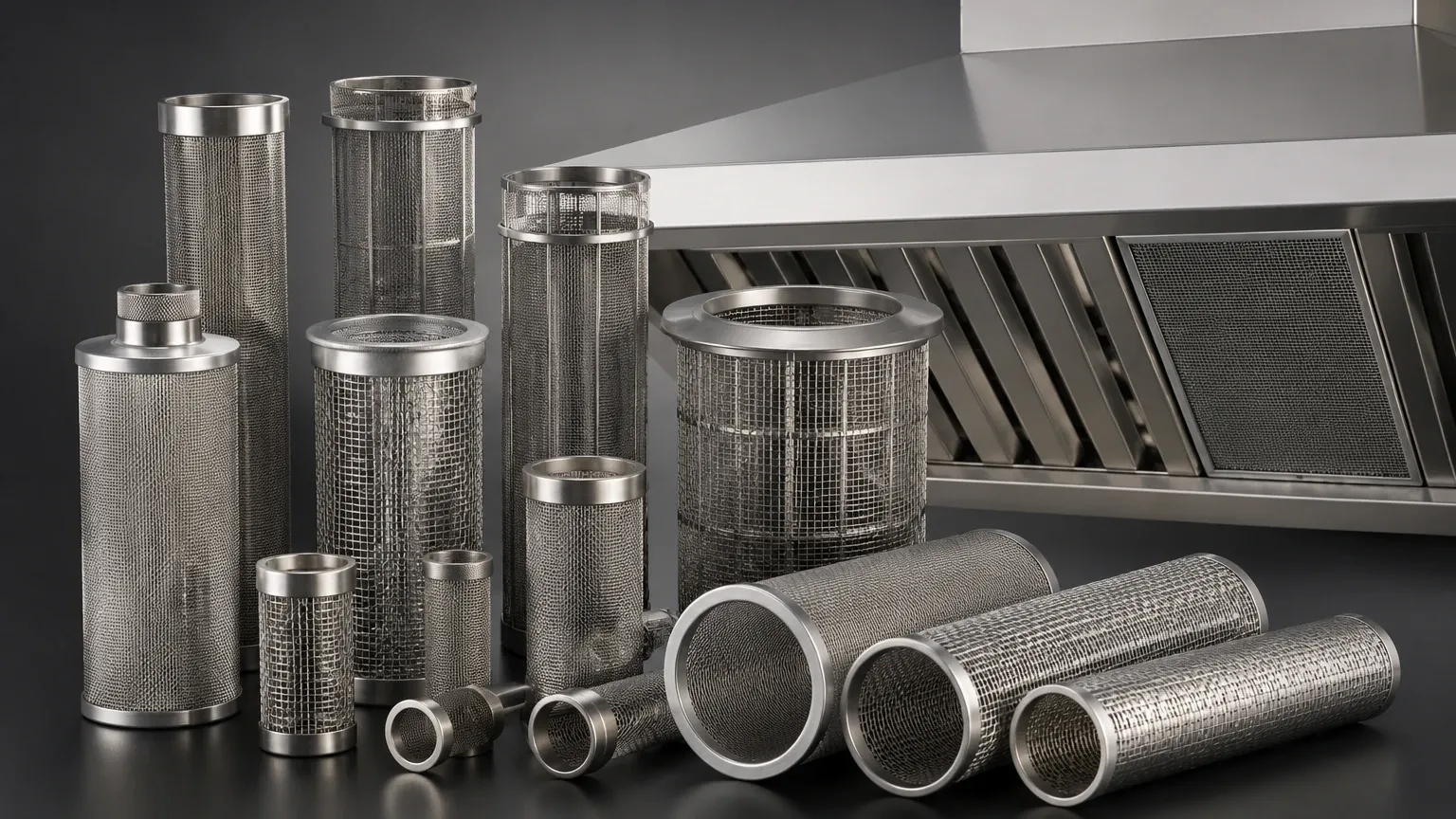
While flat panels are common in standard hoods, specialized industrial scrubbers and mist eliminators often utilize Wire Mesh Filter Cylinders & Tubes to provide a larger surface area within a compact footprint. These cylindrical designs allow for 360-degree airflow, which can significantly reduce the face velocity of the air, leading to higher capture rates of fine oil mists and reduced turbulence.
When specifying a metal mesh filter rangehood component, the following structural elements must be considered:
* Layer Count: Most industrial filters range from 3 to 7 layers of mesh. Increasing the layers improves filtration efficiency but increases air resistance.
* Mesh Weave: Plain weave is common, but twill or Dutch weaves may be used for precision applications where specific micron ratings are required.
* Frame Construction: A rigid, heavy-duty frame (often 1.0mm to 2.0mm thick) is essential to prevent the filter from vibrating or bypassing air under high-pressure loads.
4. Performance Metrics: Efficiency, Airflow, and Pressure Drop
For a technical buyer, the performance of a metal mesh filter is quantified by its pressure drop curve and its arrestance efficiency.
Static Pressure Drop
Static pressure drop refers to the resistance the filter offers to the airflow. It is measured in inches of water gauge (in. WG) or Pascals (Pa). In a B2B procurement scenario, it is vital to request the pressure drop data at the specific face velocity of your system (e.g., 500 FPM). A filter that exhibits a high initial pressure drop will lead to increased energy consumption over the life of the HVAC system.
Filtration Efficiency
Unlike HEPA filters, which are rated by micron size, metal mesh rangehood filters are often evaluated by their ability to remove a percentage of grease by weight. High-quality stainless steel mesh filters can achieve over 90% grease extraction efficiency when properly sized for the airflow. For specialized industrial mists, engineers may look for filters capable of capturing particles in the 5 to 10-micron range.
5. Customization and OEM Considerations
Industrial equipment often features non-standard dimensions or unique mounting requirements. Off-the-shelf filters rarely meet the needs of a custom-engineered exhaust hood.
When working with a manufacturer like Kaifil, customization options include:
* Dimensional Precision: Custom length, width, and thickness to ensure a bypass-free fit within the hood tracks.
* Handle and Drain Options: Integration of stainless steel handles for easy removal and drain holes to facilitate grease runoff.
* Variable Density: Designing filters with gradient density (coarser mesh on the intake side, finer mesh on the exhaust side) to prevent premature surface loading and extend the time between cleanings.
6. Maintenance and Total Cost of Ownership (TCO)
One of the primary advantages of a metal mesh filter rangehood over disposable alternatives is the significantly lower Total Cost of Ownership. While the initial capital expenditure for stainless steel filters is higher, their lifespan can extend to several years, or even decades, with proper care.
Cleaning Cycles
In high-volume environments, filters may need to be cleaned daily or weekly. Stainless steel mesh is highly resilient to the caustic degreasers and high-pressure hot water washes required to remove carbonized grease. Unlike aluminum, which can turn black and brittle when exposed to strong alkaline cleaners, stainless steel maintains its structural integrity and filtration performance.
Replacement Indicators
Engineers should monitor for two primary signs of failure:
1. Physical Deformation: If the mesh layers become separated or the frame is warped, air will bypass the filtration media, leading to grease accumulation in the ducts.
2. Permanent Clogging: If carbonized grease cannot be removed through standard cleaning, the static pressure will remain high, straining the exhaust fans.
7. Procurement Checklist: What International Buyers Should Confirm
Before finalizing a purchase order for industrial mesh filters, technical teams should verify the following specifications with the supplier:
1. Material Certification: Ensure the stainless steel meets ASTM or equivalent international standards for Grade 304 or 316.
2. Weld Quality: In high-vibration environments, spot welds or TIG welds on the frame must be robust to prevent structural failure.
3. Airflow Testing: Request data on pressure drop vs. face velocity to ensure compatibility with existing fan curves.
4. Compliance: Verify if the filters meet local fire safety and sanitation standards (such as UL 1046 or NSF standards for food-grade environments).
Conclusion
The selection of a metal mesh filter rangehood is a critical engineering decision that impacts the safety, efficiency, and maintenance costs of industrial facilities. By focusing on high-quality materials like stainless steel and considering advanced geometries such as cylindrical tubes for specialized applications, firms can ensure long-term performance in even the most demanding environments. Whether the application is a commercial kitchen, a CNC machining center with oil mist, or a chemical processing lab, the right wire mesh solution provides a reliable, cleanable, and cost-effective barrier against airborne contaminants.
