


In industrial processing, the efficiency of a filtration system is often measured by its ability to maintain consistent output quality while minimizing operational downtime and replacement costs. The metal mesh reusable filter has emerged as a standard solution for engineers seeking to replace high-volume disposable cartridges with permanent, cleanable components. Unlike polymer-based or paper filters, these stainless steel elements provide the mechanical strength and thermal resistance required for demanding environments in chemical processing, food production, and hydraulic systems.
Selecting the appropriate filtration media involves more than just identifying a micron rating. It requires an understanding of fluid dynamics, material science, and the specific structural requirements of the application. This guide examines the engineering principles behind Wire Mesh Filter Cylinders & Tubes and provides a technical framework for evaluating their performance in industrial settings.
Engineering Principles of Metal Mesh Reusable Filters
A metal mesh reusable filter operates primarily on the principle of surface filtration. Solid particles larger than the mesh openings are intercepted at the surface of the media, forming a filter cake that can, in some instances, further refine the filtration process before it is removed during cleaning.
The performance of these filters is dictated by the weave pattern and the wire diameter. Common weave types include:
* Plain Weave: The most straightforward construction where each warp wire crosses over and under each weft wire. This provides high flow rates and is ideal for coarse filtration.
* Twill Weave: Each warp wire passes over and under two weft wires, allowing for heavier wire diameters and increased strength for a given mesh count.
* Dutch Weave (Plain and Twill): These weaves use different diameters for warp and weft wires, resulting in a dense, multi-layered structure. Dutch weaves offer superior pressure resistance and are capable of achieving much finer micron ratings (down to 5-10 microns) compared to standard plain weaves.
For industrial buyers, the choice between these weaves depends on the balance between required filtration accuracy and the permissible pressure drop across the element.
Structural Design: Wire Mesh Filter Cylinders & Tubes
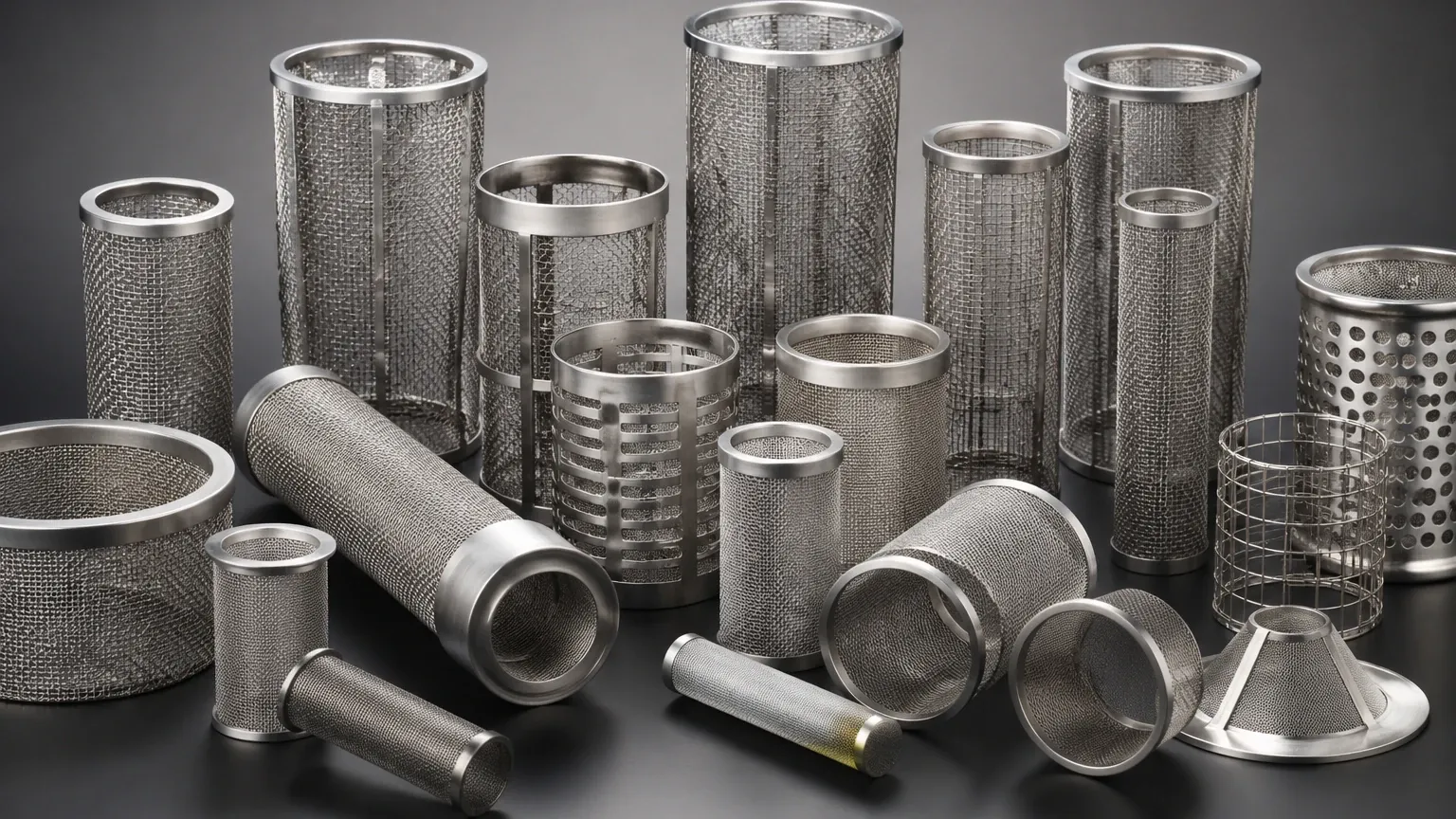
The physical configuration of the filter element is critical for its integration into existing housing and its ability to withstand operational stresses. Wire Mesh Filter Cylinders & Tubes are the most common geometries used in industrial liquid and gas filtration.
Single-Layer vs. Multi-Layer Construction
Single-layer cylinders are cost-effective and easy to clean, making them suitable for low-pressure applications or as primary strainers. However, for high-pressure systems or fine filtration, multi-layer structures are often required.
In multi-layer designs, the filtration mesh is supported by coarser mesh layers or perforated metal cores. This prevents the fine mesh from deforming under the force of the fluid flow. Sintering—a process where multiple layers of mesh are bonded together using heat and pressure without the use of binders—is frequently employed to create a monolithic structure. Sintered wire mesh tubes offer exceptional mechanical stability and precise pore size distribution, ensuring that the filter maintains its integrity even under backwashing or high-differential pressure conditions.
Customization and End Fittings
To ensure a leak-proof seal within a filter housing, the cylinders must be equipped with appropriate end fittings. Common options include:
* Threaded Connectors (NPT/BSP): For secure, high-pressure attachments.
* Flanges: Used in large-scale piping systems for ease of removal.
* Double Open End (DOE) or Single Open End (SOE): Standard configurations for cartridge-style housings, often featuring O-ring seals (EPDM, Viton, or PTFE) to prevent bypass.
Material Selection and Chemical Compatibility
The primary advantage of a metal mesh reusable filter is its material durability. Kaifil typically utilizes austenitic stainless steels, which provide a broad range of chemical resistance and thermal stability.
1. AISI 304 Stainless Steel: The standard choice for general industrial applications, offering good corrosion resistance and mechanical properties at a lower cost point. It is widely used in water treatment and general manufacturing.
2. AISI 316L Stainless Steel: Contains molybdenum, which significantly enhances resistance to pitting and crevice corrosion in chloride-rich environments. The "L" denotes low carbon content, which improves weldability and prevents intergranular corrosion. This is the preferred material for pharmaceutical and chemical processing.
3. Specialty Alloys: In extreme environments involving highly acidic or alkaline fluids, alloys such as Hastelloy, Inconel, or Monel may be used to ensure the filter does not degrade or contaminate the process stream.
Engineers must also consider the temperature range of the application. Stainless steel filters can typically operate from cryogenic temperatures up to 600°C (1112°F), depending on the specific alloy and the presence of any non-metallic seals.
Performance Evaluation: Flow Rate and Pressure Drop
When specifying a metal mesh reusable filter, the relationship between flow rate and pressure drop ($ΔP$) is a primary engineering concern. An undersized filter will lead to high initial pressure drops, reduced flow capacity, and frequent cleaning cycles.
Factors Influencing Pressure Drop
* Open Area Percentage: This is the ratio of the total area of the holes to the total area of the mesh. A higher open area results in lower resistance to flow.
* Fluid Viscosity: Higher viscosity fluids require larger surface areas or coarser mesh to maintain acceptable flow rates.
* Contaminant Loading: As particles accumulate on the surface, the effective open area decreases, causing the pressure drop to rise exponentially.
To optimize performance, it is often recommended to design the system so that the initial clean pressure drop does not exceed 2-3 PSI (0.14-0.21 bar). This provides sufficient "headroom" for the filter to operate as it begins to capture solids.
Cleaning Protocols and Life Cycle Management
The "reusable" nature of these filters is their most significant value proposition. However, the effectiveness of a metal mesh reusable filter depends on the implementation of proper cleaning protocols. Unlike disposable media, which are discarded when the terminal pressure drop is reached, metal filters are restored to near-original performance through various methods:
* Backwashing/Backpulsing: Reversing the flow of the fluid to dislodge particles from the surface of the mesh. This is often automated in continuous process systems.
* Ultrasonic Cleaning: Utilizing high-frequency sound waves in a cleaning solvent to create cavitation bubbles. These bubbles implode on the mesh surface, removing deeply embedded particles that backwashing might miss.
* Chemical Cleaning: Using acids, alkalis, or surfactants to dissolve organic or inorganic scaling. This is particularly effective in food and beverage applications where protein buildup or mineral scaling occurs.
* Burn-off/Thermal Cleaning: In applications involving polymers or resins, the filter may be placed in a controlled-vacuum oven to carbonize the contaminants, which are then removed via ultrasonic cleaning.
Establishing a regular cleaning schedule based on pressure drop triggers is essential for extending the service life of the filter and ensuring consistent product quality.
Industrial Applications and Selection Criteria
Wire Mesh Filter Cylinders & Tubes are utilized across a diverse spectrum of industries, each with unique technical requirements:
Chemical and Petrochemical Processing
In these sectors, filters must withstand aggressive solvents and high temperatures. They are used for catalyst recovery, monomer filtration, and protecting downstream equipment like pumps and valves from particulate damage.
Food and Beverage Production
Filters in this industry must meet stringent hygienic standards. Stainless steel is the material of choice due to its non-leaching properties and ability to withstand Clean-in-Place (CIP) procedures. Applications include the filtration of syrups, edible oils, and beverages to remove yeast or carbon fines.
Hydraulic and Lubrication Systems
Precision metal filters protect sensitive hydraulic components from wear-inducing particles. The high collapse strength of sintered metal mesh is particularly valuable in systems subject to high-pressure spikes.
Economic Analysis: Reusable vs. Disposable Filtration
While the initial capital expenditure (CAPEX) for a stainless steel metal mesh reusable filter is higher than that of a disposable polypropylene or glass fiber cartridge, the total cost of ownership (TCO) is often significantly lower over the long term.
Cost Factors to Consider:
1. Replacement Frequency: Disposable filters may require replacement every few days or weeks, leading to high recurring procurement costs.
2. Disposal Costs: Spent disposable cartridges often constitute hazardous waste, requiring expensive disposal procedures. Metal filters eliminate this waste stream.
3. Labor and Downtime: Each filter change-out requires system shutdown and manual labor. The longevity of metal filters reduces the frequency of these interventions.
4. Product Loss: Disposable filters often retain a significant volume of process fluid (holdup volume) which is lost during replacement. Metal filters can be drained more effectively.
For most industrial processes, the ROI on switching to reusable metal filtration is realized within 12 to 24 months, depending on the contaminant load and the cost of the disposable media being replaced.
Procurement Checklist for Engineers
Before finalizing a purchase order for Wire Mesh Filter Cylinders & Tubes, procurement teams and engineers should confirm the following technical specifications with the manufacturer:
* Micron Rating: Specify whether the requirement is for nominal (approximate) or absolute (99.9% efficiency) filtration.
* Operating Conditions: Provide maximum operating pressure, normal operating temperature, and potential pressure spikes.
* Fluid Characteristics: Note the viscosity, pH level, and chemical composition of the fluid.
* Dimensional Constraints: Confirm the outer diameter (OD), inner diameter (ID), and overall length (OAL) to ensure fitment in existing housings.
* Structural Integrity: Determine if an internal support core or external cage is necessary based on the expected differential pressure.
* Compliance Requirements: Specify if the filter needs to meet FDA, 3A, or other industry-specific certifications.
By addressing these factors during the design and selection phase, industrial operators can ensure they receive a filtration solution that provides reliable, long-term performance in demanding environments.
