


Engineering Guide to Metal Mesh Filter Sheet and Industrial Component Selection
In the landscape of industrial process engineering, the selection of filtration media is a critical factor determining system efficiency, product purity, and equipment longevity. At the core of many high-performance filtration systems is the metal mesh filter sheet, a versatile and robust medium designed to withstand the rigors of chemical processing, pharmaceutical manufacturing, and heavy industrial applications. Unlike polymer-based filters, metal mesh provides a unique combination of thermal stability, mechanical strength, and precise pore geometry that is essential for demanding environments.
Understanding the technical nuances of these sheets—from their metallurgical composition to their weave architecture—is vital for engineers and procurement teams tasked with optimizing filtration performance. This guide explores the fundamental principles of metal mesh filtration, the criteria for selecting the appropriate specifications, and the practical considerations for integrating these components into complex industrial systems.
1. Material Science and Metallurgical Considerations
The performance of a metal mesh filter sheet begins with its material composition. In industrial settings, stainless steel is the standard due to its inherent resistance to oxidation and corrosion. However, the specific grade of stainless steel must be matched to the operating environment.
* AISI 304/304L: This is the most common grade for general-purpose filtration. It offers excellent strength and good corrosion resistance for water treatment and food-grade applications. The "L" designation indicates low carbon content, which improves weldability and prevents sensitization during the fabrication of filter components.
* AISI 316/316L: Incorporating molybdenum, 316-grade stainless steel provides significantly higher resistance to chlorides and pitting. This makes it the preferred choice for marine environments, chemical processing, and pharmaceutical applications where aggressive cleaning agents are used.
* Specialty Alloys: For extreme conditions involving high-temperature sulfuric acid or high-pressure steam, engineers may specify Monel, Inconel, or Hastelloy. These alloys maintain structural integrity at temperatures exceeding 500°C and offer superior resistance to specific chemical catalysts.
Beyond chemical compatibility, the mechanical properties of the wire—such as tensile strength and ductility—dictate how the sheet will behave during the forming process when it is converted into Wire Mesh Filter Cylinders & Tubes.
2. Weave Architecture and Filtration Mechanics
The geometry of the weave determines the filtration accuracy (micron rating) and the flow characteristics of the medium. There are several primary weave types used in industrial filter sheets, each serving a distinct functional purpose:
Plain Weave and Twill Weave
Plain weave is the simplest structure, where each warp wire crosses over and under each shute wire. This results in square openings and is ideal for high-flow applications where precise particle retention is less critical than low pressure drop. Twill weave allows for thicker wires in a given mesh count, providing increased durability for heavier loads.
Dutch Weave (Plain and Twill)
Dutch weaves utilize a larger diameter warp wire and a smaller diameter shute wire, woven closely together to create a dense, "tortuous path" for the fluid. Plain Dutch weaves offer high mechanical strength and are excellent for high-pressure filtration. Twill Dutch weaves can achieve even finer filtration ratings, often down to 5–10 microns, by overlapping multiple shute wires to create a wedge-shaped opening.
Sintered Metal Mesh
For applications requiring maximum structural stability, multiple layers of metal mesh filter sheet are diffusion-bonded through a process called sintering. This creates a monolithic structure that will not migrate or fray under high pressure or backpulsing. Sintered mesh is the gold standard for high-viscosity fluids and high-pressure hydraulic systems.
3. Transforming Sheets into Wire Mesh Filter Cylinders & Tubes
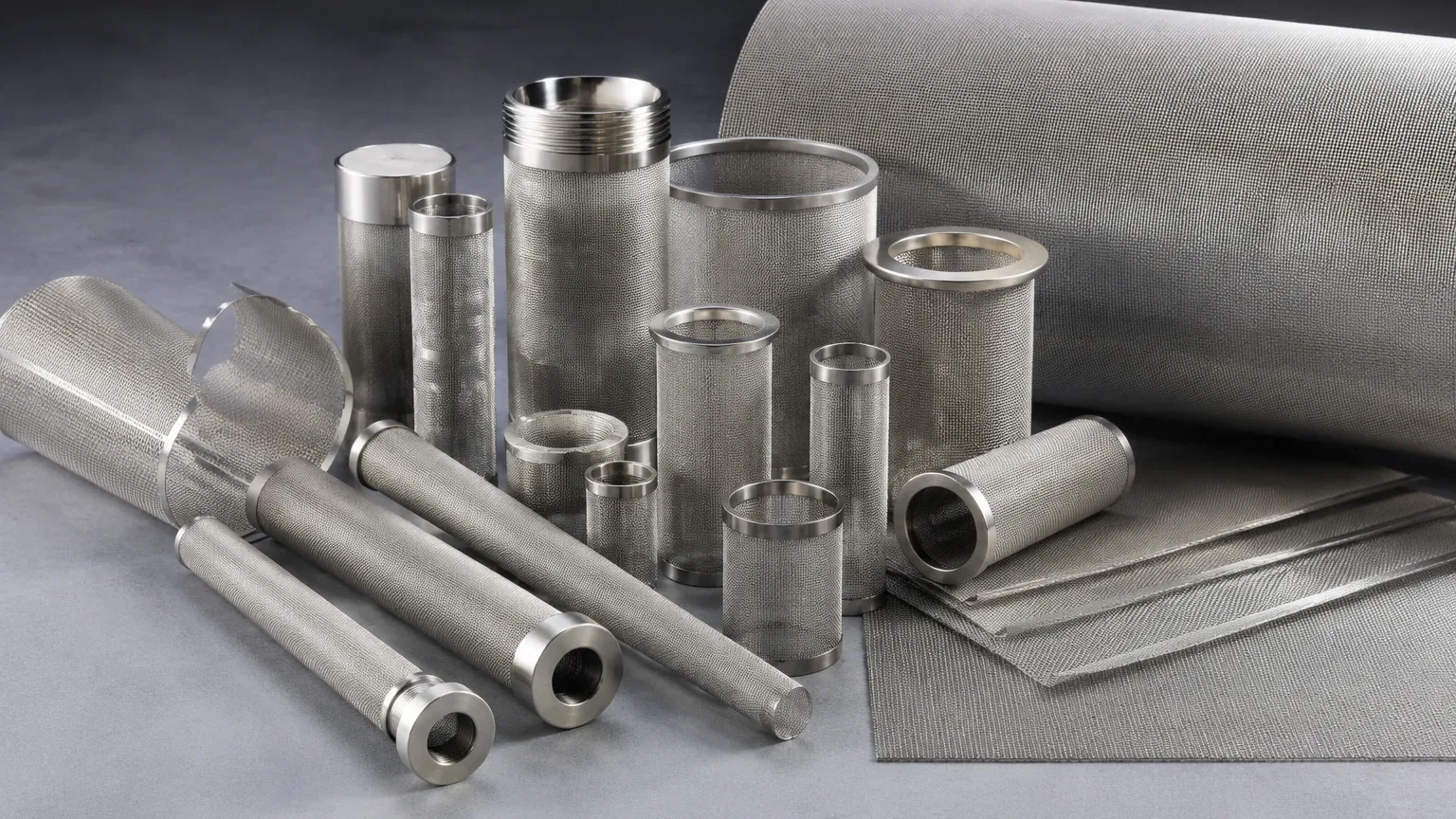
While flat sheets are used in some tray filters and strainers, the majority of industrial applications require the mesh to be fabricated into three-dimensional components. The transition from a metal mesh filter sheet to Wire Mesh Filter Cylinders & Tubes involves precision engineering to ensure the integrity of the filtration surface.
Fabrication Techniques
The fabrication process typically involves rolling the mesh into a cylindrical shape and joining the edges via longitudinal welding. In high-precision environments, plasma or TIG (Tungsten Inert Gas) welding is used to ensure a clean, burr-free seam that matches the parent material's corrosion resistance. For multi-layer filters, resistance spot welding may be used to secure the mesh to an internal perforated support core.
Structural Reinforcement
Because metal mesh is inherently flexible, cylinders and tubes often require internal or external support to prevent collapse under differential pressure. Perforated metal cores or outer cages are integrated into the design, providing the necessary rigidity while maintaining maximum open area for fluid passage. The selection of the support structure must account for the direction of flow (outside-in vs. inside-out) to ensure the mesh is supported against the force of the fluid.
4. Selection Criteria: Micron Rating and Flow Dynamics
When specifying a filter component, engineers must balance the need for fine filtration with the requirement for adequate flow rates. Two key metrics define this balance:
Absolute vs. Nominal Micron Rating
* Nominal Rating: This indicates the ability of the filter to retain a major percentage (usually 60% to 90%) of particles of a specific size. It is a useful guide for general strainers but lacks the precision required for critical processes.
* Absolute Rating: This refers to the diameter of the largest hard spherical particle that will pass through the filter under specified test conditions. For pharmaceutical or high-purity chemical applications, an absolute rating is mandatory to ensure process consistency.
Pressure Drop (ΔP)
The resistance to flow across a metal mesh filter sheet results in a pressure drop. As the filter accumulates contaminants (the "filter cake"), this pressure drop increases. Engineers must calculate the initial clean pressure drop to ensure the pump system has sufficient head. If the mesh is too fine, the system will reach its terminal pressure drop too quickly, leading to frequent downtime for cleaning.
5. Installation, Sealing, and Integration Constraints
A high-quality filter element is only effective if it is properly sealed within its housing. Bypass—where fluid flows around the filter rather than through it—is a common cause of filtration failure.
Sealing Interfaces
* Gaskets and O-Rings: Elastomeric seals (Viton, EPDM, PTFE) are commonly used at the end caps of filter cylinders. The material must be compatible with the process fluid and the operating temperature.
* Metal-to-Metal Seals: In high-temperature or high-vacuum applications where elastomers would fail, precision-machined metal surfaces or knife-edge seals are employed.
* Threaded and Flanged Connections: For permanent installations, filter tubes may feature NPT threaded ends or ANSI flanges to ensure a leak-proof integration into the piping system.
Housing Constraints
The physical dimensions of the filter element must account for thermal expansion. In high-temperature processes, a stainless steel filter cylinder will expand at a different rate than a carbon steel housing. Failure to account for this can lead to crushed elements or broken seals.
6. Maintenance, Cleaning, and Total Cost of Ownership
One of the primary advantages of utilizing a metal mesh filter sheet over disposable media is cleanability. However, the cleaning process must be carefully managed to avoid damaging the delicate wire structure.
Cleaning Protocols
* Backwashing: Reversing the flow of fluid to dislodge particles from the surface of the mesh. This is effective for surface-loading weaves like plain or Dutch weaves.
* Ultrasonic Cleaning: Using high-frequency sound waves in a detergent bath to remove deeply embedded particles. This is the most effective method for sintered or multi-layer mesh.
* Chemical Cleaning: Using acids or alkalis to dissolve organic or mineral deposits. The mesh material must be verified against the cleaning agent to prevent corrosion.
Total Cost of Ownership (TCO)
While the initial capital expenditure for stainless steel filter components is higher than for polymer cartridges, the TCO is often lower. The durability of metal allows for hundreds of cleaning cycles, reducing the costs associated with replacement inventory, disposal of hazardous waste, and system downtime. Furthermore, the high mechanical strength of metal mesh reduces the risk of catastrophic filter failure, which could lead to expensive downstream equipment damage.
7. Application Risks and Quality Assurance
In critical industries, the risk of media migration—where fragments of the filter itself enter the process stream—must be eliminated. This is particularly important in the food and beverage and pharmaceutical sectors. Buyers should confirm that the manufacturer follows strict quality control protocols, including:
* Bubble Point Testing: A non-destructive test used to verify the pore size and integrity of the filter element.
* Material Certification: Providing mill test reports (MTRs) to confirm the chemical composition of the stainless steel.
* Weld Integrity Inspection: Using dye penetrant or radiographic testing to ensure that seams in Wire Mesh Filter Cylinders & Tubes are free of defects.
By focusing on these technical parameters and working with experienced manufacturers, engineering teams can ensure that their filtration systems provide reliable, long-term performance in even the most challenging industrial environments.
