


Steel Mesh Filter Screens: A Technical Guide to Industrial Filtration Performance
In industrial processing, the efficiency of fluid and gas separation relies heavily on the structural integrity and precision of the filtration media. Steel mesh filter screens represent a fundamental component in these systems, offering a balance of mechanical strength, chemical resistance, and reusable performance. For engineers and procurement specialists, selecting the correct mesh configuration is not merely a matter of choosing a pore size; it involves a comprehensive understanding of material science, fluid dynamics, and mechanical engineering.
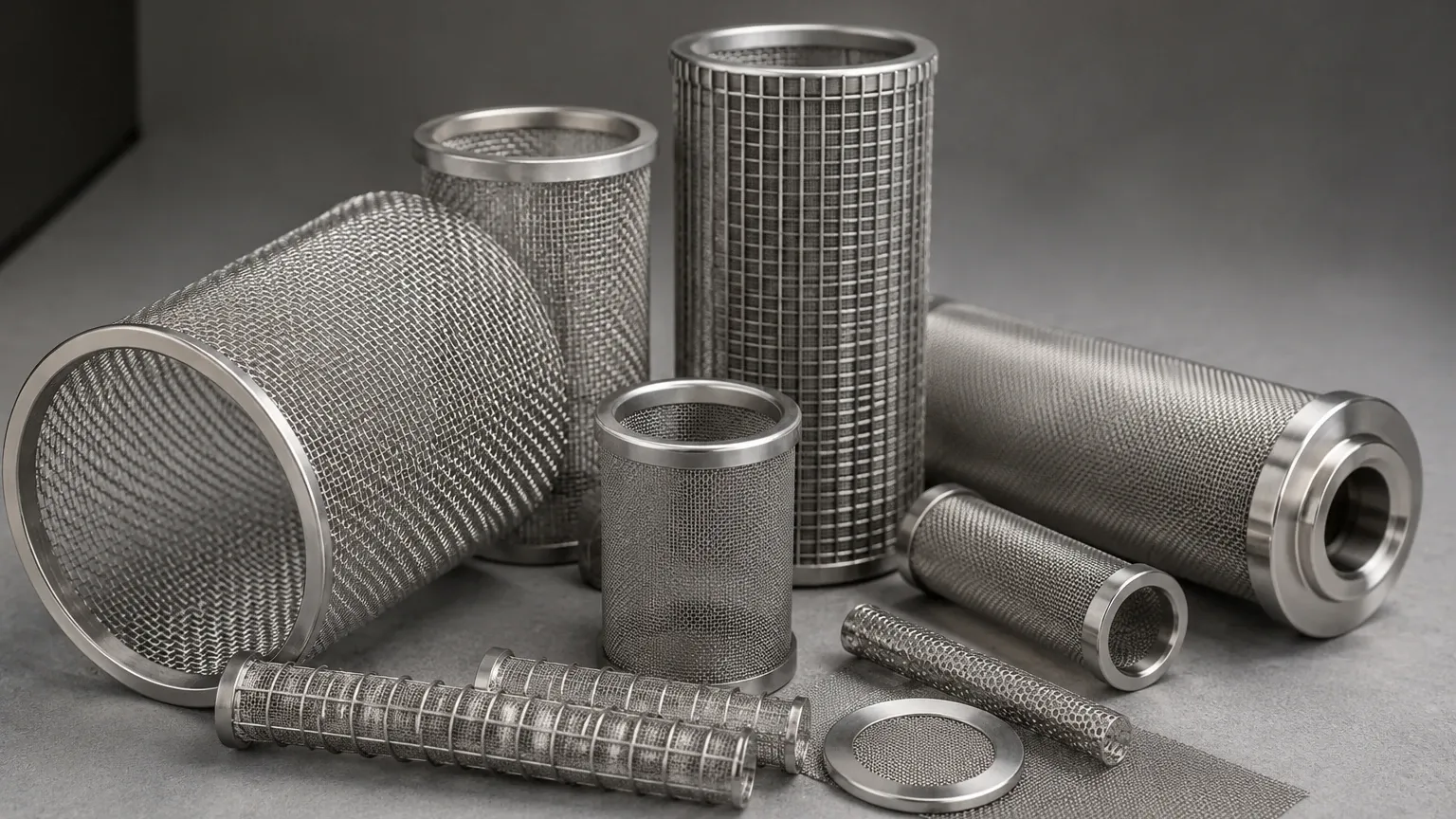
As a specialized manufacturer, Kaifil produces high-performance Wire Mesh Filter Cylinders & Tubes designed to meet the rigorous demands of chemical, pharmaceutical, and hydraulic applications. This guide examines the technical parameters of steel mesh filter screens, providing the factual data necessary for informed industrial selection.
1. Operating Principles of Steel Mesh Filter Screens
Steel mesh filter screens operate primarily through mechanical sieving or surface filtration. Unlike depth filters (such as melt-blown or string-wound cartridges) that trap particles within a thick matrix, mesh screens capture contaminants on the surface of the wire weave.
Surface Filtration Dynamics
When a fluid passes through a wire mesh, particles larger than the aperture size are physically blocked. As these particles accumulate, they form a "filter cake." In many industrial processes, this cake actually improves filtration efficiency by creating a secondary, finer filtration layer, although it simultaneously increases the pressure differential (ΔP) across the screen.
Flow Resistance and Pressure Drop
The performance of a filter is often measured by its clean pressure drop. This is influenced by the open area percentage of the mesh. A higher open area allows for higher flow rates with lower resistance, which is critical in hydraulic systems where excessive backpressure can cause pump cavitation or system failure. Engineers must calculate the required surface area to ensure that the fluid velocity through the mesh remains within laminar flow limits to prevent structural deformation of the wires.
2. Material Selection and Metallurgical Considerations
The longevity of steel mesh filter screens is dictated by their resistance to the operating environment. While various alloys are available, stainless steel remains the industry standard due to its passivated chromium oxide layer.
* AISI 304: The most common grade, offering excellent corrosion resistance in water treatment and general industrial applications. It is suitable for temperatures up to 800°F (427°C) in non-oxidizing environments.
* AISI 316/316L: Contains molybdenum, which significantly enhances resistance to chlorides and pitting. This is the preferred material for marine environments, chemical processing, and pharmaceutical manufacturing where aggressive cleaning agents are used.
* Specialty Alloys: For extreme conditions involving high-temperature oxidation or highly acidic media, alloys such as Inconel, Monel, or Hastelloy may be utilized in the mesh construction.
Understanding the chemical compatibility of the filtrate is essential. For instance, in the food and beverage industry, 316L is often mandated to prevent metallic leaching and to withstand the high-temperature Clean-in-Place (CIP) cycles.
3. Engineering Configurations: Cylinders and Tubes
While flat screens are used in simple sieving, industrial filtration typically requires the geometry of Wire Mesh Filter Cylinders & Tubes. These shapes provide a significantly higher surface-area-to-volume ratio, allowing for compact housing designs.
Weave Types and Their Impact
The method by which the steel wires are interlaced determines the mesh’s filtration characteristics:
* Plain Weave: A simple over-and-under pattern. It provides the highest open area but is limited in its ability to achieve very fine micron ratings.
* Twill Weave: Each shute wire passes over and under two warp wires. This allows for heavier wires and finer meshes, providing increased durability for high-pressure applications.
* Dutch Weave (Plain and Twill): Uses larger diameter warp wires and smaller diameter shute wires. This creates a dense, strong mesh with small, curved openings, ideal for high-pressure filtration and fine particle retention down to 5–10 microns.
Structural Reinforcement
In high-pressure systems, a single layer of mesh may lack the hoop strength required to resist collapsing or bursting. To address this, Kaifil engineers often utilize multi-layer constructions. This typically involves a fine filtration mesh supported by a coarser "drainage" mesh, which is then encased in a perforated metal core or cage. Sintering—a process of diffusion bonding the wire intersections—can further enhance the mesh’s rigidity and prevent wire migration.
4. Performance Evaluation: Micron Ratings and Efficiency
When specifying steel mesh filter screens, engineers must distinguish between nominal and absolute micron ratings.
* Nominal Rating: An arbitrary value indicating the ability of the filter to retain a percentage of solids of a specific size (usually 60% to 90%). It does not guarantee that all particles above that size will be removed.
* Absolute Rating: The diameter of the largest hard spherical particle that will pass through the filter under specified test conditions. For wire mesh, this is closely tied to the physical dimensions of the pore openings.
In critical applications, such as the protection of precision hydraulic valves or pharmaceutical batch processing, an absolute rating is required to ensure system integrity. Furthermore, the "Beta Ratio" (the ratio of particles upstream vs. downstream) provides a more scientific measure of filtration efficiency across different particle sizes.
5. Installation Constraints and Mechanical Integration
The effectiveness of a filter cylinder is compromised if the installation allows for "bypass." This occurs when fluid flows around the filter element rather than through the mesh. To prevent this, the interface between the filter and the housing must be precision-engineered.
Sealing Mechanisms
* O-Rings and Gaskets: Common in cartridge-style housings, using materials like Viton, EPDM, or PTFE depending on chemical compatibility.
* Metal-to-Metal Seals: Used in high-temperature or high-pressure environments where elastomeric seals would fail. This requires exacting tolerances in the machining of the filter end caps.
* Threaded Connections: Often used for filter tubes in gas filtration to provide a secure, vibration-resistant attachment.
Orientation and Flow Direction
Most Wire Mesh Filter Cylinders & Tubes are designed for "outside-in" flow, where contaminants are trapped on the exterior surface. This configuration is easier to clean and allows the internal support core to resist the compressive force of the fluid pressure. "Inside-out" flow is less common but used in specific applications where the goal is to contain the debris within the cylinder for easier disposal.
6. Maintenance, Cleaning, and Replacement Cycles
One of the primary advantages of steel mesh filter screens over disposable media is their cleanability. However, an improper cleaning regimen can damage the wire structure.
Cleaning Methodologies
1. Backwashing: Reversing the flow of fluid to dislodge the filter cake. This is effective for surface-loading mesh but requires a mesh with high structural integrity to withstand the reverse pressure.
2. Ultrasonic Cleaning: Using high-frequency sound waves in a solvent bath to create cavitation bubbles that dislodge fine particles from deep within the weave. This is the most effective method for Dutch weave meshes.
3. Chemical Cleaning: Utilizing acids or alkalis to dissolve organic or mineral deposits. The mesh material must be compatible with the cleaning agent (e.g., using 316L for nitric acid cleaning).
Determining Replacement
While reusable, steel mesh is subject to fatigue and abrasion. Replacement should be triggered by:
* Permanent Pressure Drop: When the "clean" pressure drop after cleaning is significantly higher than the original specification, indicating pore blinding.
* Structural Deformation: Any signs of pleat collapse or wire shifting.
* Media Migration: The presence of metallic fragments downstream, indicating a failure of the mesh or welds.
7. Procurement Checklist: What International Buyers Must Confirm
To ensure the delivery of a high-performance filtration solution, procurement teams should provide the following technical specifications to the manufacturer:
1. Fluid Characteristics: Viscosity, density, and chemical composition at operating temperature.
2. Operating Parameters: Normal and maximum flow rates, operating pressure, and maximum allowable pressure drop (ΔP).
3. Contaminant Profile: Type of solids (hard, soft, fibrous), particle size distribution, and concentration (PPM).
4. Dimensional Constraints: Total length, outside diameter (OD), inside diameter (ID), and end-cap configuration.
5. Compliance Requirements: Material certifications (MTRs), FDA compliance for food contact, or specific ISO filtration standards.
Conclusion
Steel mesh filter screens are engineered components that require a precise balance of material science and mechanical design. By selecting the appropriate weave, alloy, and structural configuration, industrial operators can achieve reliable, long-term filtration performance even in the most demanding environments. Whether integrated into a hydraulic system or a chemical reactor, high-quality Wire Mesh Filter Cylinders & Tubes provide the necessary protection for downstream equipment and product purity.
For engineers seeking to optimize their filtration processes, partnering with a manufacturer like Kaifil ensures access to the technical expertise required for custom-designed solutions that meet exact micron ratings and structural specifications. Understanding these factual boundaries allows for the implementation of filtration systems that minimize downtime and maximize total cost-efficiency.
