


Engineering Guide to Steel Mesh Pop Filter and Industrial Filtration Components
In high-precision industrial environments, the management of fluid and gas flow requires more than simple screening. For engineers and procurement specialists, selecting the correct filtration media involves a deep understanding of material science, fluid dynamics, and structural integrity. A specialized component often utilized for managing rapid pressure fluctuations, particulate capture, and acoustic dampening is the steel mesh pop filter. While the term is frequently associated with acoustic applications, in a B2B industrial context, it refers to high-durability stainless steel mesh assemblies designed to mitigate "pops" or surges in pressure and protect sensitive downstream instrumentation.
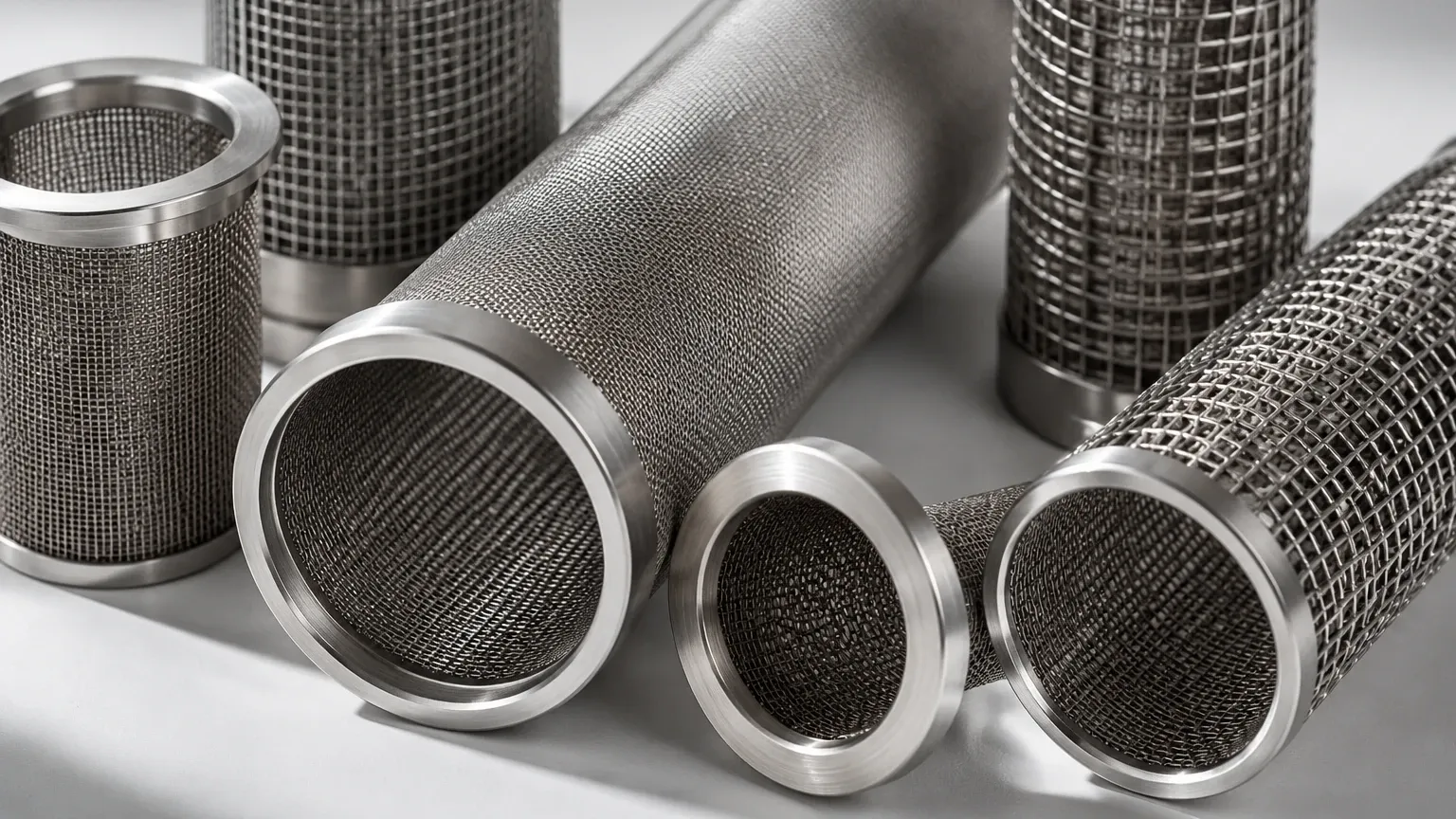
At the core of these solutions are Wire Mesh Filter Cylinders & Tubes, which provide the structural framework necessary for demanding chemical, pharmaceutical, and hydraulic applications. This guide explores the technical specifications, selection criteria, and engineering considerations essential for integrating these components into industrial systems.
1. Technical Fundamentals of Industrial Steel Mesh
Industrial filtration relies on the predictable performance of woven wire cloth. Unlike synthetic filters, a steel mesh pop filter constructed from stainless steel offers superior thermal stability and mechanical strength. The performance of these filters is dictated by the weave type and the wire diameter.
Weave Patterns and Their Impact
* Plain Weave: The most common configuration where wires cross over and under each other. It provides high flow rates and is ideal for basic particulate separation.
* Twill Weave: Each shute wire passes successively over and under two warp wires. This allows for a heavier wire diameter in a given mesh count, increasing the structural load capacity of the filter.
* Dutch Weave: This pattern utilizes a coarser warp wire and a finer shute wire, creating a dense, tortuous path for the fluid. This is critical for high-pressure applications where absolute filtration ratings are required.
For industrial cylinders and tubes, the choice of weave affects the pressure drop (ΔP) across the media. Engineers must balance the need for fine filtration (low micron rating) with the requirement for low resistance to flow to maintain system efficiency.
2. Material Selection: 304 vs. 316L Stainless Steel
Material compatibility is the primary boundary in industrial filtration design. The longevity of a steel mesh pop filter depends entirely on its resistance to the process media.
Grade 304 Stainless Steel
304 is the standard "18/8" stainless steel. It is highly effective for food and beverage applications and general industrial water treatment. It offers excellent welding characteristics and cost-effectiveness. However, it is susceptible to pitting in high-chloride environments.
Grade 316L Stainless Steel
The "L" denotes low carbon, which minimizes carbide precipitation during welding, ensuring the structural integrity of Wire Mesh Filter Cylinders & Tubes. The addition of molybdenum (2-3%) significantly enhances corrosion resistance against chlorides and industrial acids. In pharmaceutical and chemical processing, 316L is the industry standard to prevent metallic contamination and ensure a long service life under aggressive cleaning protocols.
3. Structural Design of Wire Mesh Filter Cylinders & Tubes
The geometry of the filter is as important as the mesh itself. In industrial venting or liquid processing, the filter must withstand significant differential pressure without deforming.
Reinforcement Layers
For high-pressure applications, a single layer of mesh is often insufficient. Engineers frequently specify multi-layer sintered mesh or mesh supported by a perforated metal core. The perforated core provides the rigid skeleton, while the fine wire mesh provides the filtration accuracy. This composite structure prevents the mesh from collapsing under the force of a pressure surge—a critical function of a steel mesh pop filter in pneumatic or hydraulic lines.
Seam Integrity
The weakest point of any cylindrical filter is the longitudinal seam. Advanced manufacturing utilizes plasma or TIG welding to create a fusion bond that is as strong as the parent material. Unlike mechanical crimping, welding ensures there are no bypass paths for contaminants, maintaining the integrity of the micron rating throughout the component's life.
4. Performance Metrics: Micron Ratings and Flow Dynamics
When specifying Wire Mesh Filter Cylinders & Tubes, engineers must distinguish between nominal and absolute filtration ratings.
* Nominal Rating: Indicates the ability of the filter to retain a majority of particulates of a certain size (e.g., 90% of 10-micron particles). This is suitable for non-critical applications.
* Absolute Rating: Refers to the diameter of the largest hard spherical particle that will pass through the filter under specified test conditions. In pharmaceutical or high-purity chemical lines, absolute ratings are mandatory to ensure process consistency.
Managing Pressure Drop
Every filter introduces a restriction in the line. The initial pressure drop must be calculated based on the fluid viscosity, flow velocity, and the open area of the mesh. A steel mesh pop filter with a high open-area percentage will minimize energy loss in the system. However, as the filter cake builds up, the ΔP will increase, necessitating a planned cleaning or replacement cycle.
5. Industrial Application Scenarios
Stainless steel filtration components are utilized across diverse sectors where reliability is non-negotiable.
Chemical Processing
In the production of aggressive chemicals, filters must resist both temperature and corrosion. Wire mesh tubes are used to protect pumps and valves from debris that could cause catastrophic failure. The ability of stainless steel to operate at temperatures exceeding 400°C makes it superior to polymer-based alternatives.
Food and Beverage
Hygiene is paramount. Stainless steel filters are inherently non-toxic and can be subjected to Clean-in-Place (CIP) procedures. The smooth surface of the wire mesh prevents the accumulation of organic matter, reducing the risk of bacterial growth. A steel mesh pop filter in a steam line, for example, ensures that culinary-grade steam is free of pipe scale and particulates.
Hydraulic Systems
High-pressure hydraulic systems require robust filtration to protect precision servos and actuators. Wire Mesh Filter Cylinders & Tubes are often used as suction strainers or return-line filters, where they must handle high-viscosity fluids and rapid flow reversals.
6. Maintenance, Cleaning, and Total Cost of Ownership
One of the primary advantages of stainless steel filtration media is its cleanability. While the initial capital expenditure (CAPEX) for a steel mesh pop filter may be higher than disposable cartridges, the total cost of ownership (TCO) is significantly lower due to the extended service life.
Cleaning Methods
1. Backwashing: Reversing the flow of the fluid to dislodge accumulated particles from the mesh surface.
2. Ultrasonic Cleaning: Using high-frequency sound waves in a cleaning solvent to remove fine particulates trapped within the depth of the mesh.
3. Chemical Cleaning: Utilizing acids or alkalis to dissolve organic or inorganic scaling, provided the chemical is compatible with the 304 or 316L steel grade.
Replacement Indicators
A filter should be replaced or cleaned when the differential pressure reaches a pre-defined limit, often referred to as the "terminal pressure drop." Failure to service the filter can lead to mesh deformation, media migration, or system-wide pressure loss.
7. Procurement Considerations for Engineers
When sourcing Wire Mesh Filter Cylinders & Tubes, international buyers should confirm the following technical details with the manufacturer:
* Material Certification: Ensure the alloy meets ASTM or ISO standards for 304/316L.
* Dimensional Tolerances: Precision fitting is required for housing compatibility; confirm ID/OD and length tolerances.
* Filtration Efficiency: Request data on the micron rating and the test method used (e.g., Bubble Point Test).
* Customization Options: Many industrial applications require non-standard fittings, such as NPT threads, flanges, or specialized end caps (DOE, SOE).
By focusing on these factual engineering boundaries, technical teams can ensure that their choice of a steel mesh pop filter or cylindrical tube assembly provides the necessary protection and performance for their specific industrial environment. The transition from disposable to permanent stainless steel filtration solutions represents a strategic move toward higher process reliability and reduced environmental waste.
