


Engineering Guide to Metal Mesh Sediment Filters in Industrial Applications
In industrial fluid processing, the removal of solid particulates is a fundamental requirement for protecting downstream equipment, ensuring product purity, and maintaining process efficiency. A metal mesh sediment filter serves as a primary mechanical barrier, utilizing precision-woven or sintered wire cloth to capture contaminants from liquid or gaseous streams. Unlike disposable polymer filters, these metallic components offer high thermal stability, chemical resistance, and the ability to be cleaned and reused, making them a cornerstone of sustainable industrial engineering.
Selecting the appropriate filtration media requires a deep understanding of fluid dynamics, material science, and the specific mechanical stresses of the application environment. This guide examines the technical specifications, design considerations, and procurement factors involved in implementing Wire Mesh Filter Cylinders & Tubes within professional industrial systems.
Technical Principles of Wire Mesh Filtration
The operating principle of a metal mesh sediment filter is based on surface filtration through mechanical straining. As fluid passes through the geometric openings of the mesh, particles larger than the pore size are intercepted on the upstream surface.
Geometric Precision and Pore Size
Industrial wire mesh is manufactured with high dimensional accuracy. The "mesh count" refers to the number of openings per linear inch. As the mesh count increases, the wire diameter typically decreases, resulting in a finer micron rating. Engineers must distinguish between nominal and absolute filtration ratings:
* Nominal Rating: Indicates the ability of the filter to retain a majority of particulates of a specific size (e.g., 90% of 50-micron particles).
* Absolute Rating: Refers to the diameter of the largest hard spherical particle that will pass through the filter under specified test conditions. For critical applications in pharmaceutical or hydraulic systems, absolute ratings are mandatory to prevent bypass of oversized contaminants.
Flow Dynamics and Differential Pressure
The performance of Wire Mesh Filter Cylinders & Tubes is heavily influenced by the open area percentage. A higher open area reduces the initial differential pressure ($ΔP$), allowing for higher flow rates or longer service intervals. However, increasing the open area often requires thinner wires, which may compromise the structural integrity of the filter under high-pressure loads. Balancing flow capacity with mechanical strength is a primary task in filter design.
Material Selection and Engineering Standards
The choice of alloy is the most critical factor in determining the lifespan and compatibility of a metal mesh sediment filter. Stainless steel is the industry standard due to its versatile mechanical properties.
1. AISI 304/304L: The most common grade, providing excellent cost-to-performance ratios for water treatment and general industrial use. It offers good corrosion resistance in mildly corrosive environments.
2. AISI 316/316L: Contains molybdenum, which significantly enhances resistance to pitting and crevice corrosion, particularly in chloride-rich environments or chemical processing applications.
3. Specialty Alloys: For extreme conditions, materials such as Monel, Inconel, or Hastelloy may be utilized. These are reserved for high-temperature oxidation resistance or highly acidic/alkaline environments where standard stainless steels would fail.
Beyond the alloy, the physical state of the mesh—whether it is plain weave, twilled weave, or Dutch weave—dictates the filtration characteristics. Plain Dutch weaves, for instance, provide a dense, strong mesh with relatively small openings, ideal for high-pressure sediment filtration.
Structural Design of Wire Mesh Filter Cylinders & Tubes
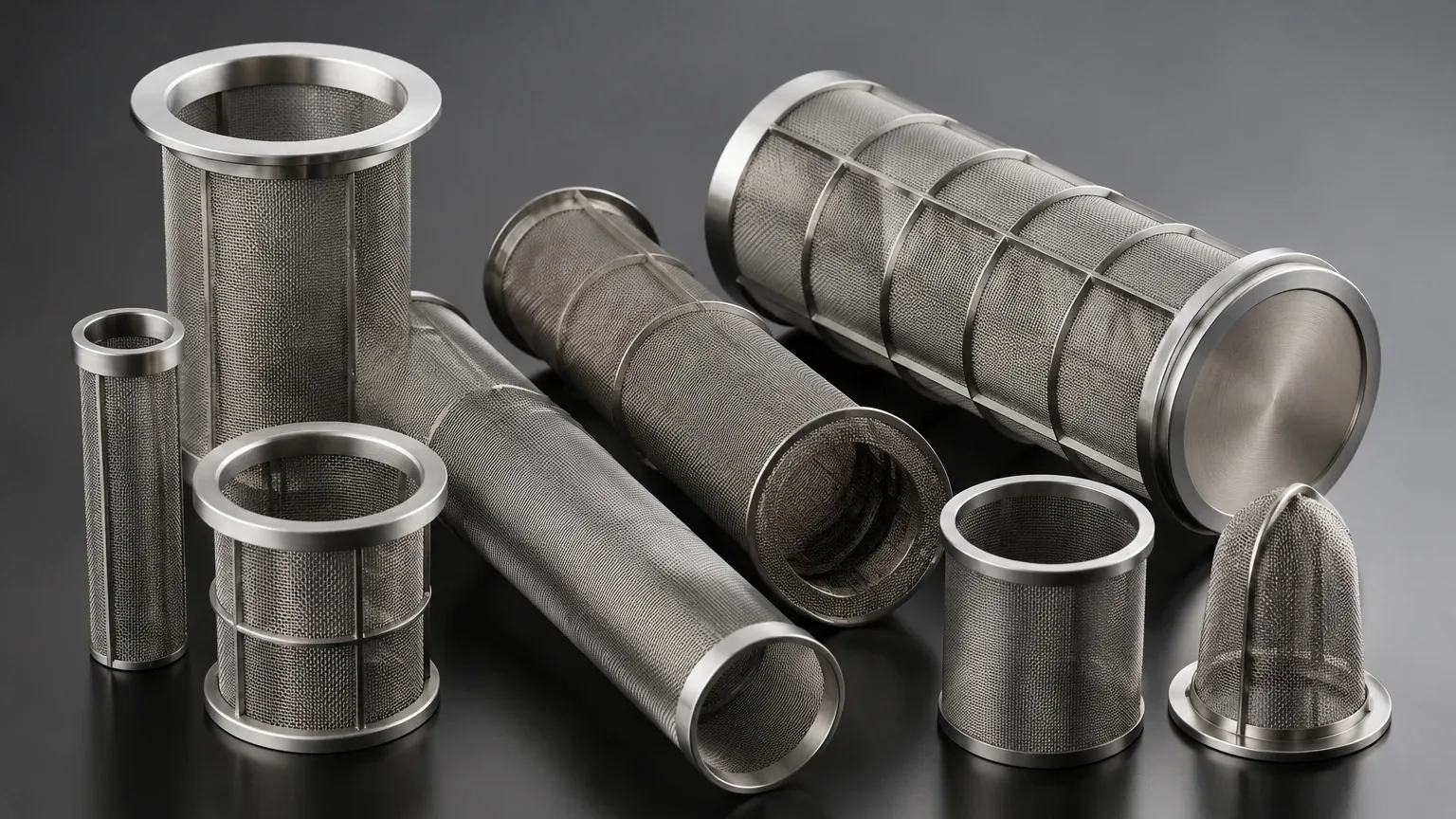
To withstand the rigors of industrial operation, a metal mesh sediment filter must be integrated into a robust physical structure. Wire Mesh Filter Cylinders & Tubes are engineered in several configurations to meet different mechanical requirements.
Single-Layer vs. Multi-Layer Construction
Single-layer cylinders are suitable for low-pressure applications where ease of cleaning is the priority. However, in high-pressure systems, the mesh requires support. Multi-layer designs often incorporate a fine filtration mesh sandwiched between coarser support layers. This "sintered" approach bonds the layers together at the molecular level, creating a composite material that combines fine filtration with high structural rigidity.
Reinforcement Components
For high-viscosity fluids or high-flow systems, the filter tube may include:
* Perforated Metal Cores: An internal or external perforated stainless steel tube provides the primary resistance against collapsing or bursting under high differential pressure.
* End Fittings: Custom-machined flanges, threaded connectors, or NPT fittings are welded to the cylinder using TIG (Tungsten Inert Gas) or plasma welding to ensure leak-proof integration into the piping system.
* Pleated Designs: To increase the Effective Filtration Area (EFA) within a restricted footprint, the wire mesh can be pleated. This significantly extends the dirt-holding capacity and reduces the frequency of maintenance cycles.
Selection Criteria for Industrial Buyers
When specifying Wire Mesh Filter Cylinders & Tubes, technical procurement teams should evaluate the following parameters to ensure system compatibility:
1. Particle Characterization
Identify the nature of the sediment. Is it hard and angular, or soft and deformable? Hard particles are easily captured by surface mesh, while soft, gelatinous contaminants may require a depth-loading media or a finer mesh than the particle size suggests to prevent "extrusion" through the pores.
2. Operating Temperature and Pressure
Metal filters excel in high-temperature environments where polymer membranes would melt or degrade. However, the mechanical strength of stainless steel decreases at elevated temperatures. Engineers must verify the "collapse pressure" rating at the maximum operating temperature of the process.
3. Chemical Compatibility
Review the pH levels and the presence of specific ions (like chlorides) in the fluid. Even "stainless" steel can suffer from stress corrosion cracking under specific chemical and thermal loads. Ensuring the material grade matches the fluid chemistry is vital for preventing premature failure.
Installation and Operational Constraints
Proper installation is as critical as the filter design itself. A metal mesh sediment filter must be seated correctly within its housing to prevent fluid bypass.
* Sealing Mechanisms: High-quality cylinders utilize O-rings (Viton, EPDM, or PTFE) or flat gaskets to ensure a positive seal. The choice of seal material must match the chemical and thermal profile of the fluid.
* Flow Direction: Most cylindrical filters are designed for outside-to-inside (O-to-I) flow, where sediment collects on the exterior surface. This simplifies cleaning, as the cake can be scraped or washed off. Inside-to-outside (I-to-O) flow is used in specific applications, such as centrifugal separators or where the contaminant must be contained within the tube for disposal.
* Monitoring: Systems should be equipped with differential pressure gauges. A sudden rise in $ΔP$ indicates that the filter is reaching its dirt-holding capacity and requires cleaning or replacement.
Maintenance and Cleaning Protocols
One of the primary B2B advantages of a metal mesh sediment filter is its cleanability. Unlike disposable cartridges, these components represent a one-time capital investment with low recurring costs.
Cleaning Methods
* Backwashing: Reversing the flow of clean fluid through the filter to dislodge particles from the mesh surface.
* Ultrasonic Cleaning: Using high-frequency sound waves in a cleaning solvent to cavitate and remove fine particulates lodged deep within the mesh pores. This is the most effective method for restored performance.
* Chemical Cleaning: Using mild acids or bases to dissolve organic or mineral scaling, provided the chemicals are compatible with the filter alloy.
Replacement Cycles
While reusable, Wire Mesh Filter Cylinders & Tubes are not infinite. Repeated cleaning cycles and mechanical stress will eventually lead to "mesh blinding" or fatigue cracks. A preventive maintenance schedule should include periodic visual inspections and integrity testing (such as a bubble point test) to ensure the filtration accuracy remains within specification.
Application Risks and Mitigation
Engineers must be aware of potential failure modes when implementing metal filters:
* Fatigue Failure: In systems with high-frequency pressure pulsations (e.g., downstream of a reciprocating pump), the wire mesh can suffer from fatigue. This is mitigated by using pleated designs with robust support layers or adding pulsation dampeners to the system.
* Bypass: If the filter is not sized correctly for the housing, or if seals are damaged during installation, unfiltered fluid will bypass the media. Precision manufacturing of end caps is essential to prevent this risk.
* Corrosion: Galvanic corrosion can occur if the filter is made of a different metal than the housing. Using consistent materials (e.g., 316L filter in a 316L housing) eliminates this risk.
Conclusion: Strategic Procurement for Industrial Filtration
For international buyers and engineers, selecting a metal mesh sediment filter is a balance of technical performance and total cost of ownership. By moving away from disposable solutions and toward high-quality Wire Mesh Filter Cylinders & Tubes, facilities can achieve higher filtration precision, better environmental compliance, and reduced operational downtime.
When sourcing these components, it is essential to partner with a manufacturer that provides detailed material certifications, pressure test reports, and customization capabilities. Whether the application involves hydraulic oil, volatile chemicals, or food-grade liquids, the structural integrity and filtration accuracy of the metal mesh remain the final line of defense for industrial process stability.
