


Engineering Guide to the Stainless Steel Cleanable Wire Mesh Filter Cartridge
In industrial process engineering, the selection of filtration media significantly impacts operational efficiency, maintenance cycles, and long-term expenditure. While disposable depth filters are common in light-duty applications, demanding industrial environments—characterized by high temperatures, corrosive fluids, and high pressure—require more robust solutions. The stainless steel cleanable wire mesh filter cartridge has emerged as a standard for these rigorous applications, offering a reusable alternative to polymer-based consumables.
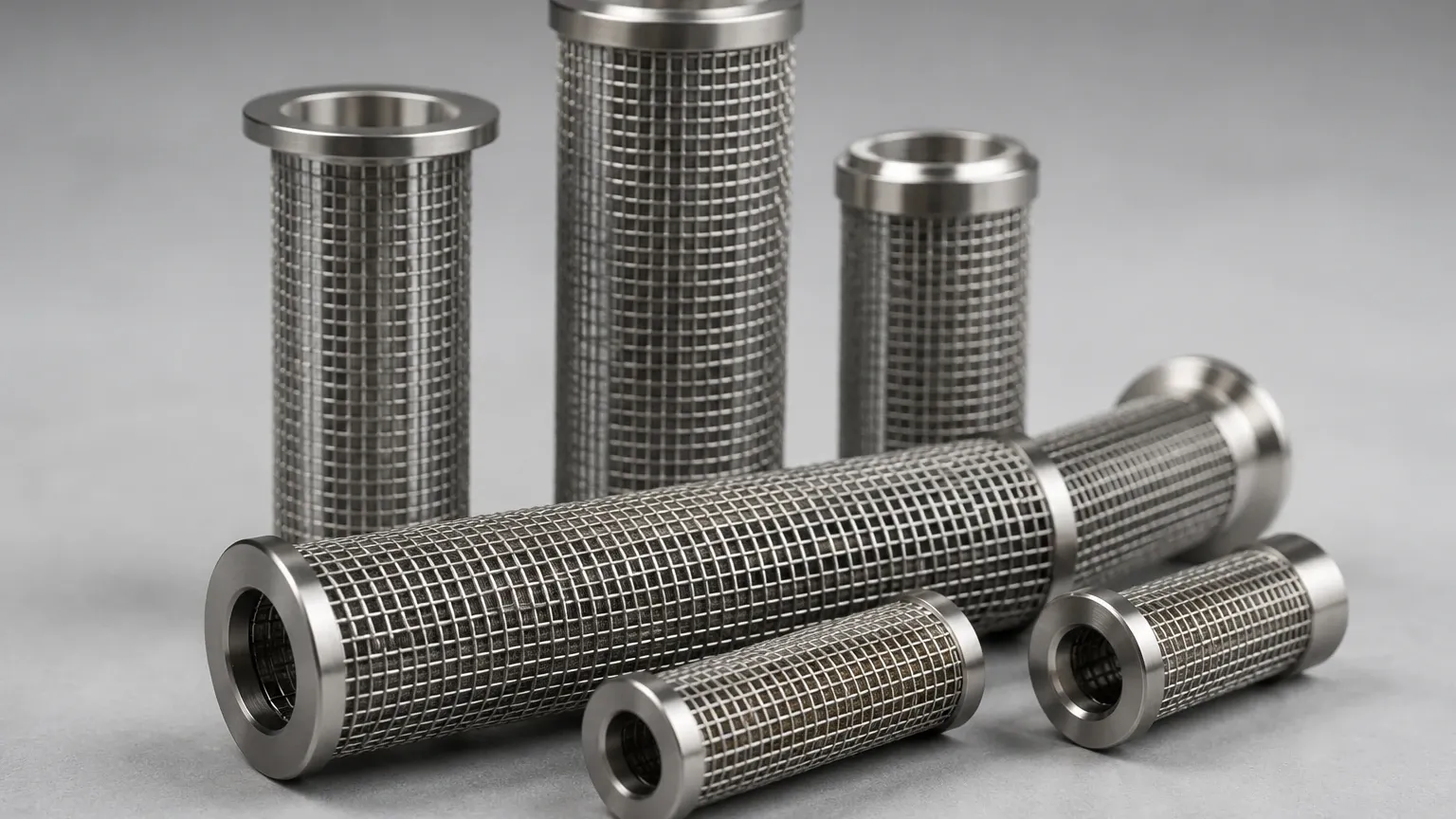
This article provides a technical overview of these components, focusing on the engineering principles behind Wire Mesh Filter Cylinders & Tubes, selection criteria for various industrial sectors, and the practical considerations necessary for optimizing filtration performance.
Understanding the Construction of Wire Mesh Filter Cylinders & Tubes
The fundamental structure of a stainless steel cleanable wire mesh filter cartridge is based on precision-woven wire cloth. Unlike depth filters that trap contaminants within a thick matrix of fibers, wire mesh operates primarily through surface filtration. This means particles larger than the mesh opening are retained on the upstream surface of the media.
Material Selection: 304 vs. 316L
Material integrity is the first consideration in industrial filtration. Most Wire Mesh Filter Cylinders & Tubes are manufactured from either AISI 304 or AISI 316L stainless steel.
* Type 304: Suitable for general industrial use where basic corrosion resistance is required. It is commonly used in water treatment and food processing where the chemical environment is relatively neutral.
* Type 316L: The "L" denotes low carbon, which improves weldability and resistance to intergranular corrosion. 316L contains molybdenum, making it the preferred choice for chemical processing, pharmaceutical production, and applications involving chlorides or high-salinity environments.
Mesh Weave Types and Filtration Accuracy
The performance of the cartridge is dictated by the weave pattern of the wire. Engineers must choose based on the required micron rating and the nature of the slurry or fluid:
1. Plain Weave: The simplest pattern, offering high open area and low pressure drop. It is typically used for coarse filtration (above 100 microns).
2. Twill Weave: Allows for a heavier wire diameter in a given mesh count, providing increased strength for finer filtration tasks.
3. Dutch Weave (Plain and Twilled): These weaves use a larger diameter warp wire and a smaller diameter shute wire. This creates a dense, strong mesh with very fine openings, often used for high-pressure applications and absolute filtration ratings down to 5–10 microns.
The Engineering Value of Cleanability
The primary advantage of a stainless steel cleanable wire mesh filter cartridge over disposable variants is its reusability. In large-scale industrial operations, the "total cost of ownership" (TCO) often favors stainless steel due to the reduction in waste disposal costs and the elimination of frequent replacement downtime.
Cleaning Mechanisms
For a filter to be truly "cleanable," the contaminants must be removable without damaging the structural integrity of the mesh. Common industrial cleaning methods include:
* Backwashing/Backpulsing: Reversing the flow of the fluid to dislodge the filter cake. This is often automated in continuous process systems.
* Ultrasonic Cleaning: Using high-frequency sound waves in a cleaning solvent to remove fine particles lodged deep within the mesh pores. This is highly effective for Dutch weave patterns.
* Chemical Cleaning: Utilizing acids, alkalis, or specialized solvents to dissolve organic or inorganic scaling. Because the cartridge is made of stainless steel, it can withstand aggressive chemical baths that would destroy polymer filters.
* Burn-off (Pyrolysis): For polymer melt filtration or heavy resin applications, cartridges can be heated in controlled ovens to carbonize organic contaminants, which are then blown out with compressed air.
Selection Criteria for Industrial Level Measurement and Fluid Control
When specifying a stainless steel cleanable wire mesh filter cartridge, engineers must look beyond the micron rating. Several physical and operational variables must be confirmed to ensure the filter performs within the intended system parameters.
1. Micron Rating: Absolute vs. Nominal
In industrial filtration, the distinction between absolute and nominal ratings is critical. A nominal rating refers to a filter's ability to retain a major percentage (usually 60% to 90%) of particles of a specific size. An absolute rating, achieved through high-precision Wire Mesh Filter Cylinders & Tubes, implies that 99.9% of particles larger than the specified micron size will be captured. For sensitive equipment like high-pressure pumps or spray nozzles, absolute ratings are mandatory.
2. Differential Pressure ($ΔP$)
Every filter introduces a pressure drop into the system. Engineers must calculate the "clean pressure drop" and define the "terminal pressure drop"—the point at which the filter must be cleaned. Because stainless steel mesh is rigid, it can withstand much higher differential pressures (often up to 25–50 bar or more, depending on the internal support core) compared to polypropylene cartridges which may collapse or "unload" contaminants under pressure spikes.
3. Effective Filtration Area (EFA)
To extend the time between cleaning cycles, the EFA can be increased through pleating. A pleated stainless steel cleanable wire mesh filter cartridge offers significantly more surface area than a cylindrical version of the same dimensions. This reduces the face velocity of the fluid, leading to lower initial pressure drops and higher dirt-holding capacity.
Installation Constraints and Application Risks
Even the highest quality filter will fail if installed incorrectly or used in an application for which it was not designed. International buyers and plant engineers should be aware of several common risks.
Bypass Issues
The most common failure in filtration systems is not the media itself, but the seal. If the cartridge does not seat correctly within the housing, fluid will take the path of least resistance, bypassing the filter entirely. It is essential to confirm the end-cap configuration. Common types include:
* DOE (Double Open End): Requires flat gaskets at both ends.
* SOE (Single Open End) with 222 or 226 O-rings: Features a locking tab or double O-ring seal to ensure a leak-proof fit in high-vibration environments.
Mechanical Fatigue
In systems with frequent pressure pulsations or hydraulic shocks, the wire mesh can suffer from fatigue. Engineers should ensure that the Wire Mesh Filter Cylinders & Tubes include an inner perforated support core and, in some cases, an outer protective shroud to prevent the mesh from flexing and eventually cracking.
Compatibility with Fluid Chemistry
While 316L is highly resistant, it is not invincible. For example, in highly acidic environments involving hydrochloric acid, even stainless steel may corrode. In such cases, specialized alloys like Hastelloy or Monel may be required for the mesh construction. Always verify the fluid's pH, concentration, and temperature before finalizing the material spec.
Information for International Procurement
For procurement teams and engineers sourcing filtration components globally, providing a complete technical data sheet is vital to receiving a product that meets operational requirements. When requesting a quote for a stainless steel cleanable wire mesh filter cartridge, the following details should be specified:
* Dimensions: Outer diameter (OD), Inner diameter (ID), and overall length.
* Micron Rating: Specify whether absolute or nominal is required.
* End-Cap Style: (e.g., DOE, 222/Flat, 226/Fin).
* Gasket/O-ring Material: (e.g., Viton, EPDM, PTFE, Silicone) based on chemical and temperature compatibility.
* Operating Conditions: Maximum operating temperature and maximum allowable differential pressure.
* Flow Rate: The volume of fluid to be processed per minute/hour, which determines the required surface area.
Conclusion: The Strategic Choice for Industrial Filtration
The transition to a stainless steel cleanable wire mesh filter cartridge represents a shift toward sustainable and high-performance engineering. By utilizing the structural benefits of Wire Mesh Filter Cylinders & Tubes, industrial facilities can achieve precise filtration, withstand extreme operating conditions, and reduce the environmental impact associated with disposable filter waste.
While the initial capital expenditure for stainless steel media is higher than that of plastic consumables, the longevity, cleanability, and reliability provide a superior return on investment for critical industrial processes. Whether in chemical refining, hydraulic systems, or food production, understanding the nuances of mesh weave, material grade, and seal integrity is the key to optimized filtration performance.
For more technical specifications and to explore custom configurations for your specific application, you can Review product options and application support to ensure your filtration system meets modern engineering standards.
Download Stainless Steel Cleanable Wire Mesh Filter Cartridge as a PDF
