


Technical Guide to Round Wire Mesh Filter Cylinders and Tubes
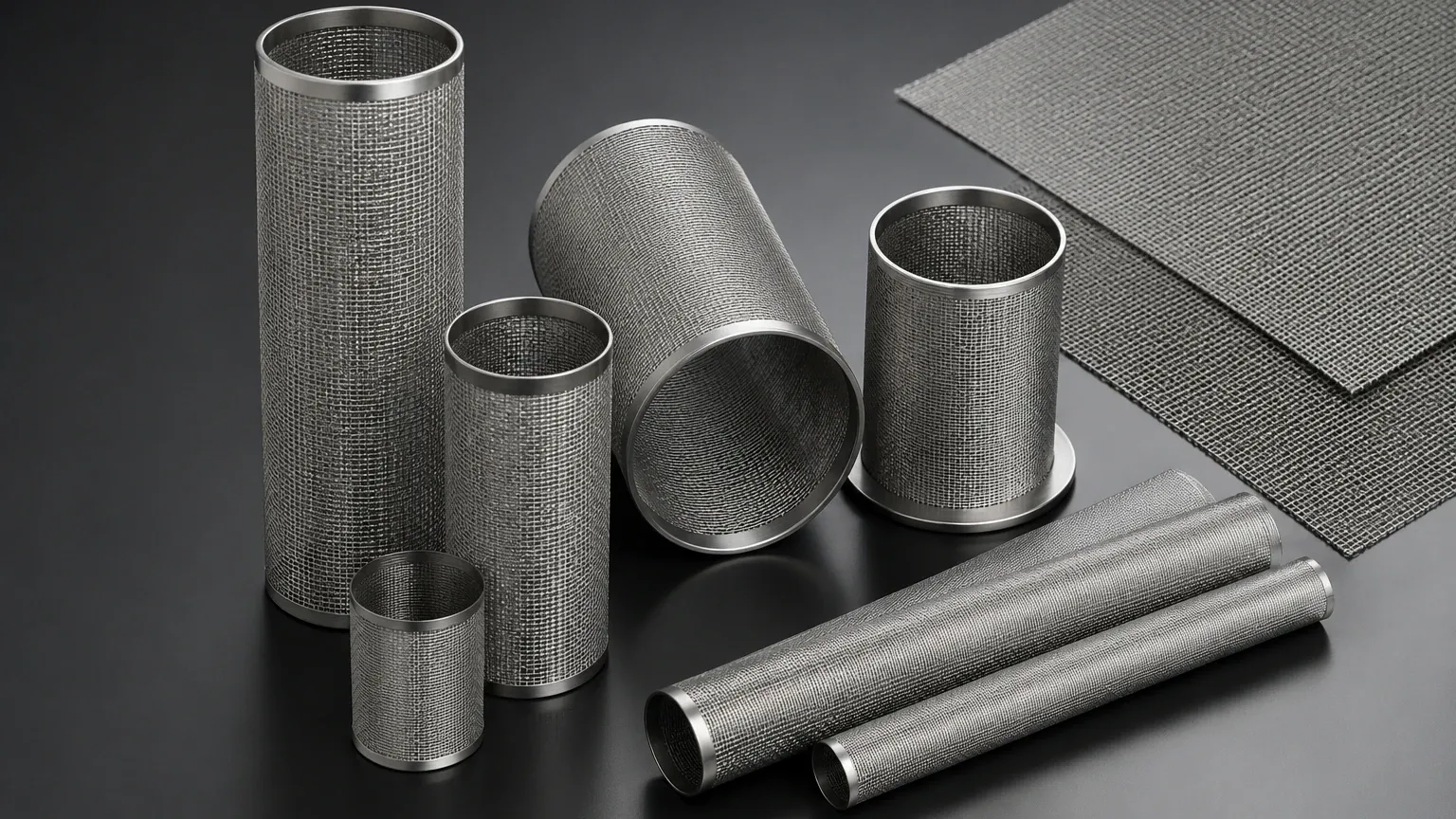
In industrial filtration, the geometry of a filter element is as critical as the material from which it is constructed. The round wire mesh filter, often referred to in engineering specifications as Wire Mesh Filter Cylinders & Tubes, represents one of the most versatile and widely utilized configurations for liquid and gas processing. These components are engineered to provide precise particulate separation while maintaining structural integrity under varying thermal and mechanical stresses.
For engineers and procurement specialists, selecting the correct cylindrical filter involves more than simply matching a micron rating. It requires a comprehensive understanding of fluid dynamics, material compatibility, and the mechanical constraints of the housing system. This guide examines the technical parameters, construction methodologies, and selection criteria essential for implementing high-performance stainless steel filtration solutions.
1. Fundamentals of Cylindrical Mesh Filtration
The primary function of a round wire mesh filter is to provide a consistent barrier against contaminants within a fluid stream. Unlike depth filters (such as wound or melt-blown cartridges) that trap particles throughout their volume, wire mesh filters primarily operate via surface filtration. This characteristic allows for predictable performance and, crucially, the ability to be cleaned and reused.
Surface Filtration Mechanics
The cylindrical shape is mathematically advantageous for filtration. It provides a high surface-area-to-volume ratio, which is essential for managing flow velocity. When fluid passes through the mesh, particles larger than the pore size are intercepted at the surface. In a round configuration, the flow is typically directed from the outside toward the center (outside-in) or from the center toward the exterior (inside-out).
Outside-in flow is more common in industrial housings because it allows the outer surface of the cylinder to act as the primary collection zone, making it easier to inspect and clean. However, inside-out flow is often preferred in applications where the filtered debris must be contained within the tube for safe disposal or recovery, such as in certain chemical or pharmaceutical processes.
2. Material Selection and Metallurgical Considerations
Kaifil specializes in stainless steel filtration because of the material's inherent resistance to corrosion, temperature extremes, and mechanical wear. The choice of alloy is the first critical decision in the engineering phase.
Stainless Steel Grades
* AISI 304: The standard grade for general industrial use. It offers excellent corrosion resistance in water treatment and food processing environments where aggressive chemicals are not present.
* AISI 316L: Containing molybdenum, 316L provides superior resistance to chlorides and acids. This is the industry standard for marine environments, chemical processing, and pharmaceutical manufacturing. The "L" denotes low carbon, which is vital for preventing carbide precipitation during the welding of the filter seams.
* Specialty Alloys: For extreme environments involving high concentrations of sulfuric acid or high-temperature oxidation, alloys such as Hastelloy or Inconel may be utilized, though 316L satisfies the vast majority of B2B industrial requirements.
Weave Types and Pore Geometry
The performance of a round wire mesh filter is dictated by how the wires are woven.
* Plain Weave: The simplest form where wires cross over and under each other. It provides high flow rates and is easy to clean but is generally limited to coarser filtration (above 50 microns).
* Twill Weave: Wires cross over two and under two, allowing for thicker wires and finer mesh counts. This is used when a balance of strength and fine filtration is required.
* Dutch Weave (Plain and Twill): These weaves use different diameters for warp and weft wires, resulting in a dense, "tortuous" path. Dutch weaves are essential for high-pressure applications and fine filtration down to the 1–5 micron range.
3. Structural Integrity and Reinforcement
One of the most common failure points in industrial filtration is the collapse of the filter element due to high differential pressure ($ΔP$). As a filter becomes loaded with contaminants, the pressure drop across the mesh increases. Without proper reinforcement, a standard wire mesh tube may deform or burst.
Perforated Metal Cores
To withstand high $ΔP$, Wire Mesh Filter Cylinders & Tubes are often constructed with an internal or external support core. These cores are usually made from perforated stainless steel sheet. The perforation pattern (staggered vs. straight) and the open area percentage are calculated to ensure the core does not restrict flow while providing maximum hoop strength.
Multi-Layer Sintered Mesh
For the most demanding applications, multiple layers of wire mesh are sintered together. Sintering uses heat and pressure to fuse the contact points of the wires without melting them. This creates a monolithic structure that combines a fine filtration layer with several coarse support layers. Sintered round filters are virtually immune to media migration (the release of wire fragments into the filtrate) and can withstand extreme backwashing pressures.
4. Engineering Parameters for Customization
When sourcing a round wire mesh filter, engineers must define several physical and operational parameters to ensure compatibility with existing systems.
Micron Rating: Absolute vs. Nominal
* Nominal Rating: Refers to the ability of the filter to retain a certain percentage (usually 60% to 90%) of particles of a specific size. This is often used for non-critical pre-filtration.
* Absolute Rating: Refers to the diameter of the largest spherical particle that will pass through the filter under laboratory conditions. In critical pharmaceutical or hydraulic applications, an absolute rating is required to ensure system protection.
End Cap Configurations
The method by which the filter cylinder interfaces with the housing is critical for preventing bypass. Common configurations include:
* Double Open End (DOE): The cylinder is open at both ends and usually requires gaskets (EPDM, Viton, or PTFE) to seal against the housing seats.
* Single Open End (SOE): One end is permanently sealed with a solid metal cap, while the other features a threaded fitting (NPT/BSP) or a specialized bayonet mount (e.g., 222 or 226 O-ring fittings).
* Flanged Ends: Used in large-scale industrial pipelines where the filter is bolted directly into the flow path.
Seam Welding Techniques
The longitudinal seam of the tube is a critical area. Kaifil utilizes advanced plasma welding or spot welding to ensure the seam is as strong as the parent mesh. A high-quality weld must be smooth to prevent contaminant buildup and must not compromise the pore size of the mesh adjacent to the weld zone.
5. Performance Evaluation: Flow Rate and Pressure Drop
In B2B industrial environments, the "Total Cost of Ownership" (TCO) of a filtration system is heavily influenced by energy consumption. A filter that creates an excessive pressure drop requires more pump power, increasing operational costs.
Calculating $ΔP$
The initial pressure drop is a function of the fluid's viscosity, the flow velocity, and the open area of the mesh. Engineers should aim for an initial $ΔP$ of less than 2-3 PSI (0.14-0.21 bar) for liquid systems. If the initial pressure drop is higher, it indicates that the filter surface area is insufficient for the required flow rate, necessitating a larger cylinder or a change in mesh geometry.
Effective Filtration Area (EFA)
The EFA is the total area of the mesh minus the area blocked by welds, end caps, and support cores. When designing custom Wire Mesh Filter Cylinders & Tubes, increasing the length or diameter of the cylinder is the most direct way to increase EFA and extend the service interval between cleanings.
6. Maintenance, Cleaning, and Replacement Cycles
Unlike disposable polymer filters, stainless steel round mesh filters are designed for longevity. However, their economic value is only realized through proper maintenance.
Cleaning Methodologies
1. Backwashing: Reversing the flow of the fluid to dislodge particles from the surface. This is highly effective for plain weave meshes.
2. Ultrasonic Cleaning: Submerging the filter in an ultrasonic bath with specialized detergents. The cavitation bubbles reach deep into Dutch weave patterns to remove fine particulates that backwashing cannot reach.
3. Chemical Cleaning: Using acids or alkalis to dissolve organic or mineral scaling. This requires careful verification of the gasket material compatibility.
Determining Replacement
While stainless steel is durable, it is not infinite. A round wire mesh filter should be replaced if:
* The mesh shows signs of "blinding" (permanent clogging) that cannot be removed by cleaning, resulting in a high permanent baseline $ΔP$.
* There is evidence of mechanical fatigue, such as cracks in the mesh or broken welds.
* The wire diameter has thinned due to erosion or corrosion, potentially compromising the micron rating.
7. Application-Specific Considerations
Different industries impose unique requirements on filter design:
* Food and Beverage: Requires "sanitary" design, meaning no dead spaces where bacteria can grow. Welds must be ground smooth, and materials must be FDA-compliant.
* Hydraulic Systems: Filters must handle high-pressure pulses and protect sensitive valves from metal wear particles. Structural strength is the priority here.
* Chemical Processing: Focuses on alloy compatibility. The filter must withstand the corrosive nature of the process fluid while maintaining a precise cut-off point for catalysts or raw materials.
Conclusion
The selection of a round wire mesh filter is a technical process that bridges the gap between fluid mechanics and material science. By specifying the correct stainless steel grade, weave type, and structural reinforcement, industrial operators can achieve a balance of high filtration efficiency and low operational costs.
As a dedicated manufacturer, Kaifil provides the engineering expertise necessary to customize Wire Mesh Filter Cylinders & Tubes for the most demanding B2B applications. Understanding these technical boundaries ensures that the chosen filtration solution provides reliable, long-term performance in any industrial environment.
