


Engineering Guide to Small Wire Mesh Filters in Industrial Systems
In precision industrial engineering, the reliability of a system often depends on the protection of its most sensitive components. Small wire mesh filters serve as the primary line of defense for valves, nozzles, sensors, and instrumentation, preventing particulate contamination from causing mechanical failure or process inaccuracies. Unlike large-scale filtration housings, these compact components must balance high filtration efficiency with minimal space requirements and low pressure drop.
For engineers and procurement teams, selecting the correct filtration media involves more than just choosing a micron rating. It requires a comprehensive understanding of material science, fluid dynamics, and manufacturing tolerances. This guide explores the technical considerations for implementing small wire mesh filters in demanding B2B environments, focusing on their design, material properties, and application-specific requirements.
Engineering Fundamentals of Small Wire Mesh Filters
Small wire mesh filters operate on the principle of surface filtration. They are constructed from metallic wires woven into specific patterns to create precise apertures. The primary function is to intercept solid particles larger than the mesh openings while allowing the fluid—whether liquid or gas—to pass through with minimal resistance.
Micron Rating and Aperture Precision
In industrial filtration, the "micron rating" is the most critical specification. For small-scale applications, precision is paramount. Engineers must distinguish between nominal and absolute ratings:
- Nominal Rating: Indicates the filter's ability to retain a majority of particles of a specific size (typically 60-80%).
- Absolute Rating: Refers to the diameter of the largest hard spherical particle that will pass through the filter under specified test conditions. In high-precision systems, such as hydraulic pilot lines or chemical dosing, absolute ratings are usually required to ensure component safety.
Weave Types and Their Impact
The geometry of the weave determines the filter’s strength, flow capacity, and cleaning characteristics. Common weaves used in small-scale filters include:
- Plain Weave: The simplest pattern where wires cross over and under each other. It offers the highest open area and lowest pressure drop but is limited in its ability to achieve very fine micron ratings.
- Twilled Weave: Allows for heavier wires and finer mesh counts by passing each shute wire over and under two warp wires.
- Dutch Weave: Utilizes different wire diameters for the warp and shute, resulting in a dense, strong mesh with high pressure resistance and fine filtration capabilities.
Material Selection for Demanding Environments
The performance of a filter is only as good as the material from which it is manufactured. Because small wire mesh filters are often used in aggressive chemical processes or high-temperature environments, stainless steel is the industry standard.
Stainless Steel Grades
- AISI 304: The most common grade, offering good corrosion resistance and durability for general industrial applications, food processing, and water treatment.
- AISI 316/316L: Contains molybdenum, which provides superior resistance to chlorides and pitting. This is the preferred choice for marine environments, pharmaceutical manufacturing, and chemical processing.
- Specialty Alloys: In extreme cases involving high temperatures or highly corrosive acids, alloys like Inconel, Monel, or Hastelloy may be specified to prevent premature filter failure.
Thermal and Chemical Compatibility
Engineers must verify that the filter material can withstand the maximum operating temperature of the process without losing structural integrity. Stainless steel filters typically maintain their properties up to 400°C (752°F) or higher, depending on the specific alloy and the presence of oxidizing agents. Furthermore, the chemical compatibility of the mesh, the support structure, and any bonding agents (such as adhesives or solder) must be confirmed to prevent leaching or corrosion.
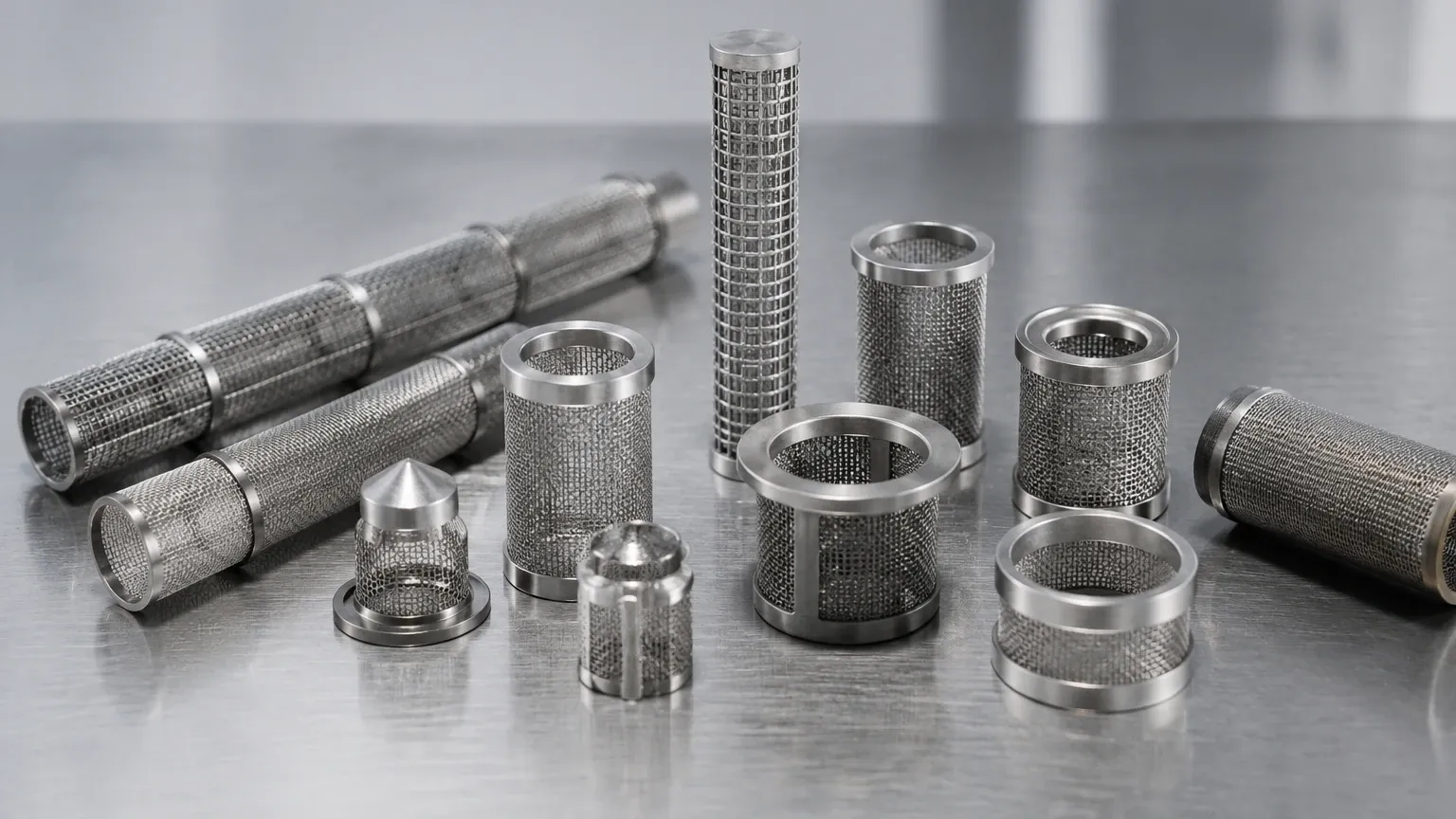
Structural Design: Wire Mesh Filter Cylinders & Tubes
One of the most effective geometries for small-scale filtration is the cylindrical form. Wire Mesh Filter Cylinders & Tubes provide a high surface-area-to-volume ratio, which is essential when installation space is limited.
Single-Layer vs. Multi-Layer Construction
- Single-Layer Cylinders: These are cost-effective and easy to clean. They are suitable for low-pressure applications where the mechanical load on the mesh is minimal.
- Multi-Layer/Sintered Tubes: For applications involving high differential pressures or back-pulsing, multiple layers of mesh are used. Often, a fine filtration layer is sandwiched between coarser support layers. Sintering these layers together creates a monolithic structure that prevents wire migration and significantly increases mechanical strength.
Reinforcement and Support
Small filters often require internal or external support cores, such as perforated metal or expanded metal, to prevent the mesh from collapsing under high flow rates or pressure spikes. The choice of support depends on the direction of flow (outside-in vs. inside-out) and the expected differential pressure across the element.
Performance Evaluation and Selection Criteria
When specifying small wire mesh filters, engineers must evaluate several performance metrics to ensure the component does not become a bottleneck in the system.
Flow Rate and Pressure Drop (ΔP)
The pressure drop across a filter is influenced by the fluid viscosity, flow velocity, and the filter's open area. A high initial pressure drop reduces the available energy for the process and shortens the time between cleaning or replacement cycles. Designers should aim for a filter area that keeps the clean pressure drop within 1-3 PSI for most liquid applications.
Dirt Holding Capacity
This refers to the amount of contaminant a filter can retain before the pressure drop reaches a critical limit. While small filters naturally have less dirt-holding capacity than larger units, choosing a pleated design can significantly increase the effective filtration area within the same footprint, thereby extending the service life.
Customization and Manufacturing Precision
In the B2B sector, "off-the-shelf" solutions rarely meet the exact requirements of specialized machinery. Customization options often include:
- Precision Welding: Utilizing TIG, plasma, or ultrasonic welding to ensure leak-proof seams and clean edges without the use of foreign binders.
- End Cap Integration: Custom end caps (threaded, flanged, or O-ring grooves) allow for seamless integration into existing manifolds or housings.
- Dimensional Tolerances: For filters used in medical or aerospace applications, tolerances as tight as +/- 0.1mm may be required to ensure proper fit and bypass prevention.
Installation Constraints and Maintenance Protocols
The longevity of a small wire mesh filter is heavily dependent on how it is installed and maintained. Improper installation can lead to "bypass," where unfiltered fluid escapes around the edges of the filter element.
Sealing Mechanisms
Effective sealing is crucial. Common methods include:
- Metal-to-Metal Seals: Used in high-temperature or high-pressure environments where elastomers would fail.
- O-Rings and Gaskets: Standard for most industrial applications, provided the material (Viton, EPDM, PTFE) is compatible with the process fluid.
- Epoxy Bonding: Sometimes used in low-temperature applications to permanently fix the filter into a plastic or metal housing.
Cleaning and Reuse
One of the primary advantages of stainless steel wire mesh over disposable paper or polymer filters is cleanability. Depending on the contaminant, filters can be cleaned via:
- Ultrasonic Cleaning: High-frequency sound waves in a cleaning solution effectively remove fine particles lodged deep within the mesh.
- Backwashing: Reversing the flow through the filter to dislodge surface cake.
- Chemical Cleaning: Using solvents or acids to dissolve organic or mineral deposits, provided the mesh material is resistant to the cleaning agent.
Information for International Procurement
For purchasing teams sourcing small wire mesh filters globally, clear communication of technical requirements is essential to avoid project delays or non-compliant parts. When requesting a quote from a manufacturer like Kaifil, the following data should be provided:
1. Micron Rating: Specify absolute or nominal.
2. Dimensions: Outer diameter (OD), inner diameter (ID), and overall length (OAL).
3. Material Grade: (e.g., SS316L).
4. Operating Conditions: Maximum temperature, operating pressure, and maximum allowable pressure drop.
5. Fluid Characteristics: Viscosity, chemical composition, and type of contaminants.
6. Quantity and Certification: Requirements for ISO 9001, FDA compliance (for food/pharma), or material test reports (MTRs).
By addressing these factors during the design and procurement phases, engineers can ensure that their systems remain protected by durable, high-performance filtration components. Small wire mesh filters may be physically minor parts of a larger machine, but their role in maintaining process integrity and equipment longevity is indispensable. Whether for protecting sensitive hydraulic actuators or ensuring the purity of a chemical reagent, the right mesh configuration and structural design are the keys to operational success.
