


Engineering Guide to Small Wire Mesh Filter Solutions in Industrial Systems
In precision industrial engineering, the requirement for localized filtration often necessitates the use of a small wire mesh filter. These components are critical for protecting sensitive downstream equipment, such as high-pressure nozzles, analytical sensors, and micro-valves, from particulate contamination. Unlike large-scale vessel filtration, small-scale filtration requires a higher focus on dimensional tolerances, structural integrity under high differential pressures, and specific material compatibility.
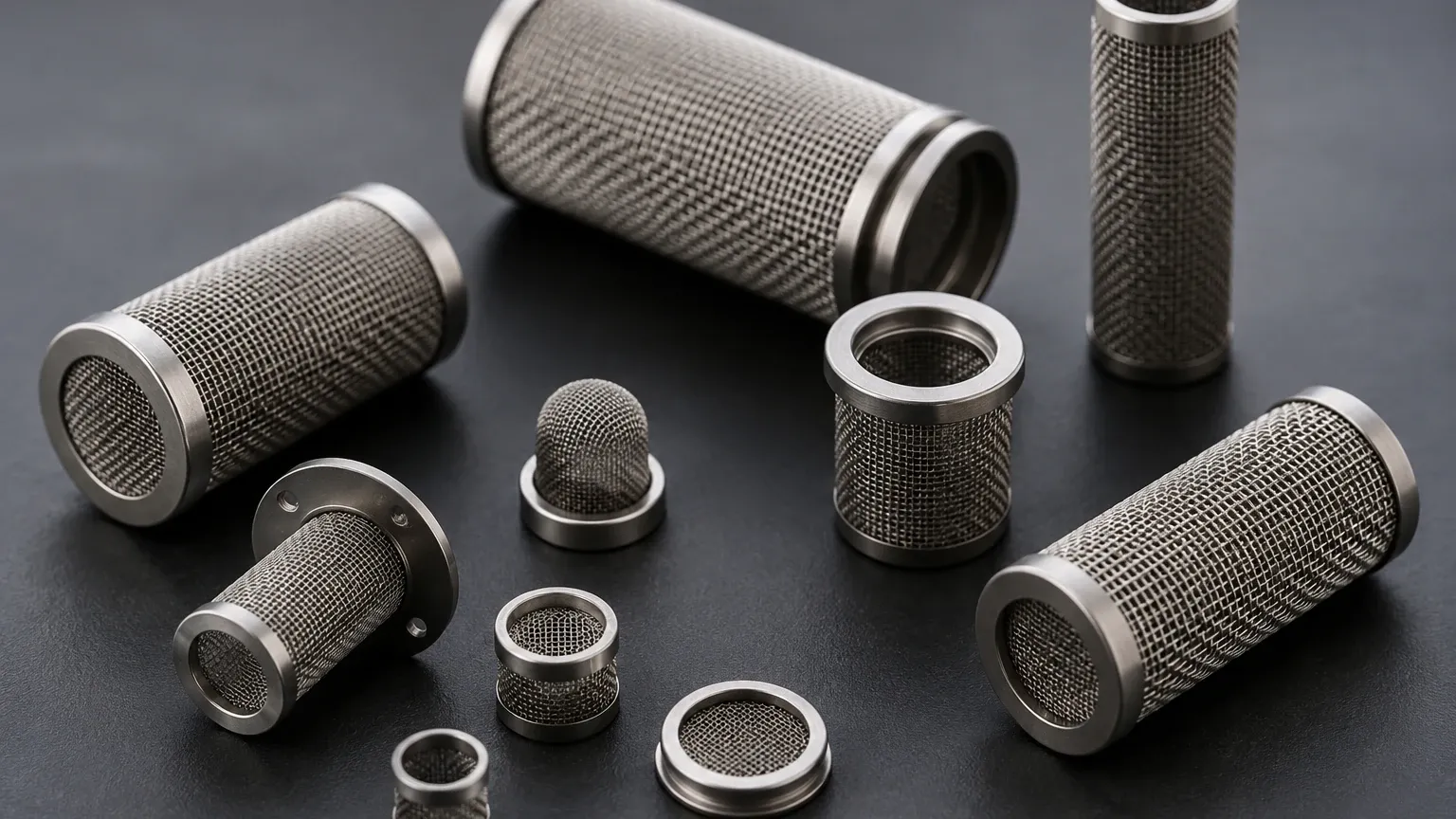
Selecting the correct configuration for Wire Mesh Filter Cylinders & Tubes involves understanding the interplay between mesh geometry, fluid dynamics, and the mechanical stresses inherent in compact industrial housings. This article provides a technical overview of the engineering considerations, material science, and selection criteria for small-scale stainless steel filtration components.
Technical Fundamentals of Wire Mesh Geometry
The performance of a small wire mesh filter is primarily defined by its weave pattern and wire diameter. In industrial applications, stainless steel wire mesh is woven to precise specifications to create uniform pore sizes. For small cylinders and tubes, the choice of weave affects both the filtration accuracy and the mechanical flexibility of the component during fabrication.
Weave Types and Their Implications
1. Plain Weave: The most common structure where each warp wire crosses over and under each weft wire. It provides the highest open area and lowest pressure drop, making it ideal for high-flow applications where coarse filtration is sufficient.
2. Twilled Weave: Each weft wire passes over and under two warp wires. This allows for a heavier wire diameter to be used for a given mesh count, increasing the mechanical strength of the filter tube.
3. Dutch Weave (Plain and Twilled): This weave utilizes different wire diameters for the warp and weft. It results in a dense, firm mesh with small, curved openings. Dutch weave is the standard for fine filtration (down to 5-10 microns) in small-scale components because it offers superior pressure resistance compared to square mesh.
Pore Size vs. Mesh Count
Engineers must distinguish between nominal and absolute micron ratings. In a small wire mesh filter, the "mesh count" refers to the number of openings per linear inch. However, the filtration efficiency is determined by the pore size, which is the physical dimension of the largest particle that can pass through the mesh. For critical applications, absolute ratings are required to ensure 100% retention of particles above a specific size.
Material Selection for Demanding Environments
Industrial filtration often occurs in aggressive chemical environments or at extreme temperatures. Stainless steel is the material of choice due to its corrosion resistance and mechanical durability. The specific grade of stainless steel selected will impact the total cost of ownership and the replacement cycle of the filter.
* AISI 304/304L: The standard grade for general industrial use. It provides good corrosion resistance and is highly weldable, which is essential for forming small-diameter tubes.
* AISI 316/316L: Contains molybdenum, which significantly enhances resistance to pitting and crevice corrosion in chloride-rich environments. This is the preferred material for pharmaceutical and marine applications.
* 904L and Duplex Steels: Used in highly acidic or specialized chemical processing where standard austenitic steels may fail.
* High-Temperature Alloys: For applications exceeding 400°C, specialized alloys like Inconel or Monel may be used, though these are typically reserved for extreme aerospace or chemical synthesis environments.
Structural Design of Wire Mesh Filter Cylinders & Tubes
When a wire mesh is formed into a cylinder or tube, its structural integrity becomes a primary engineering concern. Small filters often face high fluid velocities relative to their surface area, leading to potential deformation if not properly supported.
Construction Methods
The fabrication of Wire Mesh Filter Cylinders & Tubes typically involves longitudinal welding. High-precision TIG (Tungsten Inert Gas) or plasma welding is used to ensure a clean, burr-free seam that maintains the filtration integrity of the mesh. For very small diameters, laser welding provides the necessary precision to avoid damaging the fine wire structure.
Reinforcement and Support
To prevent the mesh from collapsing under high differential pressure (ΔP), small filters are often designed with a multi-layer approach:
* Single Layer: Suitable for low-pressure applications or where the mesh itself is sufficiently rigid.
* Multi-layer Sintered Mesh: Multiple layers of mesh are bonded together through heat and pressure (sintering) to create a single, robust plate that is then formed into a tube. This provides excellent mechanical strength and a fixed pore structure.
* Perforated Metal Support: A small wire mesh filter can be sleeved over or inside a perforated stainless steel core. The perforated core provides the structural skeleton, while the mesh provides the filtration accuracy.
Performance Evaluation Criteria
Before specifying a small wire mesh filter for an industrial system, engineers must evaluate several performance metrics to ensure the component meets the application's demands.
Pressure Drop (ΔP)
The pressure drop across a filter is a function of the fluid viscosity, flow rate, and the open area of the mesh. In small-scale systems, an excessive pressure drop can lead to pump cavitation or system inefficiency. It is essential to calculate the clean pressure drop and define the maximum allowable pressure drop before the filter requires cleaning or replacement.
Dirt Holding Capacity
Small filters have limited surface area. To extend the service life, engineers may opt for pleated designs. Pleating the wire mesh increases the effective filtration area within the same physical footprint, significantly improving the dirt-holding capacity and reducing the frequency of maintenance intervals.
Flow Dynamics
In small-diameter tubes, the flow pattern (laminar vs. turbulent) can affect how particles interact with the mesh surface. Designers must ensure that the internal diameter of the filter tube does not create excessive turbulence that could bypass the mesh or cause erosion of the wire over time.
Installation and Sealing Considerations
A filter is only as effective as its seal. In small-scale industrial applications, bypass—where fluid flows around the filter rather than through it—is a common failure mode. Proper integration into the housing is critical.
End Cap Configurations
Small wire mesh filters are typically finished with stainless steel end caps. These can be configured as:
* DOE (Double Open End): Requires gaskets at both ends to seal against the housing.
* SOE (Single Open End): Often features a threaded connection (NPT/BSP) or an O-ring plug (e.g., 222 or 226 fittings) for a secure, leak-proof interface.
* Flanged or Welded: For permanent installations in high-pressure manifolds.
* Flat or Pointed Caps: Depending on the flow direction and the need for sediment collection.
Sealing Materials
The choice of O-ring or gasket material (Viton, EPDM, PTFE, or Silicone) must be compatible with the process fluid and the operating temperature. PTFE is often preferred for chemical compatibility, while Viton is standard for high-temperature oil and gas applications.
Maintenance and Cleaning of Stainless Steel Filters
One of the primary advantages of using a stainless steel small wire mesh filter over disposable synthetic filters is cleanability. This contributes to a lower total cost of ownership and reduces industrial waste.
Cleaning Techniques
1. Ultrasonic Cleaning: The most effective method for small, intricate mesh structures. High-frequency sound waves create cavitation bubbles that dislodge fine particles trapped deep within the weave.
2. Backwashing: Reversing the flow of fluid through the filter to flush out accumulated debris. This is often integrated into automated systems.
3. Chemical Cleaning: Using compatible solvents or acids to dissolve organic or mineral deposits. This must be done with care to ensure the chemical does not degrade the stainless steel grade or the weld seams.
Replacement Cycles
While stainless steel filters are durable, they are not infinite. Fatigue from pressure cycling or erosion from high-velocity abrasive particles will eventually necessitate replacement. Engineers should establish a maintenance schedule based on the observed pressure drop trends and periodic visual inspections.
Critical Information for International Procurement
When sourcing small wire mesh filters for B2B industrial applications, providing comprehensive technical data to the manufacturer is essential for ensuring the component's performance. International buyers should confirm the following details:
* Dimensional Accuracy: Specify outer diameter (OD), inner diameter (ID), and overall length (OAL) with required tolerances.
* Filtration Grade: Define the absolute or nominal micron rating required.
* Operating Conditions: Provide maximum operating temperature, normal and peak flow rates, and the chemical composition of the fluid.
* Structural Requirements: State the maximum expected differential pressure (collapse pressure).
* Certifications: If the application is in the food, beverage, or pharmaceutical sector, confirm compliance with FDA or EU food contact regulations.
* Quantity and Consistency: For OEM applications, verify the manufacturer's ability to maintain consistent mesh quality and weld integrity across large batches.
Conclusion
The integration of a small wire mesh filter into an industrial system is a strategic decision that impacts the reliability and longevity of the entire process. By focusing on material science, weave geometry, and structural reinforcement, engineers can select Wire Mesh Filter Cylinders & Tubes that provide precise filtration without compromising system efficiency. Whether used in hydraulic circuits, chemical micro-reactors, or pharmaceutical processing, these stainless steel components offer a durable, cleanable, and highly customizable solution for demanding filtration requirements.
