


Engineering Guide to SS Wire Mesh Filter Cartridges: Performance, Selection, and Industrial Application
In industrial filtration, the selection of a filter medium is dictated by the chemical environment, thermal conditions, and the required precision of particle separation. The ss wire mesh filter cartridge has emerged as a standard for demanding applications where polymer-based filters fail due to temperature or chemical degradation. Unlike disposable depth filters, stainless steel cartridges provide a rigid, cleanable, and highly predictable filtration barrier.
For engineers and procurement teams, understanding the nuances of construction—specifically the transition from simple mesh to integrated Wire Mesh Filter Cylinders & Tubes—is essential for optimizing system uptime and ensuring product purity. This guide explores the technical specifications, material considerations, and engineering criteria necessary for selecting and maintaining stainless steel filtration components.
Understanding the Structural Integrity of Wire Mesh Filter Cylinders & Tubes
The performance of an ss wire mesh filter cartridge is not solely dependent on the mesh itself but on the structural architecture that supports it. In high-pressure or high-viscosity applications, the pressure differential (ΔP) across the filter medium can be significant. Without proper reinforcement, the fine wire mesh would collapse or deform, leading to bypass or mechanical failure.
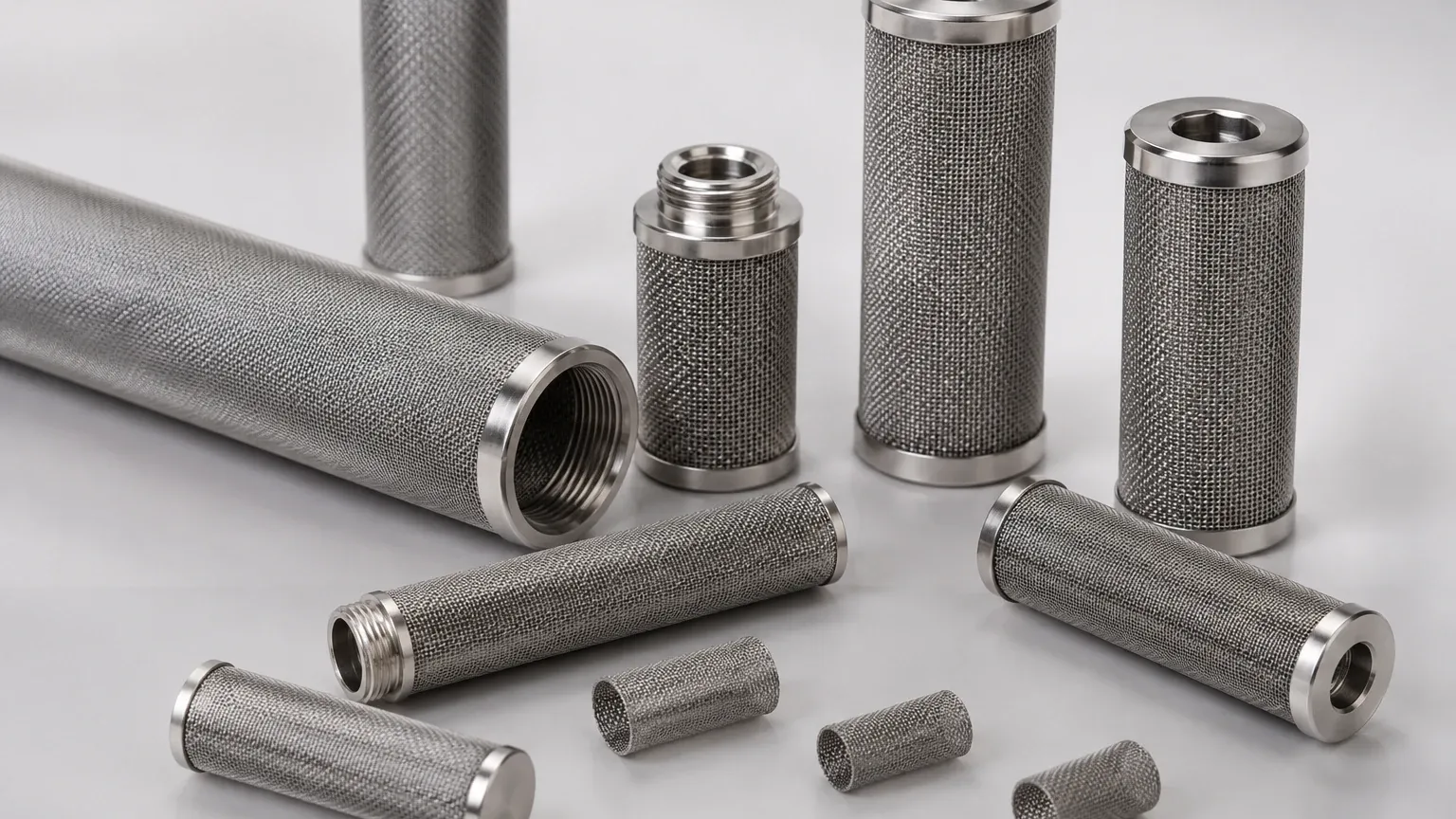
Industrial-grade Wire Mesh Filter Cylinders & Tubes typically utilize a multi-layer construction. This often includes:
1. The Filtration Layer: The primary mesh layer that determines the micron rating.
2. Support Layers: Coarser mesh layers on either side of the filtration layer that provide mechanical stability and protect the fine wires from hydraulic shock.
3. The Internal Core: A perforated stainless steel tube or a high-strength spiral-welded core that provides the primary structural framework, allowing the cartridge to withstand high collapse pressures.
By integrating these components, manufacturers like Kaifil ensure that the filter maintains its geometric integrity even under fluctuating flow conditions. This structural rigidity is a key differentiator when comparing stainless steel options to pleated paper or melt-blown cartridges.
Material Science: Selecting the Right Stainless Steel Grade
Material selection is the first line of defense against corrosion and premature failure. The most common materials used in the production of an ss wire mesh filter cartridge are T304 and T316L stainless steel, though exotic alloys may be used for extreme environments.
* Stainless Steel 304: Suitable for general industrial applications, water filtration, and less aggressive chemical environments. It offers good strength and basic corrosion resistance at a lower cost point.
* Stainless Steel 316L: The "L" stands for low carbon, which improves weldability and resistance to intergranular corrosion. 316L contains molybdenum, making it significantly more resistant to chlorides and pitting. This is the standard choice for pharmaceutical, food and beverage, and marine applications.
* Specialty Alloys: For highly acidic or high-temperature applications (exceeding 500°C), alloys such as Hastelloy, Inconel, or Monel may be utilized within the mesh structure to prevent stress corrosion cracking.
Engineers must confirm the chemical compatibility of the process fluid with the chosen alloy. Even a small percentage of a specific corrosive agent can lead to localized pitting, which compromises the filtration accuracy of the mesh.
Filtration Mechanics and Mesh Weave Types
The efficiency of an ss wire mesh filter cartridge is defined by its weave. The method by which the wires are interlaced dictates the pore shape, the open area percentage, and the dirt-holding capacity.
Plain Weave
This is the most straightforward weave where each warp wire crosses over and under each shute wire. It provides a high open area and low pressure drop, making it ideal for high-flow, low-precision straining applications.
Twill Weave
In a twill weave, wires cross over two and under two wires. This allows for the use of heavier wires in a given mesh count, resulting in a stronger mesh that is less prone to shifting under pressure. It is often used for finer filtration tasks where durability is paramount.
Dutch Weave (Plain and Twill)
Dutch weaves use different diameters for warp and shute wires. This creates a dense, triangular pore structure. Plain Dutch weaves offer high mechanical strength and are excellent for high-pressure filtration. Twill Dutch weaves allow for even finer micron ratings, often reaching down to 1–5 microns, while maintaining a robust structure that resists blinding.
Design Considerations for High-Pressure Industrial Applications
When specifying Wire Mesh Filter Cylinders & Tubes, engineers must account for the mechanical stresses of the specific installation. A critical factor is the "Collapse Pressure Rating." If the differential pressure across the cartridge exceeds the strength of the internal support core, the cartridge will fail, potentially releasing captured contaminants into the downstream flow.
Another design consideration is the end-cap configuration. To ensure a leak-proof seal within the filter housing, the ss wire mesh filter cartridge must be fitted with appropriate end-caps, such as:
* DOE (Double Open End): Used with flat gaskets, typically for lower-pressure applications.
* Code 7 (226 O-Rings/Fin): Features a bayonet-style locking mechanism and double O-rings for high-purity applications where bypass must be zero.
* NPT/Threaded Fittings: Used for permanent or high-pressure installations where the filter is integrated directly into the piping manifold.
Welding techniques also play a role. Precision TIG (Tungsten Inert Gas) or plasma welding is preferred over adhesive bonding to ensure the cartridge remains chemically inert and heat resistant.
Performance Evaluation: Micron Ratings and Flow Dynamics
In the context of an ss wire mesh filter cartridge, it is important to distinguish between "Nominal" and "Absolute" micron ratings.
* Nominal Rating: Indicates the ability of the filter to retain a majority of particles of a specified size (e.g., 90% of 10-micron particles). This is often used for general-purpose straining.
* Absolute Rating: Refers to the diameter of the largest hard spherical particle that will pass through the filter under specified test conditions. For critical pharmaceutical or chemical processes, an absolute-rated mesh is required to guarantee the removal of specific contaminants.
Flow dynamics also involve calculating the "Clean Pressure Drop." A filter with a very fine micron rating but a low open area will cause a significant drop in system pressure, requiring more pumping power. By selecting the appropriate weave and optimizing the surface area—often through pleating the wire mesh—engineers can balance filtration precision with energy efficiency.
Maintenance, Cleaning, and the Total Cost of Ownership
One of the primary advantages of a stainless steel filter over disposable media is the ability to clean and reuse the component. This significantly reduces the long-term total cost of ownership (TCO) and minimizes waste.
Cleaning Methods
1. Backwashing: Reversing the flow of fluid through the ss wire mesh filter cartridge to dislodge surface-accumulated particles. This is effective for surface-filtration meshes like plain or dutch weaves.
2. Ultrasonic Cleaning: Using high-frequency sound waves in a cleaning solvent to create cavitation bubbles. This is the most effective method for removing fine particles trapped deep within the mesh layers.
3. Chemical Cleaning: Soaking the cartridge in acids, alkalis, or surfactants to dissolve organic or mineral scaling. This requires careful selection of chemicals to avoid damaging the stainless steel passivated layer.
Replacement Cycles
While stainless steel is durable, it is not infinite. Over many cleaning cycles, the wires may undergo fatigue or the pores may become permanently blinded (clogged). Engineers should monitor the pressure differential after cleaning. If the "cleaned" ΔP is significantly higher than the original clean ΔP, the cartridge has reached the end of its service life and should be replaced.
Critical Specifications for Procurement and OEM Customization
When sourcing Wire Mesh Filter Cylinders & Tubes for industrial equipment, providing vague specifications can lead to performance gaps. International buyers and engineers should confirm the following data points with the manufacturer:
* Operating Temperature and Pressure: Define the maximum and continuous operating peaks.
* Fluid Viscosity: Higher viscosity fluids require larger surface areas or coarser meshes to maintain flow.
* Particle Loading: The concentration and type of solids (slimy, hard, fibrous) influence the choice of weave and the frequency of cleaning.
* Dimensional Tolerances: For OEM integration, precise outer diameter (OD), inner diameter (ID), and overall length (OAL) are critical for fitment within existing housings.
* Certification Requirements: Applications in the food industry may require FDA-compliant materials or 3A sanitary standards.
Kaifil specializes in bridging the gap between standard catalog items and custom-engineered solutions. By focusing on the specific hydraulic and chemical demands of an application, it is possible to design an ss wire mesh filter cartridge that maximizes throughput while protecting sensitive downstream equipment like pumps, spray nozzles, and heat exchangers.
Conclusion
Stainless steel filtration components represent a significant investment in system reliability. By understanding the structural benefits of Wire Mesh Filter Cylinders & Tubes and the technical nuances of mesh weaves and material grades, industrial professionals can achieve a balance between filtration precision and operational longevity. Whether for chemical processing, hydraulic systems, or food production, the correct ss wire mesh filter cartridge serves as a permanent, high-performance solution to the challenges of modern industrial filtration.
