


Wire Mesh Filter Size: An Engineering Guide for Industrial Applications
In industrial filtration, the term "size" refers to a multi-dimensional set of specifications that determine the performance, longevity, and compatibility of a filtration component. For engineers and procurement specialists, selecting the correct wire mesh filter size is a critical step in optimizing process efficiency and protecting downstream equipment. Whether the application involves chemical processing, hydraulic systems, or food and beverage production, understanding the technical nuances of mesh dimensions and cylinder geometry is essential.
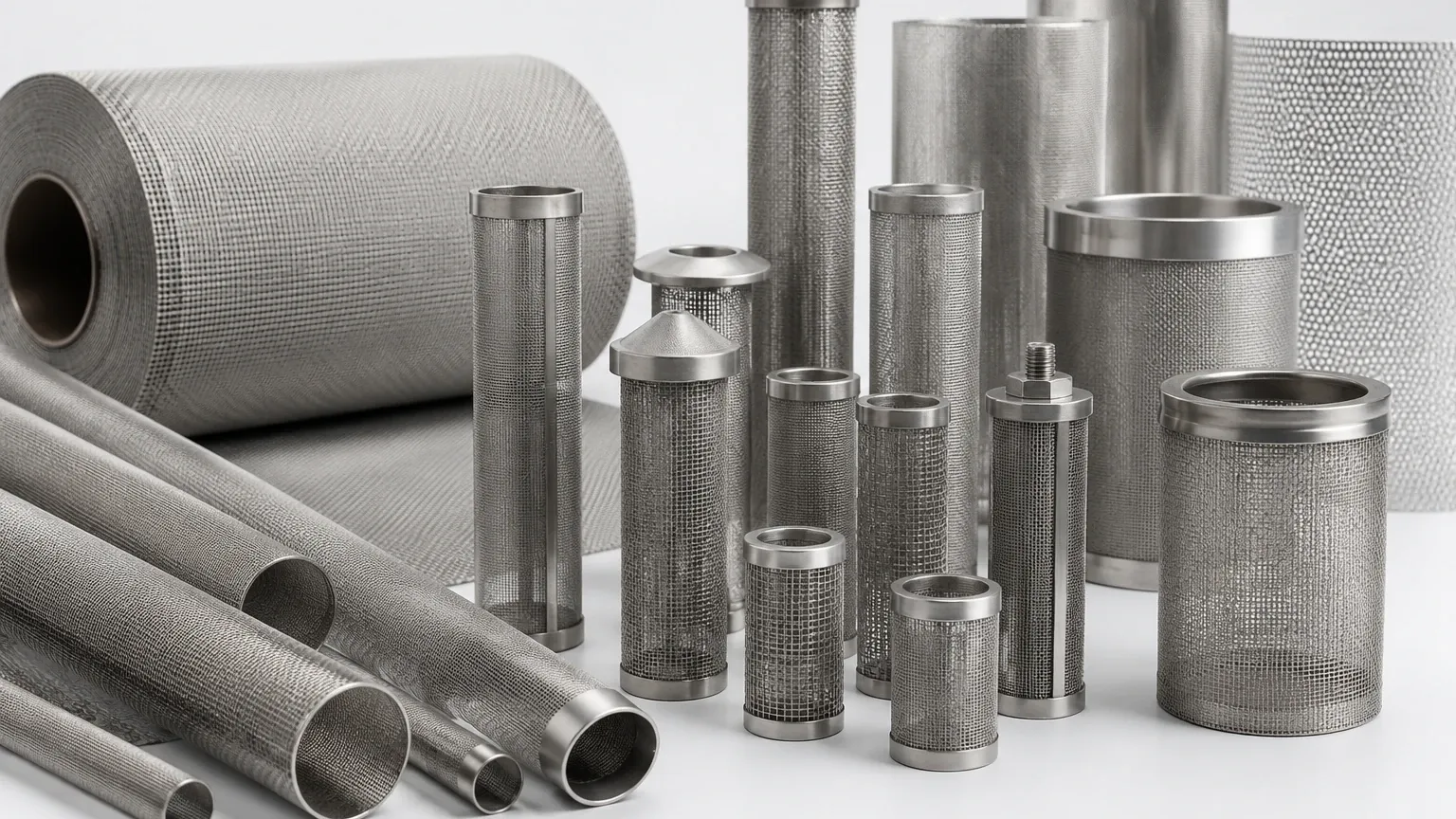
This guide explores the engineering principles behind sizing Wire Mesh Filter Cylinders & Tubes, focusing on how aperture, wire diameter, and overall physical dimensions impact industrial filtration outcomes.
Understanding the Components of Wire Mesh Filter Size
When specifying a wire mesh filter, "size" is often used interchangeably to describe two distinct concepts: the filtration accuracy (the size of the particles removed) and the physical dimensions of the filter element itself. To ensure a precise fit and function, both must be defined with technical accuracy.
Mesh Count vs. Aperture Size
The most common way to define the filtration capability of a mesh is through the mesh count. This refers to the number of wires per linear inch (25.4 mm) in both the warp and weft directions. However, mesh count alone does not provide the full picture. The actual "opening" or aperture size is what determines the largest particle that can pass through the filter.
The relationship is defined by the formula:
Aperture (w) = (1 / Mesh Count) – Wire Diameter (d)
For example, a 100-mesh screen with a wire diameter of 0.10 mm will have a different aperture than a 100-mesh screen with a wire diameter of 0.12 mm. In critical industrial applications, engineers should specify the required micron rating (the aperture size in micrometers) rather than just the mesh count to ensure consistency.
Wire Diameter and Open Area
The wire diameter significantly influences the structural integrity and the "Open Area" percentage of the filter. The open area is the ratio of the total area of the apertures to the total area of the mesh. A higher open area percentage results in lower initial pressure drops and higher flow rates but may compromise the mechanical strength of the mesh.
Open Area % = (w / (w + d))² × 100
Where *w* is the aperture and *d* is the wire diameter. In high-pressure environments, such as hydraulic systems, a larger wire diameter may be necessary to prevent mesh deformation, even if it reduces the total open area.
Geometric Specifications for Wire Mesh Filter Cylinders & Tubes
Beyond the mesh specifications, the physical dimensions of the filter element—specifically Wire Mesh Filter Cylinders & Tubes—must be precisely engineered to fit into housing units and handle the required volumetric flow.
Outer Diameter (OD) and Inner Diameter (ID)
The diameter of a filter cylinder determines its surface area and its fit within the filter housing. For cylindrical filters, the Outer Diameter (OD) is typically the critical dimension for external-to-internal flow patterns, while the Inner Diameter (ID) is vital for internal-to-external flow. Tolerances are critical here; even a 0.5 mm variance can lead to bypass issues or installation failures in precision-engineered housings.
Length and Surface Area
The length of the tube directly correlates to the total filtration surface area. In industrial engineering, maximizing the Effective Filtration Area (EFA) is a primary goal. A larger EFA allows for:
* Lower Face Velocity: Reducing the speed at which the fluid passes through the mesh, which improves filtration efficiency for deformable particles.
* Extended Service Life: A larger surface area can hold more contaminants before reaching the terminal pressure drop, thereby extending the replacement cycle.
Wall Thickness and Layers
In many demanding applications, a single layer of wire mesh lacks the necessary rigidity. Multi-layer Wire Mesh Filter Cylinders & Tubes are often employed. These may consist of a fine filtration layer bonded to or supported by a coarser mesh or a perforated metal core. The total wall thickness must be accounted for when calculating the ID and OD to ensure the assembly fits the intended hardware.
The Relationship Between Mesh Size and Flow Dynamics
Selecting a wire mesh filter size is a balancing act between filtration efficiency and flow resistance. This relationship is governed by the principles of fluid dynamics, specifically the pressure drop ($ΔP$).
Pressure Drop Considerations
As fluid passes through the mesh, it encounters resistance. The initial pressure drop is influenced by the fluid's viscosity, the flow velocity, and the mesh's open area. If the selected mesh size is too fine for the application, the initial $ΔP$ will be high, leaving little room for contaminant loading before the filter reaches its maximum allowable pressure drop.
Engineers must calculate the "Clean Pressure Drop" using the manufacturer's flow curves to ensure the system's pump or gravity feed can handle the resistance. If the $ΔP$ is too high, the solution is often to increase the physical size of the filter (length or diameter) or to opt for a mesh with a higher open area percentage.
Viscosity and Particle Loading
High-viscosity fluids, such as heavy oils or polymers, require larger apertures or significantly larger surface areas to maintain acceptable flow rates. Furthermore, the nature of the contaminants—whether they are hard, spherical particles or soft, fibrous materials—will dictate the ideal wire mesh filter size. Fibrous materials tend to "bridge" across apertures, causing a faster rise in pressure drop than granular particles.
Material Selection and Structural Integrity
The performance of a specific wire mesh filter size is also dependent on the material used. Kaifil primarily utilizes stainless steel (Grades 304, 316, and 316L) due to its excellent corrosion resistance and mechanical properties.
Stainless Steel 304 vs. 316L
* Type 304: Suitable for general industrial use, offering good strength and oxidation resistance.
* Type 316L: Contains molybdenum, providing superior resistance to chlorides and pitting. This is the standard for pharmaceutical and chemical processing where the "size" of the mesh must remain constant despite exposure to corrosive agents.
In high-temperature applications, the thermal expansion of the metal must be considered. If a filter tube is constrained at both ends, thermal stress can cause the mesh to buckle or the seams to fail. Engineering the filter with appropriate clearances or flexible end-fittings is necessary for these environments.
Customization and Specification for OEM Projects
For many industrial equipment manufacturers, standard off-the-shelf filter sizes are insufficient. Custom-engineered solutions allow for the optimization of the filter to the specific constraints of the machine.
Specifying Custom Dimensions
When requesting a quote for custom Wire Mesh Filter Cylinders & Tubes, technical teams should provide the following data:
1. Micron Rating or Mesh Count: Define the required filtration accuracy.
2. Physical Dimensions: Length, OD, and ID with required tolerances.
3. End Configuration: Options include open ends, closed ends (flat or conical), threaded fittings, or flanged edges.
4. Structural Support: Requirement for internal or external perforated cores or support mesh layers.
5. Operating Conditions: Maximum operating pressure, temperature, and fluid compatibility.
Kaifil’s manufacturing process involves precision cutting, rolling, and welding (TIG, plasma, or resistance welding) to ensure that the seams are as strong as the parent mesh and do not introduce bypass points.
Maintenance and Replacement Considerations
The choice of wire mesh filter size directly impacts the Total Cost of Ownership (TCO). While a finer mesh provides better protection, it may require more frequent cleaning or replacement.
Cleanability
One of the primary advantages of stainless steel wire mesh is its ability to be cleaned and reused. Methods such as backwashing, ultrasonic cleaning, or chemical soaking can restore the filter's performance. However, if the mesh size is extremely fine (e.g., below 20 microns), the risk of "permanent blinding"—where particles become wedged in the mesh and cannot be removed—increases. In such cases, a larger surface area or a different weave type (such as Dutch weave) may be recommended to facilitate better cleaning.
Monitoring Performance
In industrial settings, the filter's condition should be monitored using differential pressure gauges. A sudden drop in pressure may indicate a mesh failure (a "burst" or tear), while a rapid increase suggests heavy contaminant loading or the incorrect selection of mesh size for the current process conditions.
Conclusion
Selecting the appropriate wire mesh filter size involves a comprehensive evaluation of both the microscopic properties of the mesh and the macroscopic dimensions of the filter element. By understanding the interplay between mesh count, wire diameter, and cylinder geometry, engineers can specify filtration solutions that provide the optimal balance of particle retention, flow capacity, and structural durability.
As a specialist in custom stainless steel filtration, Kaifil provides the technical expertise required to develop high-performance Wire Mesh Filter Cylinders & Tubes tailored to the most demanding industrial environments. Proper sizing is not just a measurement—it is a critical engineering decision that ensures the reliability of the entire industrial process.
