


Engineering Guide to Steel Mesh Filter Coffee: Industrial Filtration Solutions and Selection
In the industrial food and beverage sector, the transition from traditional paper media to permanent stainless steel filtration has fundamentally changed the efficiency and flavor profile of large-scale coffee production. For engineers and equipment manufacturers, selecting the right steel mesh filter coffee component involves more than just choosing a mesh size; it requires a deep understanding of fluid dynamics, material science, and mechanical durability.
Stainless steel wire mesh provides a reusable, high-precision alternative to disposable filters, offering significant advantages in terms of total cost of ownership (TCO) and environmental impact. This guide explores the technical specifications, engineering considerations, and application parameters for integrating Wire Mesh Filter Cylinders & Tubes into industrial brewing and extraction systems.
1. Operating Principles of Stainless Steel Mesh in Coffee Extraction
Industrial coffee extraction relies on the precise separation of insoluble coffee grounds from the liquid extract. Unlike paper filters, which rely on depth filtration and can absorb essential oils, stainless steel mesh operates primarily through surface filtration.
Pore Geometry and Particle Retention
The effectiveness of a steel mesh filter coffee system is defined by its micron rating. In industrial settings, the goal is often to achieve a specific "mouthfeel" by allowing certain colloidal solids and oils to pass through while retaining the larger particulates.
* Coarse Filtration (200–500 microns): Typically used in the initial stages of cold brew production or for coarse-grind industrial steeping.
* Fine Filtration (50–150 microns): Standard for most commercial brewing equipment, balancing flow rate with clarity.
* Ultra-Fine Filtration (below 50 microns): Utilized in specialty extraction processes where a cleaner, sediment-free profile is required without the chemical interference of paper.
Flow Rate and Pressure Differential
Engineers must calculate the open area percentage of the mesh to ensure that the filter does not become a bottleneck in the production line. A higher open area reduces the pressure drop (∆P) across the filter, which is critical in gravity-fed or low-pressure pump systems. However, increasing the open area often requires thinner wires, which can compromise the structural integrity of the filter under high-volume throughput.
2. Material Selection: 304 vs. 316L Stainless Steel
In the context of coffee—a mildly acidic beverage with a pH typically ranging from 4.85 to 5.10—material selection is paramount to prevent corrosion and ensure food safety compliance (FDA/EHEDG).
Grade 304 Stainless Steel
Grade 304 is the standard for most food-grade applications. It offers excellent formability and cost-effectiveness. For standard brewing temperatures and routine cleaning cycles, 304 provides sufficient corrosion resistance.
Grade 316L Stainless Steel
For industrial facilities using aggressive Clean-in-Place (CIP) chemicals or processing high-concentration coffee extracts at elevated temperatures, 316L is the preferred choice. The addition of molybdenum enhances resistance to pitting and crevice corrosion. 316L is also recommended for coastal manufacturing facilities where atmospheric chlorides might affect the exterior of the equipment.
Surface Finish and Passivation
Beyond the alloy type, the surface finish of the wire mesh is critical. Electropolishing is often employed to remove microscopic burrs and create a featureless surface. This process not only improves the corrosion resistance of the steel mesh filter coffee components but also prevents coffee oils and fine particulates from adhering to the wires, making the cleaning process more efficient.
3. Structural Design: Wire Mesh Filter Cylinders & Tubes
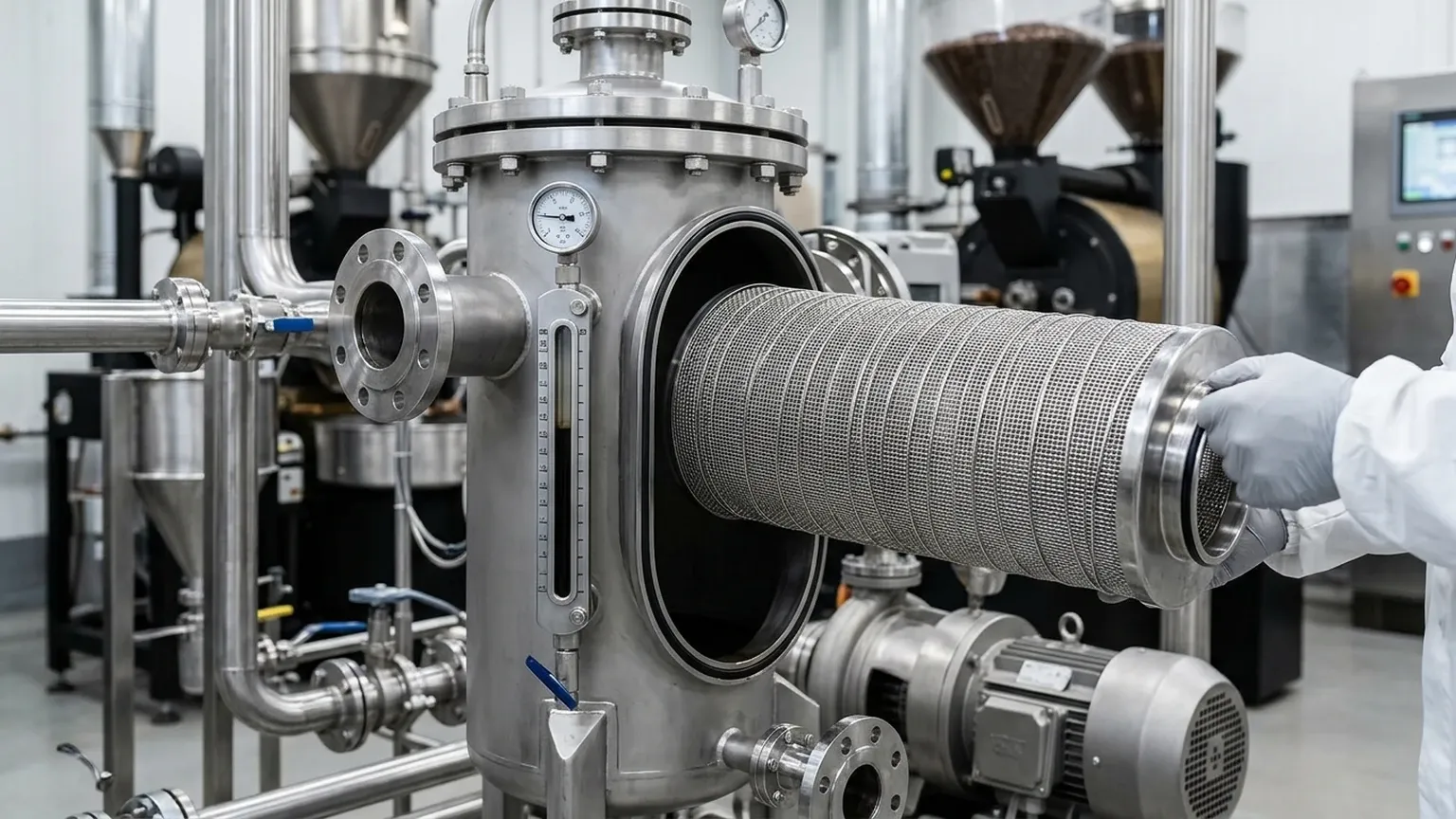
Industrial coffee equipment rarely uses flat mesh discs. Instead, Wire Mesh Filter Cylinders & Tubes are the industry standard due to their high surface-area-to-volume ratio and mechanical strength.
Weave Types for Coffee Filtration
1. Plain Weave: The most common and economical weave, providing a square opening. It is ideal for high-flow applications where the particle size distribution is relatively uniform.
2. Twill Weave: Allows for a heavier wire diameter in a given mesh count, increasing the strength of the filter for pressurized extraction systems.
3. Dutch Weave: This weave features a higher density of wires, creating a tortuous path for the fluid. It is excellent for high-pressure applications where extreme precision and structural rigidity are required to prevent mesh migration.
Reinforcement and Support
In large-scale industrial brewers, the mesh tube often requires a support core. This is typically a perforated metal cylinder that provides the necessary rigidity to withstand the weight of saturated coffee grounds or the force of a hydraulic press. The wire mesh is then sintered or welded to the support structure to ensure a seamless, bypass-free assembly.
4. Application Risks and Mitigation in Industrial Brewing
Implementing a permanent steel mesh filter coffee solution requires addressing several engineering challenges to ensure long-term performance.
Blinding and Clogging
Blinding occurs when fine coffee dust (fines) becomes lodged within the mesh openings. This is particularly prevalent in espresso-grind applications. To mitigate this, engineers should:
* Specify a mesh count that accounts for the specific grind size distribution.
* Implement back-flushing or ultrasonic cleaning protocols in the maintenance cycle.
* Consider multi-layer sintered mesh, which combines a fine filtration layer with coarser drainage and support layers to improve cake release.
Mechanical Fatigue
Repeated thermal cycling (from room temperature to boiling) and pressure fluctuations can lead to metal fatigue, especially at the weld points of the filter tube. Using high-quality TIG (Tungsten Inert Gas) or laser welding ensures that the seams of the filter cylinders remain intact under stress. Proper annealing of the wire mesh before fabrication can also reduce internal stresses that lead to premature failure.
Bypass and Sealing
A common failure point in industrial filtration is the seal between the filter element and the housing. For coffee applications, food-grade silicone, EPDM, or PTFE gaskets are used to ensure that 100% of the fluid passes through the mesh. The design of the end caps on the filter tubes must allow for easy removal and replacement of these seals during routine maintenance.
5. Total Cost of Ownership (TCO) and Sustainability
While the initial capital expenditure for a custom-engineered steel mesh filter coffee system is higher than that of paper-based systems, the long-term economic benefits are substantial.
Reduced Waste and Consumables
Industrial facilities processing thousands of gallons of coffee daily generate significant paper waste. By switching to stainless steel mesh, companies eliminate the recurring cost of paper filters and the logistics of managing their inventory. Furthermore, the reduction in waste disposal costs contributes to corporate sustainability goals.
Yield Optimization
Paper filters absorb a portion of the liquid extract along with the oils. In high-volume production, this "retention loss" can account for 2-5% of the total volume. Stainless steel mesh does not absorb liquid, allowing for higher yields per pound of coffee beans. Over the course of a year, this increased efficiency can result in tens of thousands of dollars in savings for large-scale processors.
6. Selection Criteria for International Buyers and Engineers
When sourcing Wire Mesh Filter Cylinders & Tubes for coffee applications, international buyers should provide the following specifications to the manufacturer to ensure a precise fit:
1. Micron Rating: Define the absolute or nominal filtration accuracy required based on the coffee grind profile.
2. Flow Rate (GPM/LPM): The maximum volume of liquid the filter must handle per minute at a specific pressure drop.
3. Temperature Range: Maximum operating temperature and the frequency of thermal cycling.
4. Chemical Compatibility: Details of the cleaning agents used (e.g., caustic soda, nitric acid) to ensure the appropriate stainless steel grade is selected.
5. Mechanical Dimensions: Length, outer diameter (OD), and inner diameter (ID), along with tolerances required for the housing interface.
6. End Cap Configuration: Threaded, flanged, or open-ended designs to match the existing equipment architecture.
Conclusion
The integration of stainless steel wire mesh into industrial coffee production represents a sophisticated engineering solution to the challenges of clarity, consistency, and cost-efficiency. By carefully selecting the weave type, material grade, and structural design of steel mesh filter coffee components, manufacturers can optimize their extraction processes for superior performance.
As the industry moves toward more sustainable and automated production methods, the role of precision-engineered Wire Mesh Filter Cylinders & Tubes will continue to expand, providing the durability and accuracy required for the next generation of industrial brewing equipment.
