


In industrial filtration, selecting the appropriate media is a balance between hydraulic performance, mechanical durability, and capital expenditure. Among the various technologies available, V wire screens—often referred to as wedge wire—stand out for their high open area and non-clogging characteristics. For procurement managers and process engineers, understanding the variables that dictate the v wire screen filter price is essential for optimizing the total cost of ownership (TCO) in demanding environments like chemical processing, water treatment, and food production.
While standard Wire Mesh Filter Cylinders & Tubes offer excellent precision for fine filtration, V wire screens provide a robust alternative for applications requiring high structural integrity and efficient backwashing capabilities. This guide examines the engineering principles, material considerations, and manufacturing complexities that influence the pricing and performance of these critical components.
Engineering Principles of V Wire Screen Technology
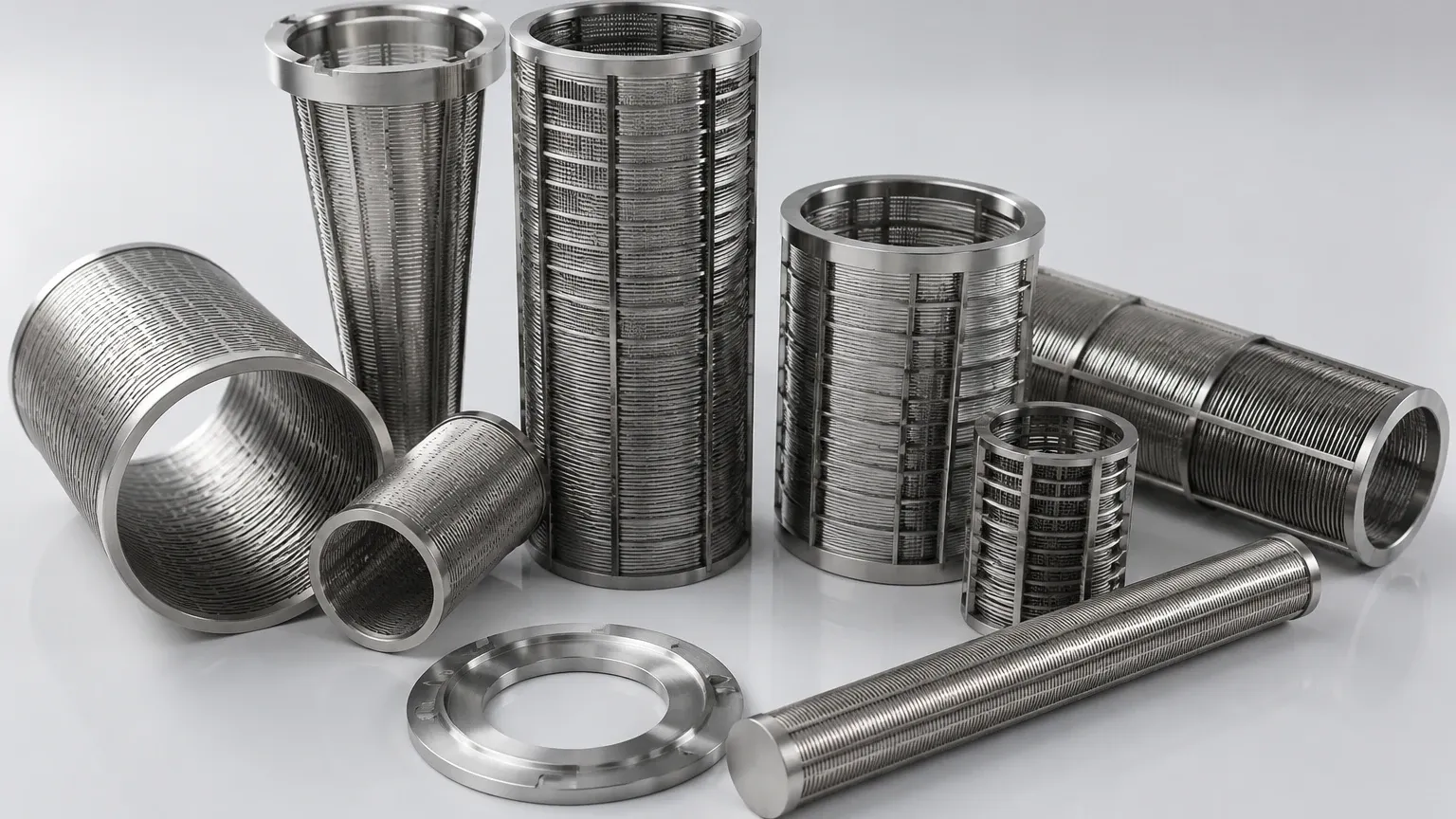
The fundamental advantage of a V wire screen lies in its geometry. Unlike traditional woven wire mesh, which consists of interlaced wires, a V wire screen is constructed by welding a continuous V-shaped profile wire onto longitudinal support rods. This creates a slot that widens inwardly, ensuring that any particle small enough to pass through the surface aperture will continue through the filter without becoming wedged.
This "two-point contact" design is the primary reason for the technology's non-clogging nature. From an engineering perspective, this results in lower pressure drops across the media and more consistent flow rates over extended periods. When evaluating the v wire screen filter price, it is important to recognize that the precision of these slot openings—often maintained within tolerances of ±0.05mm—requires advanced CNC-controlled resistance welding equipment, which contributes to the initial investment cost compared to simpler perforated or woven alternatives.
Critical Factors Influencing V Wire Screen Filter Price
Several technical specifications directly impact the manufacturing cost and, consequently, the market price of V wire filters. Understanding these factors allows engineers to specify the most cost-effective solution without compromising process safety.
1. Material Grade and Alloy Selection
Stainless steel is the industry standard due to its corrosion resistance and mechanical strength. However, the specific grade chosen significantly shifts the cost profile:
* AISI 304/304L: The most common and cost-effective option, suitable for general industrial applications and water treatment.
* AISI 316/316L: Contains molybdenum for enhanced resistance to chlorides and pitting, commonly required in chemical processing and marine environments. This typically carries a 15-25% price premium over 304.
* Duplex and Super Duplex: Used in highly corrosive or high-pressure oil and gas applications. These alloys are significantly more expensive due to both material costs and the specialized welding techniques required.
2. Slot Opening and Open Area Requirements
The slot size determines the filtration rating. Smaller slots require a higher density of profile wires per inch of screen diameter. Because the price is often tied to the weight of the material used and the duration of the welding process, a filter with a 50-micron slot will be substantially more expensive than one with a 500-micron slot, even if the overall dimensions are identical.
3. Structural Reinforcement and Pressure Ratings
In high-pressure hydraulic systems or deep-well applications, the filter must withstand significant collapse pressure. This is achieved by increasing the frequency or the cross-sectional area of the support rods. More support rods increase the material volume and welding time, which are key drivers of the v wire screen filter price. Engineers must calculate the required collapse strength to avoid over-engineering, which unnecessarily inflates costs.
Comparing V Wire Screens with Wire Mesh Filter Cylinders & Tubes
When deciding between wedge wire and Wire Mesh Filter Cylinders & Tubes, it is vital to assess the specific needs of the application. Woven wire mesh is generally preferred for very fine filtration (below 20 microns) where a high degree of surface area is needed in a compact space. Mesh filters are often lighter and can be pleated to increase surface area.
However, V wire screens excel in applications involving:
* Backwashing and Cleaning: The smooth surface and widening slots make V wire screens significantly easier to clean via back-pulsing or mechanical scraping.
* Mechanical Loading: Wedge wire is inherently more rigid. In systems where the filter is subjected to vibration or high-velocity flow, a V wire screen will typically outlast a mesh filter, which may suffer from wire fatigue or displacement.
* Longevity: While the initial v wire screen filter price may be higher than a standard mesh cylinder, the extended service life and reduced downtime often result in a lower TCO.
Customization and OEM Considerations
As a professional manufacturer, Kaifil emphasizes that customization is often more economical than adapting a process to fit standard off-the-shelf components. Customization factors that influence pricing include:
* End Fittings: The type of connection (flanges, threaded fittings, or reinforced rings) affects both the assembly time and the material cost. Precision-machined fittings ensure a leak-proof seal but add to the manufacturing complexity.
* Surface Treatments: Depending on the industry, filters may require passivation, pickling, or electropolishing. Electropolishing, common in the pharmaceutical and food sectors, increases the v wire screen filter price but provides a microscopically smooth surface that prevents bacterial growth and improves corrosion resistance.
* Flow Direction: Designers must specify whether the flow is "Out-to-In" (FOTI) or "In-to-Out" (FITO). FITO designs often require the V-wire to be wrapped on the inside of the support rods, which is a more complex manufacturing process than the standard FOTI configuration.
Evaluating Total Cost of Ownership (TCO)
For B2B procurement, the purchase price is only one component of the value equation. Engineers should evaluate the following when comparing quotes:
1. Maintenance Intervals: How often does the filter require manual cleaning? A higher-priced V wire screen that supports automated backwashing can save thousands in labor costs annually.
2. Replacement Frequency: How many years will the filter last in the specific chemical environment? Using a cheaper alloy that requires replacement every 12 months is rarely as cost-effective as a premium alloy that lasts five years.
3. Energy Efficiency: A filter with an optimized open area reduces the load on pumps. Over the life of the equipment, the energy savings from a lower pressure drop can outweigh the initial v wire screen filter price.
Procurement Checklist for Industrial Filters
Before requesting a quote for Wire Mesh Filter Cylinders & Tubes or V wire screens, engineers should confirm the following technical parameters to ensure accurate pricing and performance:
* Media Characteristics: Viscosity, temperature, and chemical composition of the fluid.
* Particle Load: Type and size of solids to be removed (minimum, average, and maximum).
* Flow Rate: Normal and peak flow requirements (m³/h or GPM).
* Pressure Parameters: Maximum operating pressure and allowable pressure drop (ΔP).
* Mechanical Constraints: Dimensions (OD, ID, Length) and required end-cap configurations.
Conclusion
Navigating the complexities of the v wire screen filter price requires a deep understanding of both the manufacturing process and the operational environment. While V wire screens represent a significant technical investment, their durability, ease of cleaning, and structural integrity make them indispensable in critical industrial processes. By focusing on material selection, slot precision, and structural requirements, engineering teams can secure filtration solutions that provide reliable performance and long-term value. Whether the application calls for the ruggedness of wedge wire or the precision of Wire Mesh Filter Cylinders & Tubes, working with an experienced manufacturer like Kaifil ensures that the final product meets the exact rigorous standards of modern industrial engineering.
