


Wire Filter Mesh
In industrial engineering, the selection of filtration media is a critical decision that impacts process efficiency, equipment longevity, and product purity. Among the various materials available, wire filter mesh remains a cornerstone for high-performance applications. Its versatility, mechanical strength, and precision make it indispensable in sectors ranging from chemical processing to food and beverage production. For technical professionals, understanding the nuances of mesh geometry, material properties, and structural configurations—particularly when integrated into Wire Mesh Filter Cylinders & Tubes—is essential for optimizing system performance.
This guide provides a factual exploration of wire filter mesh technology, focusing on engineering considerations, selection criteria, and the practical application of cylindrical filter components in demanding industrial environments.
Understanding the Fundamentals of Wire Filter Mesh
Wire filter mesh, also referred to as industrial wire cloth or woven wire mesh, is produced by weaving metallic wires in specific patterns to create precise openings. Unlike synthetic filters or non-woven media, wire mesh offers a fixed pore structure that ensures consistent particle retention. The performance of a filter is primarily dictated by its mesh count (the number of wires per linear inch) and the wire diameter.
In industrial contexts, the primary function of the mesh is to act as a surface filtration medium. Particles larger than the mesh openings are captured on the upstream side, while the fluid (liquid or gas) passes through. Because it is a rigid, metallic structure, wire filter mesh can withstand significantly higher temperatures and pressures than polymer-based alternatives. Furthermore, the inherent stability of the weave prevents "media migration," a common failure mode in fiber filters where fragments of the filter material contaminate the filtrate.
Engineering Specifications: Weave Types and Micron Ratings
The geometry of the weave determines the filtration accuracy, flow resistance, and mechanical strength of the mesh. Engineers must select a weave type that aligns with the specific requirements of their fluid dynamics and particle size distribution.
Plain Weave
The most common and straightforward configuration, where each warp wire crosses over and under each shute wire. This provides a high percentage of open area and low pressure drop, making it ideal for coarse filtration and high-flow applications.
Twill Weave
In this pattern, each wire passes over and under two successive wires. This allows for the use of heavier wires in a given mesh count, resulting in a more robust mesh capable of supporting higher loads without deforming. It is often used when a combination of fine filtration and mechanical durability is required.
Dutch Weave (Plain and Twill)
Dutch weaves utilize different wire diameters for the warp and shute. The wires are driven closely together, creating a dense, wedge-shaped opening rather than a square one. This configuration provides the finest filtration ratings (often down to 5-10 microns) and superior pressure resistance. Dutch weave is the standard for high-pressure hydraulic systems and precision chemical processing.
Micron ratings are categorized as either "nominal" or "absolute." A nominal rating indicates the ability to retain a majority of particles of a certain size, while an absolute rating refers to the diameter of the largest spherical particle that can pass through the mesh under laboratory conditions. For critical industrial processes, absolute ratings are preferred to ensure process integrity.
Design Considerations for Wire Mesh Filter Cylinders & Tubes
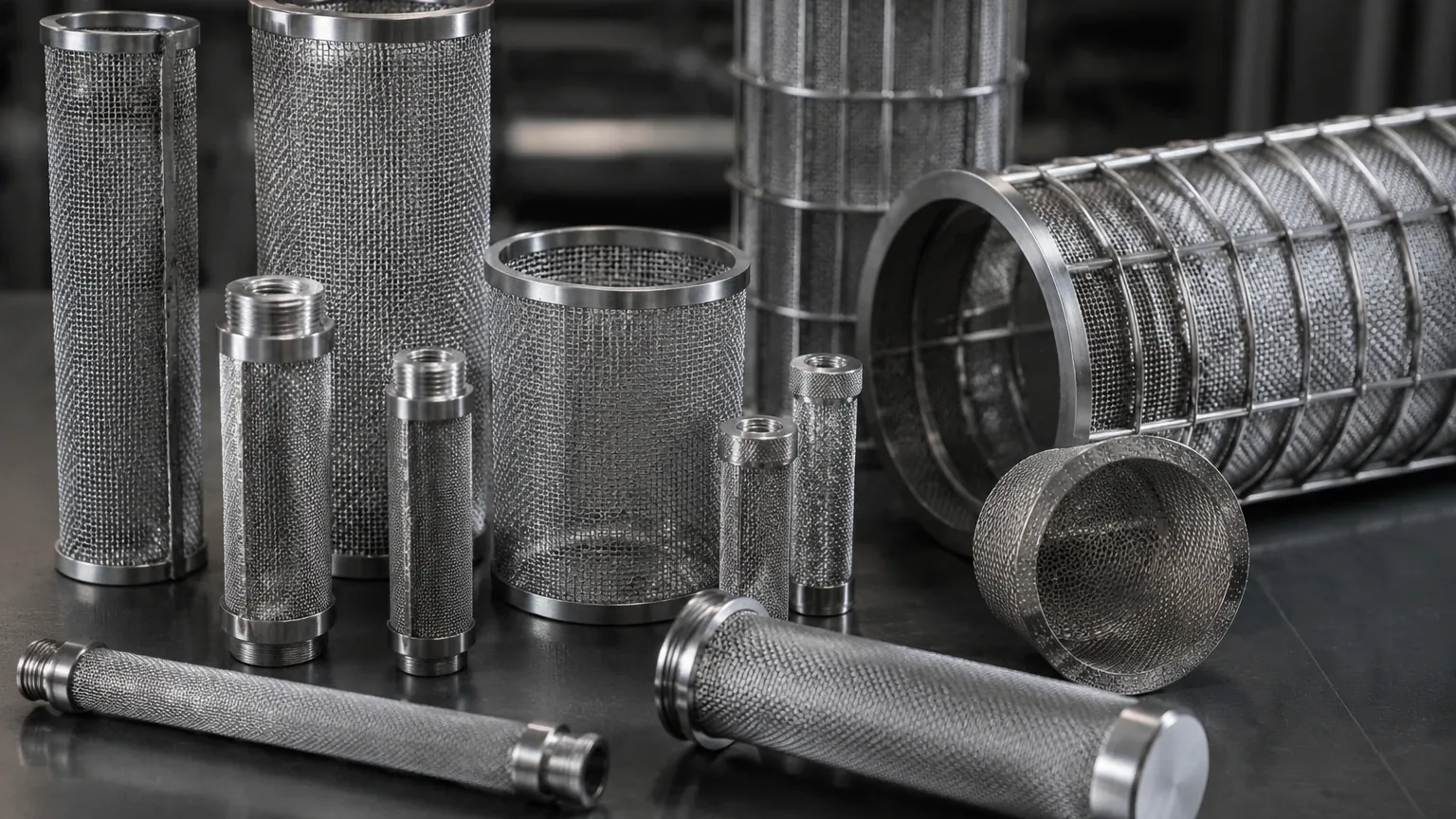
While flat mesh sheets are used in some applications, most industrial processes require the mesh to be formed into three-dimensional shapes. Wire Mesh Filter Cylinders & Tubes are the most prevalent configurations due to their structural efficiency and ease of integration into existing piping systems.
Structural Integrity and Reinforcement
A single layer of fine wire filter mesh is often too delicate to withstand the differential pressure (ΔP) encountered in industrial pumps. To address this, filter cylinders are frequently constructed using a multi-layer approach. A fine filtration layer is sandwiched between coarser "support" and "protection" layers. In high-pressure applications, the mesh is often pleated to increase surface area or wrapped around a perforated metal core. The core provides the necessary hoop strength to prevent the cylinder from collapsing or bursting under load.
Seam Welding and End Caps
The method used to join the mesh edges into a cylinder is vital. Plasma or TIG welding is typically employed to create a seamless, high-strength bond that does not introduce contaminants. The ends of the tubes are then fitted with custom end caps—such as NPT fittings, flanges, or O-ring seals—to ensure a bypass-free installation within the filter housing.
Material Selection for Demanding Industrial Environments
The chemical and thermal environment of the application dictates the material choice. Stainless steel is the industry standard due to its corrosion resistance and mechanical properties.
* AISI 304: The standard grade for general industrial use, offering good corrosion resistance and affordability. It is widely used in food processing and water treatment.
* AISI 316/316L: Contains molybdenum, which provides enhanced resistance to pitting and crevice corrosion in chloride-rich environments. This is the preferred choice for marine, pharmaceutical, and chemical applications. The "L" (low carbon) variant is used when extensive welding is required to prevent carbide precipitation.
* Specialty Alloys: For extreme conditions, materials such as Monel (for hydrofluoric acid), Inconel (for high-temperature oxidation), or Hastelloy (for highly aggressive chemical environments) can be utilized to manufacture wire filter mesh components.
Engineers must also consider the potential for galvanic corrosion if the filter is in contact with dissimilar metals within the system. Ensuring material compatibility across the entire fluid path is essential for preventing premature failure.
Performance Evaluation: Flow Rate and Pressure Drop
A primary challenge in filtration design is balancing filtration efficiency with flow characteristics. Every filter introduces a pressure drop into the system. As the wire filter mesh captures particles, the effective open area decreases, causing the pressure drop to increase.
Calculating Delta P (ΔP)
Engineers must calculate the initial (clean) pressure drop to ensure the pump capacity is sufficient. Factors influencing ΔP include:
1. Fluid Viscosity: Higher viscosity fluids require more force to pass through the mesh.
2. Flow Velocity: Pressure drop increases exponentially with the square of the velocity.
3. Percentage of Open Area: A mesh with 40% open area will have a significantly lower ΔP than one with 20% open area, even if the micron rating is similar.
Dirt Holding Capacity
This refers to the amount of contaminant the filter can collect before reaching a terminal pressure drop. Increasing the surface area—either by using larger cylinders or by pleating the mesh—directly improves the dirt-holding capacity and extends the service life between cleaning cycles.
Customization and Integration in Industrial Systems
Off-the-shelf filtration solutions rarely meet the specific needs of complex industrial equipment. Customization is often necessary to ensure the filter fits perfectly within the spatial constraints of the machinery while meeting performance targets.
When specifying Wire Mesh Filter Cylinders & Tubes, purchasing teams and engineers should confirm the following parameters with the manufacturer:
* Dimensional Tolerances: Precise outer and inner diameters are required for proper sealing.
* Filtration Direction: Is the flow from "outside-to-inside" or "inside-to-outside"? This determines which side of the mesh requires the support structure.
* Connection Type: Custom threaded ends, bayonet fittings, or flat gaskets must be specified to match the housing interface.
* Surface Treatment: Options such as passivating, electropolishing, or ultrasonic cleaning may be required for high-purity applications in the pharmaceutical or semiconductor industries.
By working closely with an OEM manufacturer like Kaifil, engineers can develop filtration components that are tailored to the unique rheology of their process fluids and the specific contaminants they need to remove.
Maintenance, Cleaning, and Replacement Cycles
One of the greatest advantages of stainless steel wire filter mesh is that it is often cleanable and reusable, offering a lower total cost of ownership (TCO) compared to disposable cartridges. However, the cleaning process must be carefully managed to avoid damaging the delicate mesh structure.
Cleaning Methods
1. Backwashing: Reversing the flow of fluid through the mesh to dislodge particles. This is often automated in continuous process systems.
2. Ultrasonic Cleaning: Using high-frequency sound waves in a cleaning solvent to remove fine particles embedded deep within the weave. This is highly effective for Dutch weave mesh.
3. Chemical Cleaning: Using acids or alkalis to dissolve organic or mineral scales. Material compatibility must be verified before using harsh chemicals.
4. Burn-off/Pyrolysis: For polymer or heavy oil applications, the filter can be heated in a controlled oven to carbonize and remove contaminants.
Determining Replacement Cycles
While cleanable, wire mesh filters eventually reach a point where they can no longer be restored to their original clean pressure drop. This is usually due to "blinding" (permanent entrapment of particles) or mechanical fatigue from repeated pressure cycling. Engineers should monitor the "recovered" pressure drop after each cleaning; once this value exceeds a predetermined threshold (e.g., 50% higher than the original clean ΔP), the filter element should be replaced to maintain system efficiency.
Application Risks and Mitigation
Inaccurate selection of wire filter mesh can lead to significant operational risks. If the mesh is too fine, the system may suffer from frequent clogging and excessive downtime. If it is too coarse, downstream components—such as high-pressure nozzles, valves, or sensitive instrumentation—may be damaged by particulate matter.
Furthermore, in high-velocity gas applications, engineers must account for the risk of wire vibration and fatigue. If the mesh is not properly supported, the constant oscillation can lead to wire breakage, resulting in a sudden loss of filtration integrity. Utilizing reinforced Wire Mesh Filter Cylinders & Tubes with internal or external cages is a standard engineering practice to mitigate these risks.
Conclusion
Wire filter mesh is a highly engineered material that provides precise, durable, and cleanable filtration solutions for a wide array of industrial applications. By understanding the technical trade-offs between weave types, material grades, and structural designs, engineers can specify filtration components that optimize process uptime and protect critical infrastructure. Whether used in chemical reactors, hydraulic power units, or food processing lines, the correct implementation of stainless steel mesh cylinders ensures reliable performance in the most demanding environments.
