


Industrial Engineering Guide: Implementing Wire Mesh Dust Filter Solutions
In industrial environments, air quality and particulate management are critical to both operational efficiency and equipment longevity. Unlike disposable synthetic or paper filters, a wire mesh dust filter constructed from stainless steel offers a robust, reusable, and high-temperature-resistant alternative for demanding B2B applications. These filters are essential components in systems where abrasive particles, corrosive gases, or extreme thermal conditions would compromise standard filtration media.
As a specialized manufacturer, Kaifil provides precision-engineered filtration components designed to meet the rigorous standards of chemical processing, pharmaceutical manufacturing, and heavy industrial sectors. Understanding the technical nuances of material selection, structural design, and filtration mechanics is vital for engineers tasked with optimizing dust collection and gas purification systems.
Operating Principles of Wire Mesh Dust Filtration
The performance of a wire mesh dust filter is governed by mechanical principles that differ significantly from depth filtration media like felt or fiberglass. Stainless steel wire mesh operates primarily through surface filtration, where particles are captured on the upstream side of the mesh screen.
Mechanical Sieving
This is the primary mechanism for larger particles. When the particle size exceeds the pore opening of the mesh, it is physically blocked. In industrial dust collection, the precision of the weave determines the "absolute" filtration rating, ensuring that no particles larger than the specified micron size pass through the system.
Inertial Impaction and Interception
For finer dust particles moving within a gas stream, filtration occurs as particles deviate from the airflow lines due to inertia and strike the wire strands. Because stainless steel wires have a fixed, non-deformable geometry, the interception path remains constant even under high-pressure differentials, a critical advantage over flexible fabric filters.
Cake Formation
In many dust collection applications, a thin layer of captured dust (the "filter cake") builds up on the surface of the wire mesh. This cake actually enhances filtration efficiency by creating a secondary, finer filtration layer. However, engineers must balance this efficiency gain against the resulting increase in pressure drop across the Wire Mesh Filter Cylinders & Tubes.
Material Selection and Environmental Compatibility
One of the primary reasons engineers specify stainless steel for dust filtration is environmental resistance. The choice of alloy directly impacts the filter's service life and total cost of ownership.
* AISI 304 Stainless Steel: The standard choice for general industrial applications. It provides excellent strength and good corrosion resistance for dry dust environments and non-corrosive gas streams.
* AISI 316L Stainless Steel: Specified for environments containing chlorides or acidic vapors. The addition of molybdenum makes 316L the preferred material for chemical processing and pharmaceutical dust extraction where sanitization or chemical exposure is frequent.
* High-Temperature Alloys: For applications such as flue gas filtration or kiln dust recovery, specialized alloys like Inconel or Monel may be used to maintain structural integrity at temperatures exceeding 500°C (932°F).
When selecting a wire mesh dust filter, engineers must also consider the wire diameter. A thicker wire increases the mechanical strength and resistance to abrasion from high-velocity particles but reduces the open area, which can increase the initial pressure drop.
Structural Design: Wire Mesh Filter Cylinders & Tubes
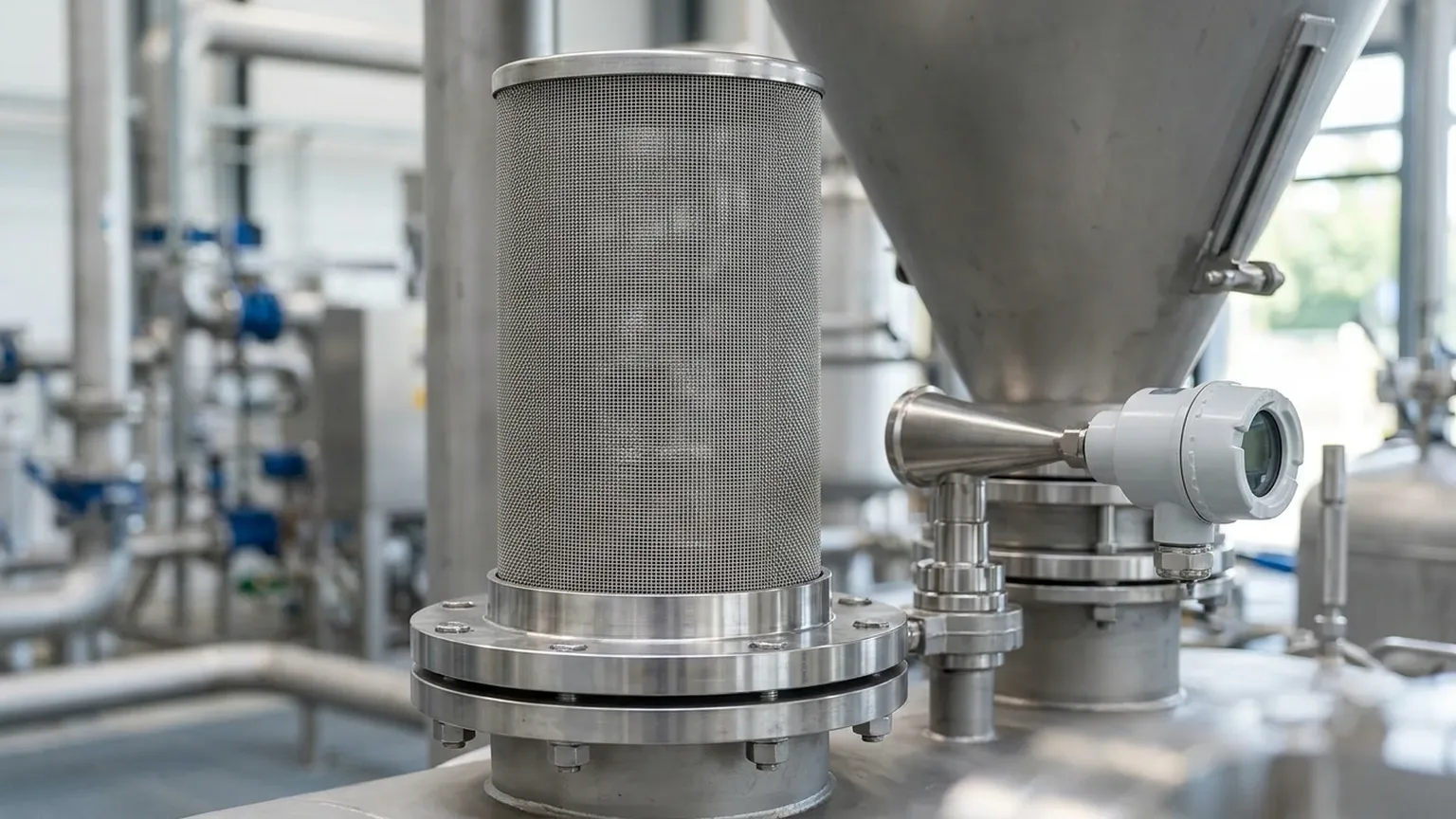
The geometry of the filter element is as important as the mesh itself. Industrial dust collectors typically utilize Wire Mesh Filter Cylinders & Tubes to maximize the surface area within a compact footprint.
Single-Layer vs. Multi-Layer Construction
Single-layer cylinders are cost-effective for coarse dust removal. However, for fine dust applications requiring high structural rigidity, multi-layer sintered mesh is often used. This process involves heat-treating multiple layers of mesh together to create a single, porous plate that is then rolled and welded into a cylinder. This construction prevents wire migration and ensures the pore size remains stable under back-pulsing or high-pressure cleaning.
Support Structures
To prevent the collapse of the filter under high vacuum or pressure, wire mesh tubes are often reinforced with internal or external perforated metal cores. These cores provide the necessary hoop strength while the wire mesh provides the actual filtration. For international buyers, confirming the gauge of the support core is a critical step in ensuring the component can withstand the system's maximum operating pressure.
Sealing and End Caps
The interface between the filter and the housing is a common point of bypass. Kaifil offers various end-cap configurations, including flange mounts, threaded connectors, and DOE (Double Open End) designs with integrated gaskets. Ensuring a gas-tight seal is paramount for maintaining the integrity of the dust collection system.
Performance Evaluation and Micron Ratings
When evaluating a wire mesh dust filter, engineers must distinguish between nominal and absolute filtration ratings.
1. Nominal Rating: Indicates the ability of the mesh to retain a majority of particles of a specific size. This is often used for non-critical applications where some bypass is acceptable.
2. Absolute Rating: Refers to the diameter of the largest hard spherical particle that will pass through the mesh under specified test conditions. For hazardous dust or high-purity gas streams, an absolute rating is mandatory.
Another critical metric is the Permeability, which defines the volume of air that can pass through the mesh at a given pressure drop. A higher permeability allows for smaller filter housings or lower energy consumption by the system's blowers. Engineers should request pressure drop curves (ΔP vs. Flow Rate) to ensure the selected mesh density aligns with the system's fan curve.
Cleaning and Maintenance Cycles
A significant advantage of stainless steel filtration is the ability to clean and reuse the elements. In industrial dust collection, two primary cleaning methods are employed:
* Online Cleaning (Pulse-Jet): High-pressure air is pulsed down the center of the cylinder, momentarily reversing the flow and dislodging the dust cake. The rigid structure of sintered wire mesh is particularly well-suited for this, as it does not flex or fatigue like fabric bags.
* Offline Cleaning (Ultrasonic/Chemical): For stubborn or sticky dusts, the filters can be removed and cleaned in an ultrasonic bath or with compatible chemical solvents. This restores the original pressure drop and extends the service life of the filter to several years, significantly reducing waste compared to disposable alternatives.
Procurement Considerations for International Buyers
When sourcing Wire Mesh Filter Cylinders & Tubes for global projects, technical documentation and manufacturing precision are the primary safeguards against operational failure. Buyers should provide the following data points to the manufacturer to ensure an accurate quote and product performance:
1. Gas Stream Composition: Are there corrosive elements or moisture present?
2. Operating Temperature: Both the steady-state and maximum excursion temperatures.
3. Particle Characteristics: Average particle size, shape (spherical vs. angular), and abrasiveness.
4. Flow Rate and Pressure: Maximum CFM (Cubic Feet per Minute) and the allowable initial pressure drop.
5. Dimensional Constraints: Precise outer diameter, inner diameter, and overall length, including end-cap specifications.
Kaifil’s engineering team works closely with clients to translate these requirements into high-performance filtration components. By focusing on the intersection of material science and precision weaving, we ensure that every wire mesh dust filter delivered meets the specific demands of the application.
Conclusion
Selecting the right industrial filtration solution requires a balance of performance, durability, and cost-effectiveness. Stainless steel wire mesh provides a permanent solution for dust collection in environments where traditional media fails. By utilizing Wire Mesh Filter Cylinders & Tubes with optimized micron ratings and structural reinforcements, industrial facilities can achieve superior air quality, protect downstream equipment, and reduce long-term maintenance overhead.
For engineers and purchasing teams, partnering with a manufacturer that understands the technical complexities of metal filtration is the first step toward optimizing industrial process efficiency. Whether for chemical, food, or hydraulic applications, the reliability of a custom-engineered stainless steel filter remains an industry benchmark.
