


Engineering Guide to Wire Mesh Filter Sheets and Industrial Components
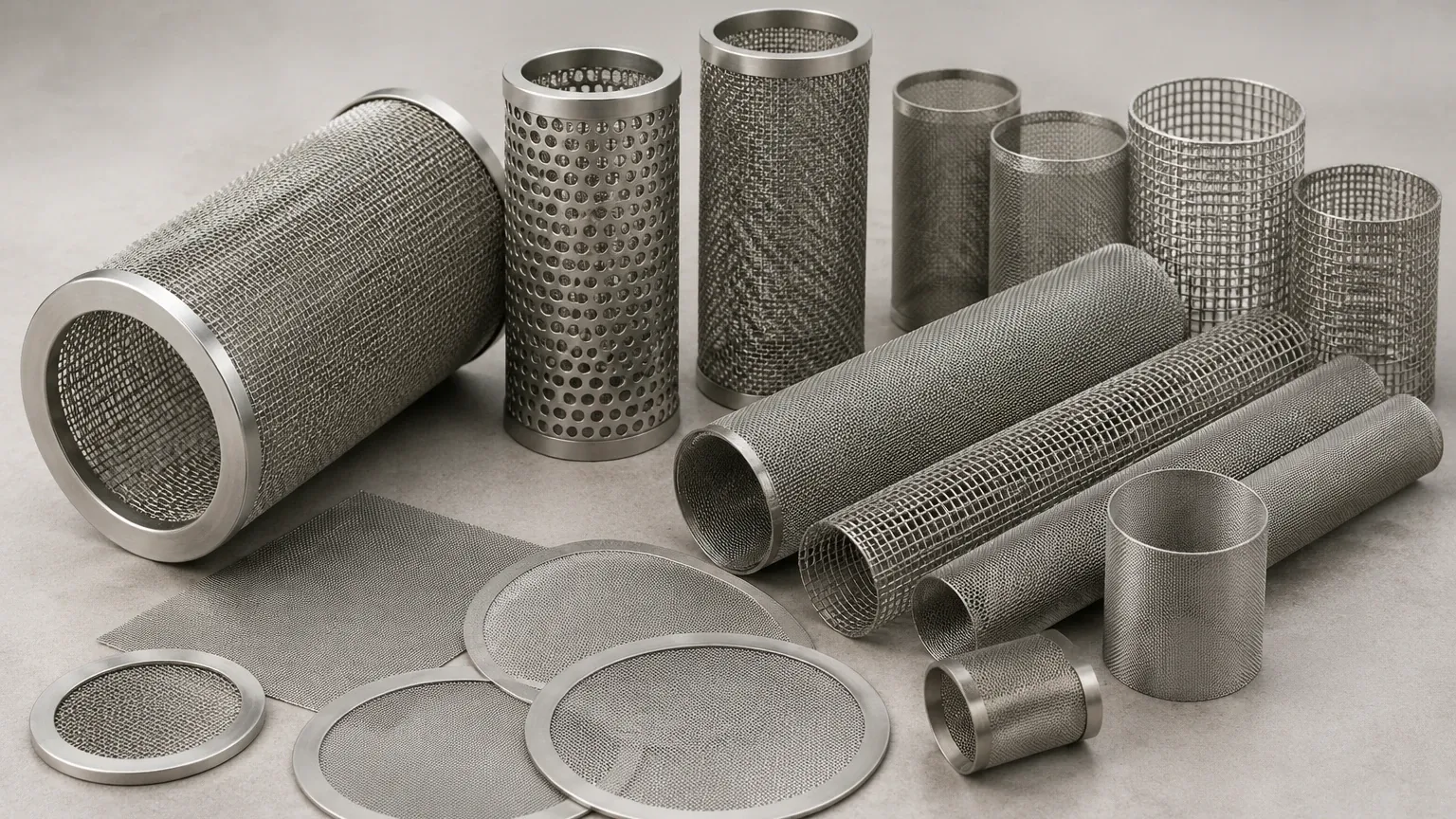
In industrial filtration, the wire mesh filter sheet serves as the foundational medium for a vast array of separation processes. Whether used as a flat screening element or fabricated into complex Wire Mesh Filter Cylinders & Tubes, the performance of the filtration system is dictated by the mechanical and metallurgical properties of the mesh. For engineers and procurement specialists, understanding the nuances of weave patterns, material grades, and structural integrity is essential for optimizing process efficiency and ensuring equipment longevity.
This guide examines the technical specifications of wire mesh filter sheets, their transition into structural components, and the critical factors that influence their performance in demanding environments such as chemical processing, pharmaceuticals, and hydraulic systems.
Understanding the Wire Mesh Filter Sheet as an Engineering Material
A wire mesh filter sheet is a precision-engineered textile produced by weaving metallic wires—typically stainless steel—into specific patterns. Unlike non-woven or polymer-based media, metallic mesh offers high mechanical strength, thermal stability, and precise pore geometry.
Material Selection
Material choice is the first boundary in filter design. While various alloys are available, stainless steel remains the industry standard due to its balance of cost and performance:
* AISI 304: Suitable for general industrial applications where basic corrosion resistance is required. It is commonly used in food processing and water filtration.
* AISI 316L: The "L" denotes low carbon, which improves weldability and resistance to intergranular corrosion. This grade is preferred in chemical and pharmaceutical environments where exposure to chlorides or organic acids is common.
* Specialty Alloys: For extreme environments, materials like Hastelloy, Inconel, or Duplex stainless steel may be specified to combat high-temperature oxidation or high-stress chloride environments.
Weave Types and Their Impact on Filtration
The geometry of the weave determines the filtration accuracy (micron rating) and the flow characteristics of the sheet. Common weaves include:
1. Plain Weave: Each warp wire crosses over and under each weft wire. This provides a high open area and low pressure drop, ideal for coarse filtration and high-flow applications.
2. Twilled Weave: Wires cross over two and under two, allowing for thicker wires and finer mesh counts. This is used when a balance of strength and fine filtration is required.
3. Dutch Weave (Plain and Twilled): These weaves use different diameters for warp and weft wires, resulting in a dense, robust structure with small, triangular openings. Dutch weaves are the primary choice for high-pressure applications and fine particulate removal.
Key Selection Criteria for Industrial Filtration Media
When specifying a wire mesh filter sheet, engineers must look beyond simple dimensions. The following parameters define the operational boundaries of the media:
Micron Rating: Absolute vs. Nominal
* Nominal Rating: Refers to the ability of the mesh to retain a certain percentage (usually 60% to 90%) of particles of a specific size. It is an indication of the average pore size.
* Absolute Rating: Refers to the diameter of the largest hard spherical particle that will pass through the mesh under specified test conditions. In critical applications like pharmaceutical sterile filtration or hydraulic protection, the absolute rating is the mandatory metric.
Mechanical Strength and Durability
In high-pressure systems, the filter media must withstand significant differential pressure (Delta P) without deforming. Sintered wire mesh sheets are often used to address this. Sintering involves bonding multiple layers of mesh together through a diffusion-bonding process, creating a monolithic structure that combines fine filtration layers with heavy-duty support layers.
Fabrication Transitions: From Sheet to Wire Mesh Filter Cylinders & Tubes
While flat sheets are used in some vibrating screens and strainers, most industrial processes require the mesh to be formed into three-dimensional shapes. The most common configurations are Wire Mesh Filter Cylinders & Tubes, which provide a higher surface-area-to-volume ratio and can be integrated into pressurized housings.
Forming and Welding
Converting a flat wire mesh filter sheet into a cylinder requires precision rolling and longitudinal welding. For industrial-grade filters, Plasma or TIG (Tungsten Inert Gas) welding is preferred over resistance welding. These methods ensure a clean, continuous seam that maintains the structural integrity of the filter under thermal cycling and mechanical stress.
Structural Reinforcement
Because a single layer of fine mesh lacks the rigidity to withstand high flow rates, industrial filter tubes often incorporate an internal or external support core. These cores are typically made from perforated metal or heavier, coarser mesh. The filtration sheet is then wrapped around or pleated within this core to provide the necessary mechanical support while maintaining the required filtration accuracy.
Evaluating Performance: Micron Ratings and Flow Dynamics
The efficiency of a filter is not just about what it stops, but how much energy it consumes in the process. The relationship between the wire mesh filter sheet’s open area and the resulting pressure drop is a critical engineering consideration.
Pressure Drop (Delta P)
As fluid passes through the mesh, resistance causes a drop in pressure. A high-density weave (like a Twilled Dutch Weave) will naturally have a higher initial pressure drop than a Plain Weave. Engineers must calculate the "Clean Pressure Drop" to ensure the system pump can handle the resistance at the required flow rate. As the filter accumulates debris, the pressure drop increases; if it exceeds the design limit, the filter may collapse or the system may shut down.
Effective Filtration Area (EFA)
To minimize pressure drop and extend the interval between cleanings, designers aim to maximize the EFA. This is often achieved by pleating the wire mesh filter sheet before forming it into a cylinder. Pleating can increase the surface area by 3 to 5 times compared to a smooth-walled cylinder of the same external dimensions.
Installation Constraints and Structural Support
Proper installation is as important as the filter's specifications. Even the highest quality wire mesh filter sheet will fail if the bypass is not prevented or if the support structure is inadequate.
Sealing Methods
To ensure all fluid passes through the media, robust sealing is required at the ends of the cylinders or tubes. Common methods include:
* Metal End Caps: Welded directly to the mesh for a permanent, leak-proof seal.
* Elastomeric Gaskets: Used in housings where the filter must be frequently removed for cleaning. Material compatibility (e.g., Viton, EPDM, PTFE) must be verified against the process fluid.
* Epoxy Bonding: Used in applications where welding is not feasible, though it has temperature and chemical limitations.
Flow Direction
Filters are typically designed for "Outside-In" or "Inside-Out" flow. Outside-In flow is more common as it allows for a larger filtration surface and easier cleaning of the housing. However, Inside-Out flow is used when the goal is to capture and contain valuable solids within the filter tube for recovery.
Maintenance, Cleaning, and Replacement Cycles
One of the primary advantages of stainless steel wire mesh over disposable media is cleanability. However, the cleaning method must be matched to the contaminant and the mesh structure.
Cleaning Protocols
* Backwashing: Reversing the flow of fluid to dislodge particles from the surface. This is highly effective for surface filtration media like plain weave mesh.
* Ultrasonic Cleaning: Using high-frequency sound waves in a detergent bath to remove fine particles trapped deep within the weave of a Dutch weave or sintered sheet.
* Chemical Cleaning: Using acids or solvents to dissolve organic or mineral deposits. The chemical compatibility of the mesh material (e.g., 316L) must be confirmed to prevent pitting.
Identifying the End of Life
While durable, wire mesh filters are not infinite. Fatigue from pressure pulsations, erosion from abrasive particles, and chemical degradation eventually necessitate replacement. A consistent increase in the "recovered" pressure drop (the Delta P after cleaning) indicates that the mesh is becoming permanently blinded and should be replaced to maintain system efficiency.
Procurement Checklist for International Purchasing Teams
When sourcing wire mesh filter sheets or fabricated components from global manufacturers, technical clarity is the best defense against procurement errors. Buyers should confirm the following before finalizing an order:
1. Material Certification: Request Mill Test Reports (MTRs) to verify the chemical composition of the stainless steel.
2. Pore Size Verification: For critical applications, ask for bubble point test results or glass bead challenge test data to confirm the absolute micron rating.
3. Dimensional Tolerances: Specify tolerances for length, diameter, and wall thickness, especially for Wire Mesh Filter Cylinders & Tubes that must fit into precision-machined housings.
4. Welding Standards: Confirm that welding is performed by qualified technicians and that seams are free of burrs or oxidation.
5. Packaging for Transit: Ensure that fine mesh components are packaged in rigid containers to prevent crushing or deformation during international shipping.
By focusing on these technical boundaries, engineers can ensure that the wire mesh filter sheets they select will perform reliably in their specific industrial environment, providing the necessary balance of filtration accuracy and structural durability.
