


Engineering Guide to Wire Mesh Filter Strainer Selection and Application
In industrial fluid processing, the mechanical separation of solids from liquids or gases is a fundamental requirement for protecting downstream equipment and ensuring product purity. A wire mesh filter strainer serves as a primary defense mechanism, utilizing precisely woven stainless steel fabric to intercept contaminants. Unlike disposable depth filters, these metallic components offer high mechanical strength, thermal resistance, and the ability to be cleaned and reused, making them a cornerstone of sustainable industrial filtration.
Selecting the correct filtration component requires an understanding of fluid dynamics, material science, and the specific structural requirements of the application. This guide examines the technical considerations for implementing Wire Mesh Filter Cylinders & Tubes in industrial environments, focusing on performance optimization and long-term reliability.
1. Operating Principles of Wire Mesh Filtration
Wire mesh strainers operate primarily through surface filtration. The geometric arrangement of the wires creates uniform pores that allow fluids to pass while trapping particles larger than the pore size on the upstream surface of the mesh.
Surface vs. Depth Filtration
While depth filters (such as melt-blown cartridges) trap particles within a thick matrix, a wire mesh filter strainer provides a definitive barrier at the surface. This characteristic allows for more predictable filtration performance and easier cleaning. The efficiency of the strainer is determined by the weave type and the wire diameter, which together define the "open area" percentage.
Weave Types and Their Impact
* Plain Weave: The most common configuration where wires cross over and under each other. It provides high flow rates and is suitable for general-purpose straining.
* Dutch Weave: Uses heavier warp wires and finer shute wires, resulting in a dense, strong mesh with very fine filtration capabilities. This is often used in high-pressure applications where mechanical integrity is paramount.
* Twill Weave: Each shute wire passes over and under two warp wires, allowing for heavier wire diameters in a given mesh count, enhancing the durability of the strainer.
2. Structural Configurations: Wire Mesh Filter Cylinders & Tubes
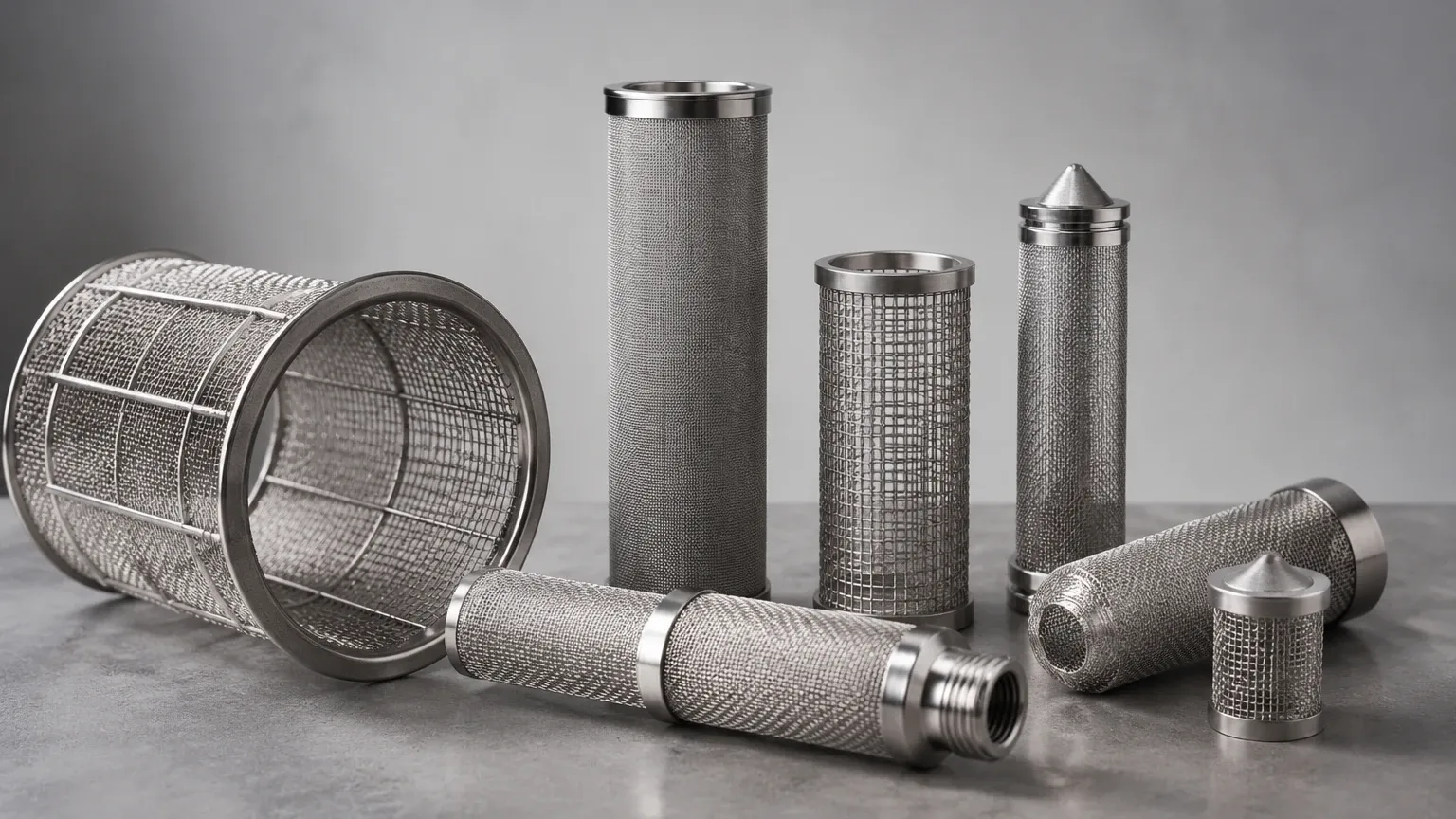
The geometry of the filter element significantly influences its capacity and pressure handling. Wire Mesh Filter Cylinders & Tubes are the most prevalent shapes in industrial strainers due to their inherent structural stability under internal or external pressure.
Single-Layer vs. Multi-Layer Construction
For low-pressure applications with large particle sizes, a single layer of heavy-duty mesh may suffice. However, most industrial processes require a multi-layer approach. This typically involves:
1. Filtration Layer: The fine mesh that determines the micron rating.
2. Support Layer: A coarser, heavier mesh or perforated metal core that provides the mechanical strength to resist collapsing or bursting under differential pressure.
3. Drainage Layer: In complex assemblies, this layer facilitates the flow of filtered fluid away from the filtration surface.
Sintered Mesh Technology
In demanding environments, layers of wire mesh are sintered together—a process of diffusion bonding under high temperature and pressure. Sintered wire mesh filter strainer elements do not suffer from wire migration, maintain precise pore geometry even under extreme stress, and are significantly easier to clean via ultrasonic methods or backwashing.
3. Technical Selection Criteria for Engineers
When specifying a filter for a new or existing system, several engineering parameters must be evaluated to prevent premature failure or system inefficiency.
Micron Rating: Absolute vs. Nominal
It is critical to distinguish between nominal and absolute ratings. A nominal rating refers to the ability of the mesh to retain a certain percentage of particles of a specific size. An absolute rating, typically achieved with high-precision Dutch weaves or sintered mesh, indicates the diameter of the largest hard spherical particle that can pass through the mesh. For critical protection of high-precision valves or nozzles, an absolute-rated wire mesh filter strainer is required.
Material Compatibility
Stainless steel is the standard for industrial filtration, but the specific grade must match the chemical environment:
* AISI 304: Suitable for water treatment, food processing, and general industrial use where corrosion risk is moderate.
* AISI 316L: Contains molybdenum, providing superior resistance to chlorides and acids. This is the preferred choice for marine, chemical processing, and pharmaceutical applications.
* Specialty Alloys: For extreme temperatures or highly aggressive chemicals, alloys like Monel, Inconel, or Hastelloy may be utilized in the mesh construction.
Differential Pressure ($ΔP$)
The pressure drop across the filter is a function of the fluid viscosity, flow rate, and the open area of the mesh. Engineers must calculate the "clean pressure drop" to ensure the system pump can maintain the required flow. As the wire mesh filter strainer accumulates debris, the $ΔP$ will increase. A common design standard is to size the filter so that the clean pressure drop does not exceed 2-3 PSI (0.14-0.21 bar).
4. Installation and Integration Constraints
The effectiveness of a filtration system is often limited by the quality of its installation and the integrity of its seals.
Sealing Mechanisms
To prevent bypass—where fluid flows around the filter rather than through it—proper sealing is essential. Common methods include:
* Gaskets: Flat gaskets made of PTFE, EPDM, or Viton, compressed between the filter flange and the housing.
* O-Rings: Used in cylindrical designs to provide a radial seal, often found in "plug-in" style filter housings.
* Metal-to-Metal Seals: Utilized in high-temperature applications where elastomeric seals would fail.
Flow Direction
In most Wire Mesh Filter Cylinders & Tubes, the flow is from the inside to the out (out-to-in is also possible depending on housing design). Inside-to-out flow allows contaminants to collect within the cylinder, making it easier to remove the debris during maintenance without it falling back into the clean side of the housing.
5. Maintenance, Cleaning, and Life Cycle
One of the primary B2B advantages of stainless steel filtration is the total cost of ownership. While the initial investment is higher than disposable media, the longevity of metal mesh provides significant savings.
Cleaning Protocols
* Backwashing: Reversing the flow of fluid to dislodge particles from the mesh surface. This can often be automated.
* Ultrasonic Cleaning: The most effective method for fine meshes, using high-frequency sound waves in a cleaning solvent to remove particles lodged deep within the weave.
* Chemical Cleaning: Using acids or alkalis to dissolve organic or mineral scaling, provided the mesh material is compatible with the cleaning agent.
Replacement Indicators
Despite being cleanable, wire mesh elements have a finite lifespan. Fatigue from pressure cycling or erosion from abrasive particles can eventually compromise the mesh. Elements should be inspected for "blinded" areas (pores that cannot be cleaned) and mechanical deformation. A consistent failure to return to a low baseline $ΔP$ after cleaning usually indicates that the element requires replacement.
6. Application Risks and Engineering Mitigations
Engineers must be aware of specific risks that can lead to filter failure:
1. Pressure Spikes: Sudden surges in flow can create a water hammer effect, potentially rupturing a non-reinforced wire mesh filter strainer. Using a perforated metal support core is the standard mitigation strategy.
2. Corrosion Fatigue: In corrosive environments, the combination of chemical attack and mechanical stress can lead to micro-cracking of the wires. Selecting 316L or higher alloys is necessary here.
3. Bypass Leakage: If the filter is not seated correctly or if the seals have degraded, unfiltered fluid will bypass the mesh. Regular inspection of sealing surfaces is mandatory.
4. Vibration: In high-flow gas applications, mesh wires can vibrate, leading to work-hardening and eventual breakage (wire migration). Sintered mesh is highly recommended for such high-velocity gas streams.
7. Buyer’s Checklist: Information for Custom Procurement
When sourcing custom Wire Mesh Filter Cylinders & Tubes, providing the manufacturer with precise data ensures the delivered component meets the application's demands. Buyers should confirm the following:
* Fluid Properties: Type of fluid, viscosity, temperature, and chemical composition.
* Contaminant Profile: Nature of the solids (hard, soft, fibrous), particle size distribution, and expected concentration.
* Operational Parameters: Normal and maximum flow rates, maximum operating pressure, and allowable pressure drop.
* Dimensional Requirements: Outer diameter (OD), inner diameter (ID), overall length, and end-cap configuration (e.g., open, closed, threaded, or flanged).
* Compliance Standards: Requirements for FDA (food grade), 3-A (sanitary), or specific industrial certifications.
By addressing these technical variables, engineering and purchasing teams can implement filtration solutions that optimize process uptime and protect the integrity of the entire industrial system. Kaifil’s expertise in manufacturing precision stainless steel components ensures that each wire mesh filter strainer is engineered to withstand the rigors of demanding industrial environments while providing consistent, high-accuracy filtration performance.
