


Engineering Guide to Wire Mesh Sand Filters for Industrial Applications
In industrial fluid processing, the management of particulate matter—specifically sand and similar abrasive solids—is a critical factor in maintaining system integrity and operational efficiency. A wire mesh sand filter serves as a primary defense mechanism, protecting downstream pumps, valves, and instrumentation from erosion and clogging. These filters are not merely screens; they are engineered components designed to withstand high pressure, corrosive environments, and continuous flow while maintaining precise filtration accuracy.
For engineers and procurement specialists, selecting the correct filtration hardware requires a deep understanding of mechanical design, material science, and the specific dynamics of the fluid being processed. Central to these systems are Wire Mesh Filter Cylinders & Tubes, which provide the structural and functional foundation for effective sand control and solid-liquid separation.
1. Operating Principles of Wire Mesh Sand Filtration
The primary function of a wire mesh sand filter is surface filtration. Unlike depth filters that trap particles within a thick medium, wire mesh filters capture solids on the surface of the weave. This is particularly advantageous in sand control because it allows for easier cleaning and more predictable flow characteristics.
When fluid containing sand particles passes through the mesh, particles larger than the pore size are retained. In many industrial applications, a phenomenon known as "sand bridging" occurs, where larger particles form a secondary filtration layer over the mesh, effectively catching even finer particles. However, if the mesh is not engineered correctly, this can lead to rapid pressure buildup. Therefore, the design of the mesh—whether it is a plain weave, twilled weave, or Dutch weave—must be matched to the particle size distribution (PSD) of the sand in the process stream.
2. Structural Design: Wire Mesh Filter Cylinders & Tubes
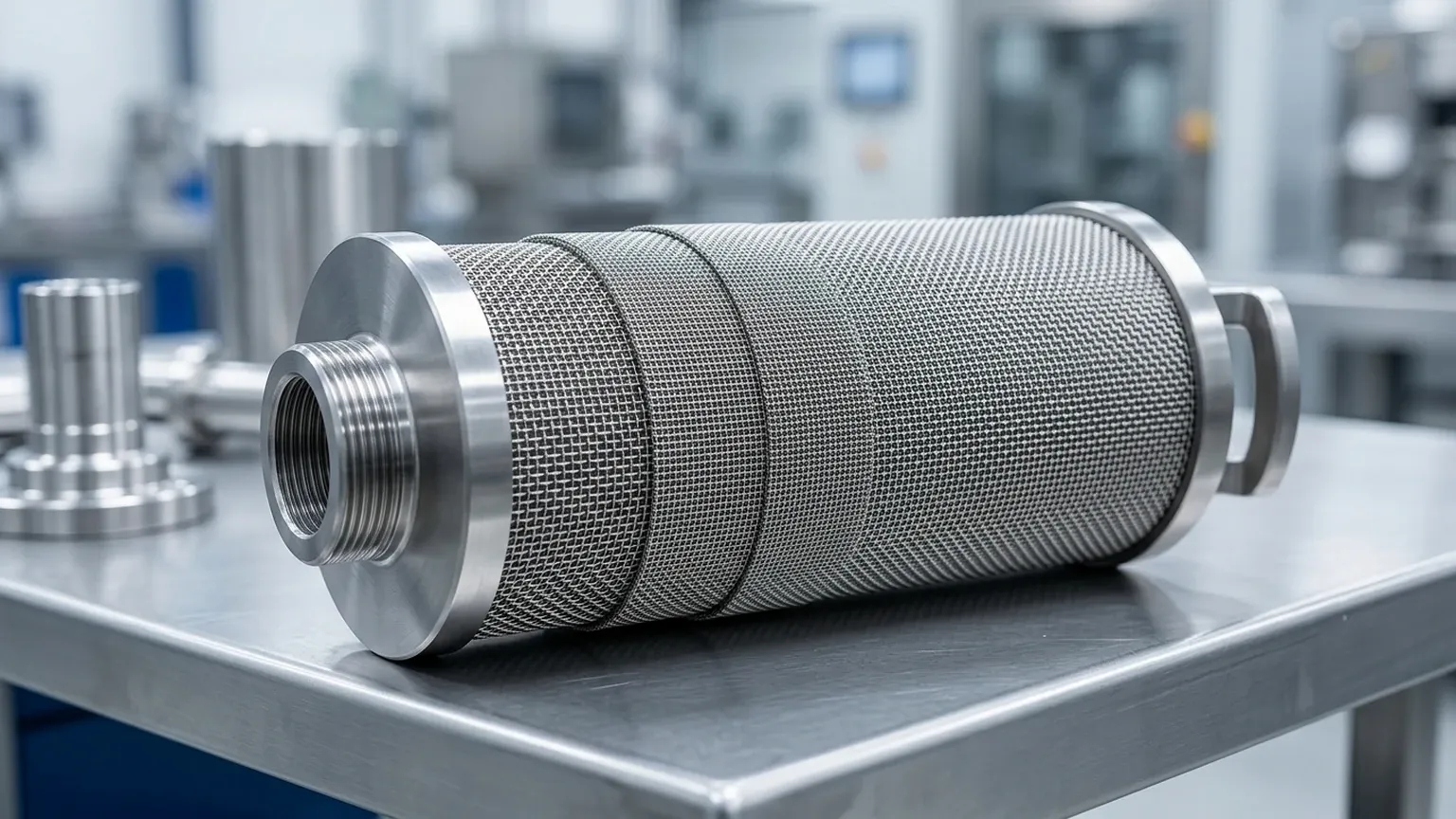
The geometry of the filter element is as important as the mesh itself. In most industrial housings, Wire Mesh Filter Cylinders & Tubes are the preferred configuration due to their inherent structural strength and high surface-area-to-volume ratio.
Single-Layer vs. Multi-Layer Construction
For light-duty applications, a single layer of stainless steel wire mesh may suffice. However, in high-pressure industrial environments, multi-layer constructions are standard. These often involve:
* The Filtration Layer: The fine mesh that determines the micron rating.
* The Support Layer: A coarser mesh or perforated metal core that provides rigidity against collapsing under differential pressure.
* The Drainage Layer: Ensures even flow distribution across the filtration surface.
Sintered Wire Mesh Options
For the most demanding sand filtration tasks, sintered wire mesh is utilized. This process involves diffusion-bonding multiple layers of mesh together under high temperature and pressure. The result is a monolithic structure where the wires cannot shift, ensuring that the pore size remains constant even under extreme mechanical stress or high-velocity flow.
3. Material Selection for Corrosive and Abrasive Environments
Sand is naturally abrasive, and the fluids transporting it are often chemically aggressive, such as produced water in oil and gas or brackish water in desalination plants. Material selection is therefore a cornerstone of filter longevity.
* Stainless Steel 304/304L: The standard choice for general industrial applications with low corrosive risk.
* Stainless Steel 316L: Contains molybdenum, providing superior resistance to chlorides and pitting, making it the industry standard for chemical processing and marine environments.
* 904L and Duplex Stainless Steels: Reserved for highly acidic or high-salinity applications where standard 316L might suffer from stress corrosion cracking.
Beyond chemical resistance, the hardness of the wire material affects its resistance to erosion. High-velocity sand particles can gradually wear down the wire diameter, eventually enlarging the pore size and compromising filtration integrity. Selecting high-quality, cold-drawn stainless steel wire ensures a consistent grain structure that resists this abrasive wear.
4. Technical Specifications: Micron Ratings and Sieve Analysis
To specify a wire mesh sand filter correctly, engineers must perform a sieve analysis of the sand present in the fluid. This analysis provides the $d_{10}, d_{50},$ and $d_{90}$ values, representing the particle sizes at which 10%, 50%, and 90% of the sample is smaller.
* Absolute vs. Nominal Ratings: In B2B industrial procurement, it is vital to distinguish between these two. An absolute rating implies that 99.9% of particles above a certain size will be captured, whereas a nominal rating is an approximation. For critical pump protection, absolute-rated wire mesh is typically required.
* Mesh Count: This refers to the number of wires per linear inch. While a higher mesh count indicates finer filtration, it also increases the resistance to flow. The challenge is to find the "sweet spot" where sand is effectively captured without causing an unacceptable drop in system pressure.
5. Hydraulic Performance: Pressure Drop and Flow Rates
Every filter introduces a pressure drop ($\Delta P$) into the system. For a wire mesh sand filter, the initial (clean) pressure drop must be calculated to ensure the pump capacity is sufficient.
Factors influencing $\Delta P$ include:
1. Fluid Viscosity: Thicker fluids require larger mesh openings or more surface area.
2. Flow Velocity: High velocity increases the risk of particle "breakthrough" and accelerates erosion.
3. Open Area Ratio: This is the percentage of the total mesh surface that is actually open space. A higher open area ratio allows for higher flow rates but may reduce the structural strength of the mesh.
When designing with Wire Mesh Filter Cylinders & Tubes, increasing the length or diameter of the cylinder is a common engineering strategy to increase the total filtration area, thereby reducing the face velocity and extending the time between cleaning cycles.
6. Installation Constraints and System Integration
Integrating a sand filter into an existing industrial skid requires careful consideration of mechanical constraints.
* Flow Direction: Most cylindrical filters are designed for outside-to-inside (O-to-I) flow, where the sand is captured on the exterior surface. This makes it easier to inspect and clean. However, inside-to-outside (I-to-O) configurations are sometimes used when the sand volume is extremely high and needs to be contained within the tube for removal.
* End Cap Configurations: The method of sealing the filter into the housing is a common failure point. Options include double O-rings, NPT threaded ends, or flat gaskets. A bypass-free seal is mandatory; even a 1mm gap can allow enough sand through to destroy a high-precision downstream valve.
* Orientation: While vertical installation is preferred to allow gravity to assist in settling heavy sand particles during backwash, horizontal installations are common in space-constrained environments. In such cases, internal baffles may be necessary to prevent uneven loading of the mesh.
7. Maintenance, Cleaning, and Life Cycle Management
One of the greatest advantages of stainless steel wire mesh over disposable cartridges is cleanability. For a wire mesh sand filter, maintenance typically follows one of three paths:
1. Manual Cleaning: The filter is removed and cleaned using high-pressure water or air. This is suitable for non-hazardous applications where downtime is manageable.
2. Backwashing: The flow is momentarily reversed, flushing the captured sand out of a secondary drain port. This is often automated based on a differential pressure trigger.
3. Ultrasonic Cleaning: For fine mesh that has become "blinded" by microscopic particles or scale, ultrasonic baths can dislodge contaminants that manual washing cannot reach.
Engineers should monitor the "terminal pressure drop"—the point at which the filter must be cleaned. Consistently hitting this limit too quickly suggests that the mesh micron rating may be too fine for the application or that the total filtration area is undersized.
8. Strategic Procurement: What International Buyers Must Verify
When sourcing Wire Mesh Filter Cylinders & Tubes from global manufacturers, technical documentation is as important as the physical product. To ensure the reliability of a wire mesh sand filter, buyers should confirm the following with their supplier:
* Material Certification: Request MTRs (Material Test Reports) to verify the alloy composition (e.g., actual Nickel and Chromium content in SS316L).
* Weld Integrity: In cylindrical filters, the longitudinal seam is the weakest point. Ensure the manufacturer uses advanced welding techniques like TIG (Tungsten Inert Gas) or Plasma welding to prevent mesh fraying or seam failure.
* Dimensional Tolerances: For OEM applications, precise outer diameter (OD) and length (OAL) tolerances are critical for ensuring a proper seal within the filter housing.
* Customization Capabilities: Can the manufacturer provide custom end-fittings or reinforced internal cores? Industrial systems rarely follow a one-size-fits-all model, and the ability to customize the support structure of the filter tube is often necessary for high-pressure differentials.
Conclusion
Wire mesh sand filters are indispensable components in the industrial landscape, providing a robust and reusable solution for solid-liquid separation. By focusing on the engineering fundamentals of Wire Mesh Filter Cylinders & Tubes—including material science, hydraulic dynamics, and structural design—technical professionals can ensure their systems operate with minimal downtime and maximum protection against abrasive wear. Whether in water treatment, chemical processing, or hydraulic systems, the right wire mesh configuration is the key to long-term filtration success.
