


100 Mesh 304 Stainless Steel Woven Wire Mesh: Technical Specifications and Industrial Applications
In the field of industrial filtration and separation, selecting the correct mesh specification is critical to process efficiency and equipment longevity. Among the most versatile configurations utilized across chemical, pharmaceutical, and food processing sectors is the 100 mesh 304 stainless steel woven wire mesh. This specific grade and mesh count strike a balance between fine filtration capabilities and structural durability, making it a standard component for liquid and gas filtration systems.
Understanding the technical nuances of 100 mesh—ranging from aperture size and wire diameter to the metallurgical properties of Type 304 stainless steel—is essential for engineers and procurement teams. This guide examines the engineering considerations, performance expectations, and selection criteria for integrating this material into industrial environments.
Technical Specifications of 100 Mesh Woven Wire Mesh
The term "mesh count" refers to the number of openings per linear inch, measured from the center of one wire to the center of the next. A 100 mesh specification indicates 100 openings in every inch of the fabric. However, the mesh count alone does not fully define the performance of the Woven Wire Mesh. To accurately assess filtration efficiency, engineers must consider the relationship between wire diameter and aperture.
Aperture and Micron Rating
For a standard 100 mesh configuration, the wire diameter typically ranges from 0.0040 inches (0.10 mm) to 0.0045 inches (0.11 mm). This results in an aperture (the clear opening between wires) of approximately 0.0060 inches or 150 microns. This 150-micron rating makes it suitable for removing fine particulates while maintaining a relatively high flow rate.
Open Area Percentage
The open area is a critical metric for calculating flow velocity and pressure drop. For a standard 100 mesh with a 0.10 mm wire diameter, the open area is approximately 36%. A higher open area reduces the initial pressure drop across the filter but may compromise the mechanical strength of the mesh if the wire diameter is too thin for high-pressure applications.
Weave Type
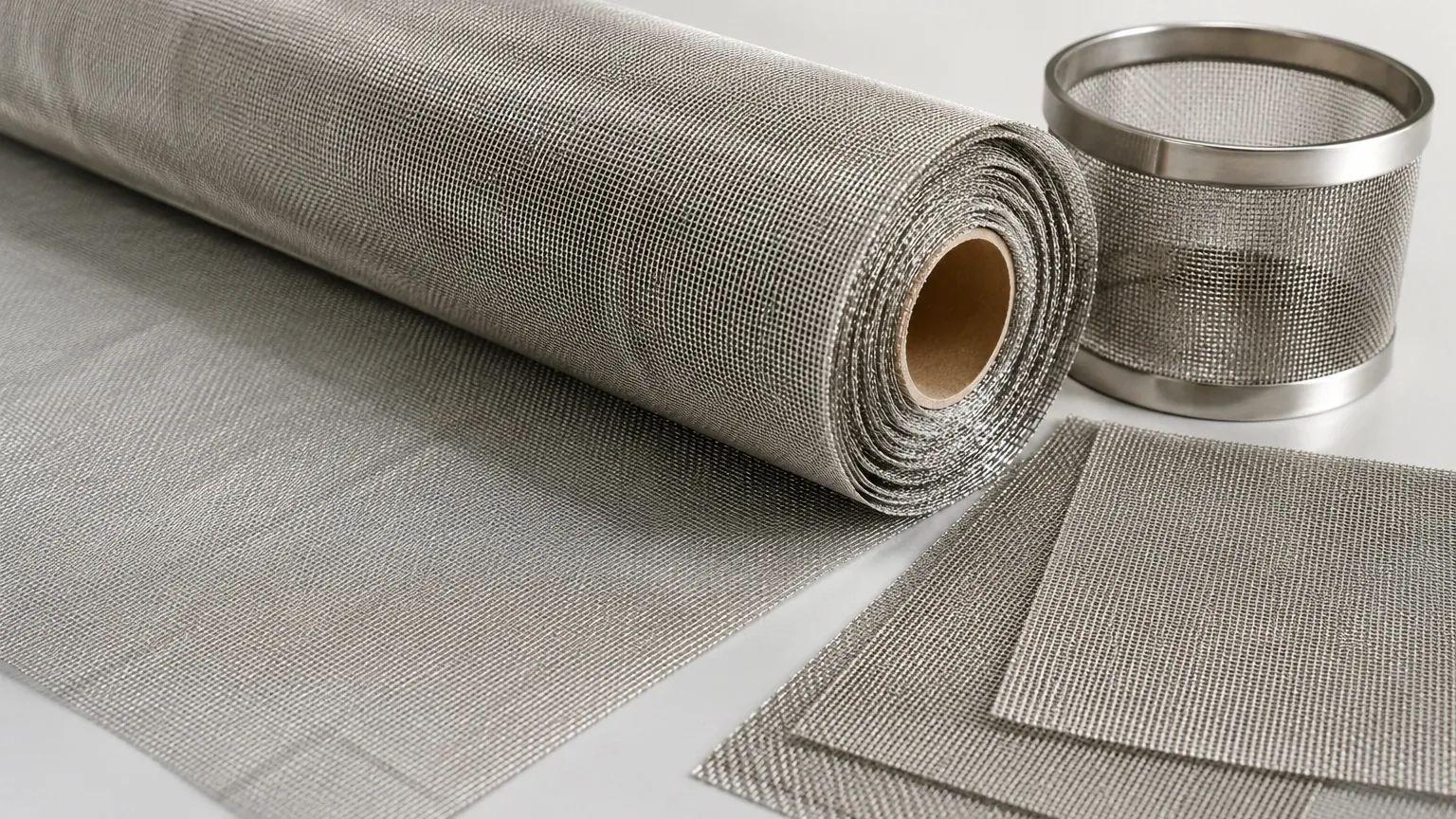
At 100 mesh, the most common weave is the Plain Weave. In this pattern, each warp wire crosses alternately over and under each shute wire. This produces a stable, consistent opening size and a smooth surface. For specialized high-pressure filtration where greater density is required, Dutch weaves may be utilized, though standard 100 mesh usually refers to a square opening plain weave.
Material Properties: Why 304 Stainless Steel?
Type 304 stainless steel is the most widely used austenitic stainless steel in the filtration industry. Its popularity in the production of 100 mesh 304 stainless steel woven wire mesh stems from its excellent balance of corrosion resistance, formability, and cost-effectiveness.
Chemical Composition and Corrosion Resistance
304 stainless steel contains approximately 18% chromium and 8% nickel. The chromium provides a passive layer of chromium oxide that protects the material from oxidation and many organic chemicals. It is highly effective in environments involving fresh water, atmospheric conditions, and many mild acids used in food processing.
However, it is important for engineers to note that 304 stainless steel is susceptible to pitting and crevice corrosion in high-chloride environments (such as seawater or high-salt brines). In such cases, upgrading to 316L stainless steel, which contains molybdenum, is often recommended.
Temperature and Mechanical Strength
304 stainless steel maintains its mechanical integrity across a wide temperature range. It can withstand continuous service temperatures up to 870°C (1598°F) in oxidizing environments without significant scaling. In filtration applications, the material's high tensile strength ensures that the mesh openings remain uniform even under the mechanical stress of high-viscosity fluid flow.
Key Industrial Applications
The 150-micron filtration capability of 100 mesh makes it a staple in several critical industries. Kaifil provides customized filtration components using this mesh to meet the specific demands of these sectors.
1. Chemical and Petrochemical Processing
In chemical manufacturing, 100 mesh is frequently used as a primary filtration layer in strainers and basket filters. It effectively removes larger suspended solids that could damage downstream pumps or foul catalyst beds. Its resistance to various solvents and intermediate chemicals makes it a reliable choice for batch processing.
2. Food and Beverage Industry
Compliance with hygiene standards is paramount in food production. 304 stainless steel is generally recognized as safe for food contact. 100 mesh is used in the filtration of syrups, juices, and oils to ensure product clarity and remove fine debris. Its ability to withstand frequent Clean-in-Place (CIP) cycles with caustic detergents without degrading is a significant advantage.
3. Pharmaceutical and Biotechnology
In pharmaceutical manufacturing, precision is non-negotiable. 100 mesh serves as a pre-filter or support layer for finer membrane filters. It helps in the recovery of active ingredients or the removal of precipitates during the crystallization process. The smooth surface of plain weave mesh also facilitates easier cleaning and sterilization, reducing the risk of cross-contamination.
4. Hydraulic and Lubrication Systems
Protecting precision hydraulic components from wear particles is essential for system longevity. 100 mesh is often used in suction strainers or as a secondary safety screen in hydraulic reservoirs to capture contaminants that could cause valve stiction or pump failure.
Engineering Considerations for Selection
When specifying 100 mesh 304 stainless steel woven wire mesh for a project, engineers should evaluate several performance factors beyond the basic dimensions.
Pressure Drop and Flow Rate
The pressure drop ($ΔP$) across a clean mesh is influenced by the fluid's viscosity, velocity, and the mesh's open area. Because 100 mesh has a 150-micron aperture, it offers lower resistance compared to finer 200 or 325 meshes. However, as particles accumulate (the "filter cake" formation), the pressure drop will increase. Engineers must design the system with sufficient surface area—often through pleating—to extend the time between cleaning cycles.
Mechanical Support
While 100 mesh is durable, it is relatively thin. In high-pressure applications or systems with significant flow surges, the mesh may require a support structure. This often involves laminating the 100 mesh onto a coarser, heavier backing mesh (such as 10 or 20 mesh) or sintering multiple layers together to create a rigid filter plate.
Edge Treatment and Fabrication
How the mesh is integrated into the final housing affects its performance. Options include:
* Cut-to-size discs: For laboratory or small-batch filtration.
* Cylindrical cartridges: For continuous flow systems.
* Framed panels: For vibrating screens or architectural applications.
* Welded edges: To prevent fraying and ensure a bypass-free seal within the filter housing.
Quality Standards and Procurement
To ensure consistent performance, it is vital to source mesh that adheres to international standards such as ASTM E2016 (Standard Specification for Industrial Woven Wire Cloth). This standard defines the tolerances for mesh count, wire diameter, and aperture size.
When requesting a quote or technical evaluation, purchasing teams should provide the following information to the manufacturer:
1. Material Grade: (e.g., 304, 304L, 316L).
2. Mesh Count: (100 mesh).
3. Wire Diameter: (Standard is typically 0.10mm).
4. Dimensions: (Roll width/length or specific part dimensions).
5. Application Environment: (Temperature, chemical exposure, and pressure).
Maintenance and Replacement Cycles
Stainless steel filters are valued for their cleanability and reusability, which lowers the total cost of ownership compared to disposable polymer filters. However, the lifespan of a 100 mesh filter depends on the cleaning method and the nature of the contaminants.
Cleaning Methods
* Backwashing: Reversing the flow to dislodge particles from the mesh surface.
* Ultrasonic Cleaning: Effective for removing fine particles trapped within the wire intersections.
* Chemical Cleaning: Using mild acids or bases to dissolve organic or mineral buildup, provided the chemicals are compatible with 304 stainless steel.
Signs for Replacement
Filters should be inspected regularly for signs of mechanical fatigue, such as wire displacement or "blinding" (permanent clogging that cannot be cleaned). If the pressure drop remains high even after a thorough cleaning, or if the mesh shows signs of thinning or pitting, replacement is necessary to prevent downstream contamination.
Conclusion
The 100 mesh 304 stainless steel woven wire mesh remains a cornerstone of industrial filtration due to its 150-micron precision and the robust physical properties of the 304 alloy. Whether used as a standalone screen or as part of a complex multi-layer filter cartridge, its ability to provide reliable separation under demanding conditions is well-proven. By understanding the technical specifications and engineering trade-offs between flow rate and filtration fineness, technical professionals can optimize their processes for maximum efficiency and durability.
Kaifil specializes in transforming high-quality woven wire mesh into precision-engineered filtration solutions. From material selection to customized component design, our technical team supports global industries in achieving superior filtration performance.
Download 100 Mesh 304 Stainless Steel Woven Wire Mesh as a PDF
