


Woven Wire Mesh 20
In industrial filtration and separation processes, selecting the correct specification for a metal medium is critical to operational efficiency and equipment longevity. Among the various configurations available, woven wire mesh 20 (commonly referred to as 20 mesh) serves as a versatile, medium-coarse standard used across diverse sectors, including chemical processing, water treatment, and food production.
Understanding the technical nuances of 20 mesh—ranging from wire diameter and aperture size to material grade and open area—allows engineers to optimize flow rates while ensuring reliable particle retention. This guide examines the engineering considerations, performance metrics, and application-specific selection criteria for Woven Wire Mesh in industrial environments.
Technical Specifications of 20 Mesh
The term "20 mesh" refers to the number of openings per linear inch, measured from the center of one wire to the center of the wire one inch away. While the mesh count is a primary identifier, the performance of the mesh is dictated by the relationship between the wire diameter and the resulting aperture.
Aperture and Wire Diameter
For a standard 20 mesh screen, the wire diameter typically ranges from 0.40 mm (0.016 inches) to 0.50 mm (0.020 inches). The aperture, or the clear distance between two adjacent wires, is calculated using the formula:
Aperture = (1 / Mesh Count) – Wire Diameter
* Standard Configuration: With a 0.40 mm wire, a 20 mesh screen provides an aperture of approximately 0.87 mm (870 microns).
* Heavy-Duty Configuration: Increasing the wire diameter to 0.50 mm reduces the aperture to 0.77 mm (770 microns) but significantly enhances the mechanical strength and abrasion resistance of the mesh.
Open Area Percentage
The percentage of open area determines the flow capacity and pressure drop across the filter medium. A standard 20 mesh with 0.40 mm wire offers an open area of approximately 47% to 50%. This high open area is beneficial for high-flow applications where minimizing resistance is essential to prevent pump strain or system cavitation.
Material Selection for Industrial Environments
The durability of woven wire mesh 20 is heavily dependent on the alloy selected. As a manufacturer specializing in stainless steel solutions, Kaifil emphasizes the importance of matching the material grade to the chemical and thermal demands of the application.
Stainless Steel 304
SS304 is the most common material for 20 mesh. It provides excellent mechanical properties and basic corrosion resistance. It is suitable for general industrial use, architectural applications, and food processing where exposure to high concentrations of chlorides or acids is minimal.
Stainless Steel 316L
For more demanding environments, SS316L is the preferred choice. The addition of molybdenum improves resistance to pitting and crevice corrosion, particularly in marine environments or chemical processing involving brine and organic acids. The "L" (low carbon) designation ensures better weldability and prevents carbide precipitation during the fabrication of custom filter cartridges.
Specialized Alloys
In high-temperature or highly corrosive settings, such as catalyst recovery or petrochemical refining, 20 mesh may be produced using Inconel, Monel, or Duplex stainless steels. These materials maintain structural integrity at temperatures exceeding 800°C or in environments with extreme pH fluctuations.
Engineering Considerations: Performance and Durability
When integrating woven wire mesh 20 into an industrial system, engineers must evaluate several performance factors beyond simple particle size.
Mechanical Stability and Support
20 mesh is often utilized as a support layer for finer filter media (such as 100 or 200 mesh). Because it possesses a relatively thick wire diameter for its opening size, it provides a rigid framework that prevents the finer mesh from collapsing under high differential pressure. In pleated filter cartridges, 20 mesh can act as both a drainage layer and a structural reinforcement.
Pressure Drop (ΔP)
The pressure drop across a 20 mesh screen is relatively low due to its high open area. However, engineers must account for the "blinding" or "clogging" factor. As particles accumulate on the surface, the effective open area decreases, leading to an exponential rise in ΔP. Calculating the total surface area required for the expected solids loading is vital for determining the replacement or cleaning cycle.
Weave Types
While most 20 mesh is produced using a Plain Weave (one wire over, one wire under), certain applications may require variations:
* Twill Weave: Used when a heavier wire is required for the 20 mesh count that would otherwise be too stiff for a plain weave.
* Crimped Mesh: Pre-crimping the wires before weaving provides greater stability for larger panels, often used in vibrating screens or protective guards.
Primary Applications of Woven Wire Mesh 20
The 800-900 micron range of 20 mesh makes it an ideal candidate for several critical industrial functions.
1. Pre-Filtration and Macro-Separation
In water treatment and hydraulic systems, 20 mesh is frequently used as a primary strainer to remove large debris, scale, and suspended solids before the fluid reaches more sensitive downstream components like high-pressure pumps or fine membrane filters.
2. Catalyst Support and Retention
In chemical reactors, 20 mesh screens serve as support grids for catalyst beds. The mesh must be precisely manufactured to ensure uniform flow distribution while preventing the loss of expensive catalyst particles into the product stream.
3. Food and Beverage Processing
Stainless steel 20 mesh is used in the processing of juices, syrups, and dairy products to remove pulp, seeds, or coagulated solids. The smooth surface of the woven wire allows for effective Clean-in-Place (CIP) procedures, meeting stringent hygienic standards.
4. Extruder Screens and Polymer Filtration
In the plastics industry, circular discs of 20 mesh are used in "screen packs" for extruders. These packs remove unmelted resin or contaminants from the polymer melt, ensuring a consistent final product.
Customization and Fabrication Options
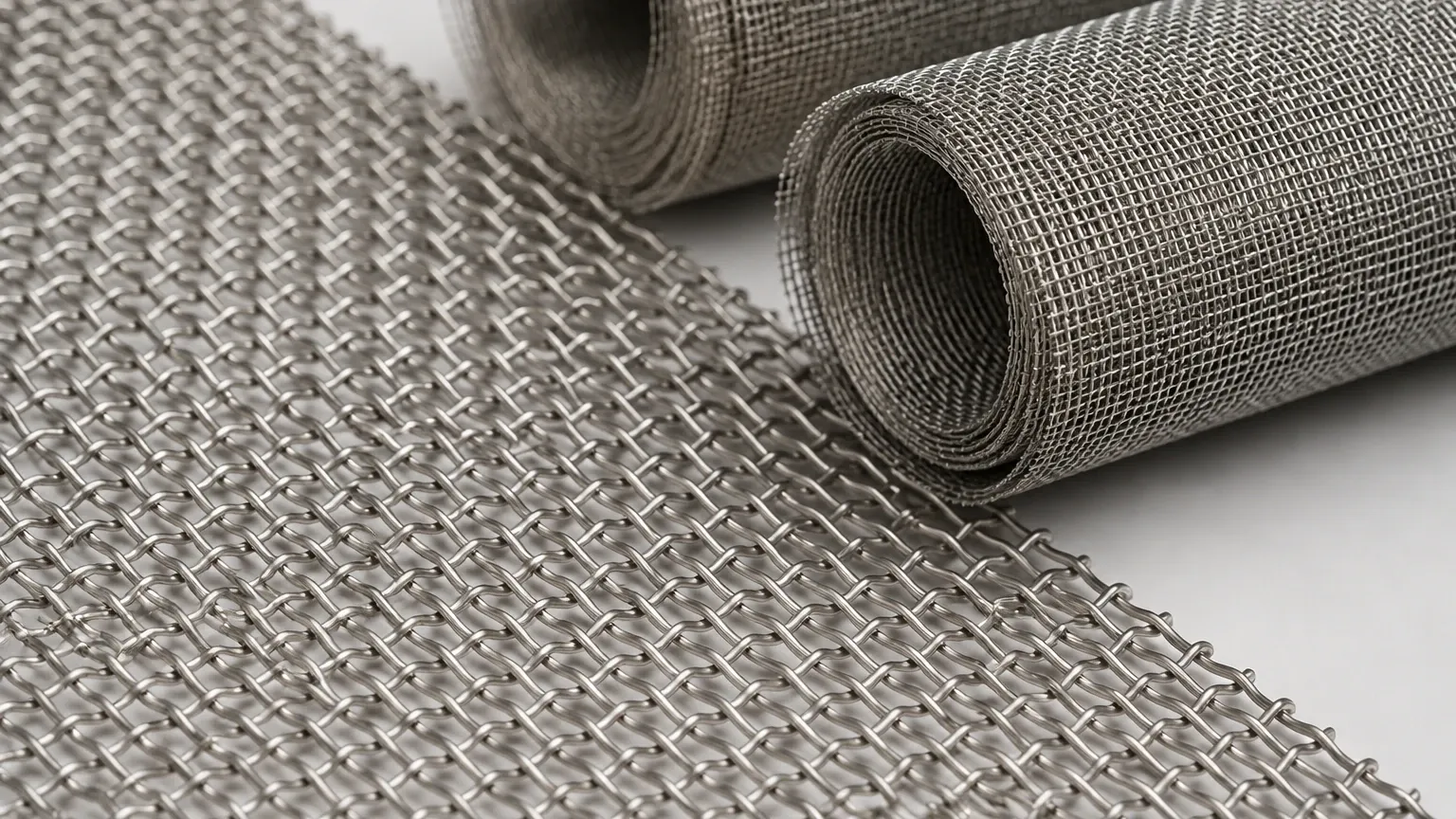
Standard rolls of woven wire mesh 20 are often just the starting point for industrial applications. Depending on the equipment design, the mesh may require further processing:
* Slitting and Cutting: Precision cutting to specific widths or shapes (circles, rectangles, or custom geometries) using laser or waterjet technology to ensure clean edges.
* Forming and Welding: 20 mesh can be formed into cylinders, cones, or pleated structures. Resistance welding or TIG welding is used to join the mesh edges without compromising the filtration integrity.
* Framing and Edging: For use in vibrating sieves or removable panels, the mesh is often fitted with U-shaped metal frames or silicone gaskets to provide a secure seal and prevent fraying.
* Sintering: In high-pressure applications, multiple layers of mesh (including a 20 mesh support layer) can be diffusion-bonded (sintered) to create a single, porous plate with exceptional strength.
Evaluation Criteria for Purchasing 20 Mesh
When sourcing woven wire mesh 20, procurement teams and engineers should confirm the following technical details with the manufacturer to avoid operational failures:
1. Mesh Tolerance: Ensure the mesh count and wire diameter adhere to ASTM E2011 or ISO 9044 standards. Inconsistent spacing can lead to "bypass," where particles larger than the target micron rating pass through the screen.
2. Material Certification: Request Mill Test Reports (MTRs) to verify the chemical composition of the stainless steel, particularly for 316L applications where molybdenum content is critical.
3. Surface Finish: For food or pharmaceutical applications, specify the required surface roughness (Ra). Electropolishing may be necessary to reduce particle adhesion and improve corrosion resistance.
4. Flatness and Tension: For large panels or vibrating screens, the mesh must be supplied flat and capable of maintaining tension to prevent sagging or premature fatigue failure.
Maintenance and Cleaning Cycles
The longevity of a 20 mesh filter depends on the cleaning regime. Because it is a surface-loading medium, contaminants are trapped on the upstream side of the wires.
* Backwashing: Effective for liquid systems where flow can be reversed to dislodge particles.
* Ultrasonic Cleaning: Recommended for removing fine or sticky residues that have become wedged in the wire intersections.
* Chemical Cleaning: Used in the polymer and chemical industries to dissolve organic build-up without damaging the stainless steel substrate.
Monitoring the differential pressure is the most reliable method for determining when a cleaning cycle is required. If the ΔP exceeds the manufacturer's recommended threshold (typically 15-25 psi depending on the housing), the mesh should be inspected for permanent deformation or localized thinning.
Conclusion
Woven wire mesh 20 represents a fundamental component in the industrial filtration landscape. Its balance of high open area, structural rigidity, and predictable micron retention makes it indispensable for protecting downstream equipment and ensuring product purity. By carefully selecting the appropriate wire diameter and material grade, and by considering the mechanical stresses of the specific application, engineers can achieve a cost-effective and durable filtration solution.
For organizations requiring specialized configurations, Kaifil provides comprehensive OEM support, from material selection to the production of complex, finished filter components. Plain, twill and dutch woven wire mesh in SS304/316L — rolls, cut mesh and framed panels. Send mesh count or micron target for a technical quote.
