


Heavy Duty Woven Wire Mesh: An Engineering Guide to Industrial Strength and Filtration Integrity
In industrial filtration and material separation, the structural integrity of the media is often as critical as its filtration accuracy. While standard mesh handles light-duty liquid or gas filtration, applications involving high-pressure differentials, abrasive slurries, or heavy mechanical loads require a more robust solution. Heavy duty woven wire mesh represents the intersection of precision engineering and mechanical durability, designed to withstand rigorous industrial environments without compromising on aperture consistency.
Selecting the right Woven Wire Mesh involves more than just identifying a required micron rating. For engineers and procurement teams, understanding the relationship between wire diameter, weave type, and alloy properties is essential to ensuring long-term performance and minimizing downtime. This guide examines the technical specifications and selection criteria for heavy-duty mesh solutions in demanding B2B sectors.
1. Defining Heavy Duty Woven Wire Mesh
The term "heavy duty" in the context of wire mesh typically refers to a specific ratio between the wire diameter and the aperture (opening) size. Unlike fine laboratory mesh, which uses hair-thin wires to achieve high mesh counts, heavy-duty variants utilize larger wire gauges to provide structural stability.
In a standard plain weave, the wire diameter often dictates the maximum possible mesh count. As the wire diameter increases, the mesh becomes more rigid and resistant to physical deformation. This is particularly important in applications such as aggregate screening, mining, and high-viscosity chemical processing, where the mesh must support the weight of the material being processed or resist the impact of high-velocity particles.
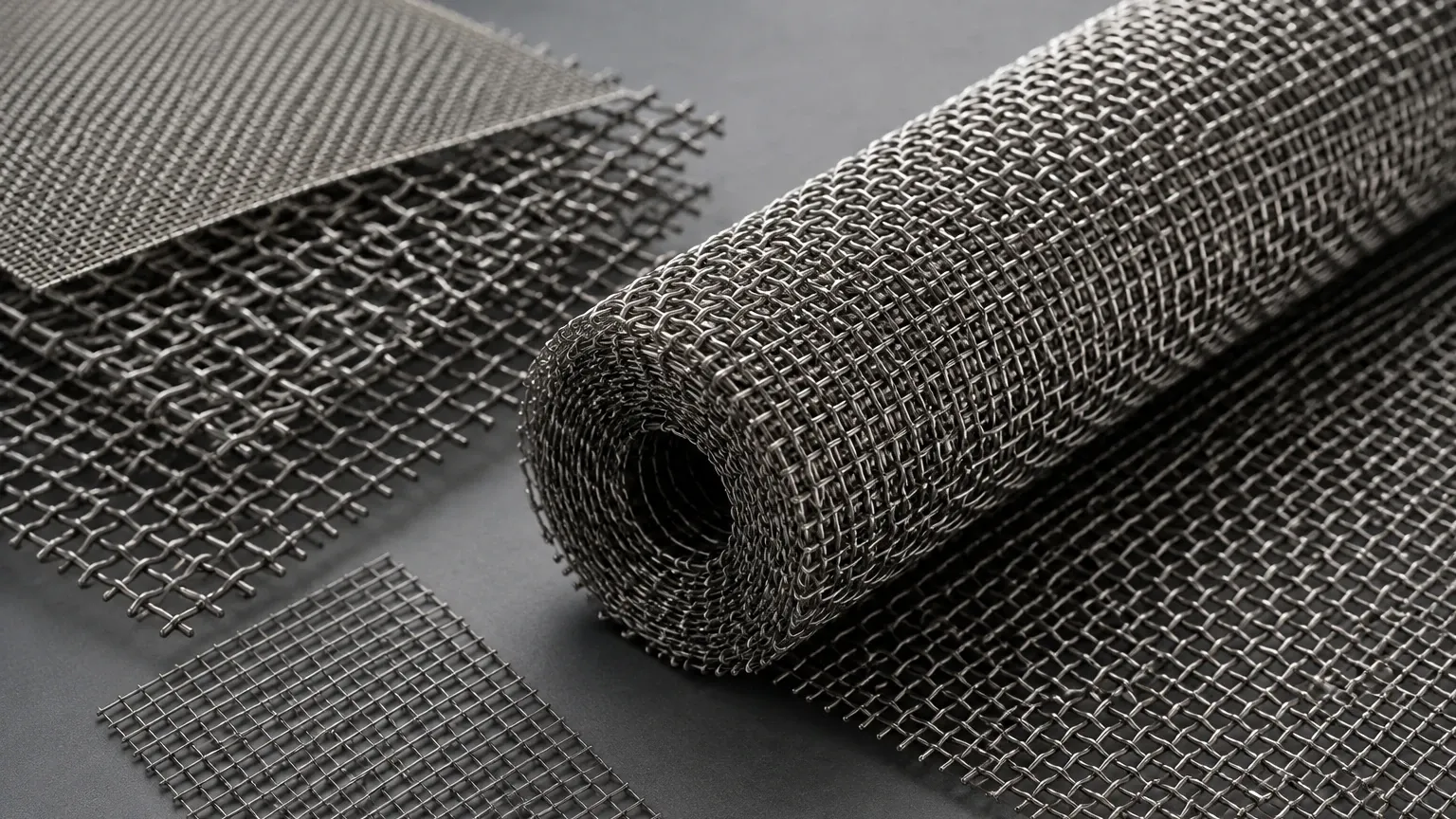
When evaluating Plain, twill and dutch woven wire mesh in SS304/316L — rolls, cut mesh and framed panels, engineers must balance the "open area" with the "mechanical strength." A higher open area allows for greater flow rates and lower pressure drops, but thinner wires may fail under mechanical stress. Conversely, a heavy duty woven wire mesh with thicker wires offers superior longevity but may require a larger footprint to achieve the same throughput due to reduced open area.
2. Material Selection: The Foundation of Durability
The performance of heavy-duty mesh is fundamentally tied to the metallurgy of the wire. In most industrial filtration scenarios, stainless steel is the standard due to its combination of tensile strength and corrosion resistance.
Stainless Steel 304 (SS304)
SS304 is the most common grade used for industrial mesh. It provides excellent strength and good corrosion resistance for general applications, including food processing and light chemical filtration. However, in environments exposed to chlorides or high-salinity conditions, SS304 may be susceptible to pitting corrosion, which can weaken the structural integrity of the weave over time.
Stainless Steel 316L (SS316L)
For heavy-duty applications in marine environments, pharmaceutical manufacturing, or aggressive chemical processing, SS316L is the preferred choice. The addition of molybdenum enhances its resistance to chloride-induced corrosion. The "L" denotes low carbon content, which is critical if the mesh components are to be welded into frames or cartridges, as it prevents carbide precipitation that can lead to intergranular corrosion at the weld sites.
Specialized Alloys
In extreme cases involving high-temperature oxidation or highly acidic environments, alloys such as Inconel, Monel, or Hastelloy may be required. These materials maintain their mechanical properties at temperatures where standard stainless steel would lose tensile strength, ensuring that the heavy duty woven wire mesh remains functional under thermal stress.
3. Weave Geometries and Their Impact on Load Bearing
The method by which the wires are interlaced—the weave—determines how the mesh reacts to pressure and mechanical impact. There are three primary weave types used in heavy-duty industrial applications:
Plain Weave
This is the simplest and most common weave, where each shute wire passes over and under one warp wire. In heavy-duty configurations, plain weave provides a consistent aperture and is easy to clean. It is ideal for primary screening and separation where the mesh is supported by a backup plate or a rigid internal core.
Twill Weave
In a twill weave, each shute wire passes over and under two warp wires. This allows for the use of heavier wire diameters than would be possible in a plain weave of the same mesh count. Twill weave is often used when a high level of filtration is needed in a heavy-duty format, as it allows for a more compact and sturdy structure.
Dutch Weave (Plain and Twill)
Dutch weaves use different wire diameters for the warp and shute directions. The warp wires are usually heavier and spaced further apart, while the shute wires are smaller and driven tightly together. This creates a "tortuous path" for the fluid, providing excellent filtration depth and high pressure resistance. For heavy-duty filtration, a Reverse Dutch Weave is often employed, where the higher density of wires is in the warp direction, providing exceptional strength against high-pressure flow.
For technical assistance in selecting the correct weave, engineers can send mesh count or micron target for a technical quote to ensure the selected geometry aligns with the specific pressure and flow requirements of the system.
4. Engineering Considerations: Open Area vs. Structural Integrity
One of the most critical calculations in filter design is the Percentage of Open Area (POA). The formula for POA is:
POA = ((Aperture) / (Aperture + Wire Diameter))² x 100
In heavy duty woven wire mesh, the wire diameter is intentionally increased to provide durability. This naturally reduces the POA. For an engineer, this presents a trade-off:
1. Pressure Drop: A lower POA results in a higher initial pressure drop across the filter. This may require more powerful pumps or larger filter housings to maintain the desired flow rate.
2. Service Life: While the initial pressure drop might be higher, a heavy-duty mesh is less likely to suffer from "wire migration" or "mesh blinding" under load. Thicker wires resist the deformation that can cause apertures to enlarge or close up during high-pressure pulses.
3. Burst Strength: In hydraulic and high-pressure liquid systems, the mesh must withstand the maximum system pressure in the event of a total blockage. Heavy-duty mesh provides the necessary burst strength to prevent downstream contamination if the filter element fails.
5. Applications of Heavy Duty Woven Wire Mesh
Because of its resilience, heavy-duty mesh is found in sectors where equipment failure leads to significant financial loss or safety risks.
* Mining and Quarrying: Used in vibrating screens to sort ores and aggregates. The mesh must withstand constant abrasion and high-impact loads.
* Petrochemical Processing: Employed in catalyst recovery and filtration of high-temperature hydrocarbons. The mesh must maintain its shape and filtration accuracy under extreme thermal cycling.
* Water Treatment: Used as intake screens and primary filtration in desalination and municipal plants. Heavy duty woven wire mesh resists the mechanical stress of debris impact and the corrosive nature of seawater.
* Food and Beverage: Utilized in large-scale straining and sieving operations where the mesh is subject to frequent high-pressure cleaning (CIP) and mechanical scraping.
6. Customization and Fabrication for Industrial Integration
Rarely is a roll of mesh used in its raw form in a heavy-duty application. Most industrial use cases require the mesh to be fabricated into a specific component. Customization options include:
* Framed Panels: For use in shaker screens or architectural grilles, the mesh is tensioned and welded into a rigid stainless steel frame. This prevents sagging and ensures uniform tension across the surface.
* Multi-Layer Sintered Mesh: For the ultimate heavy-duty application, multiple layers of Woven Wire Mesh are sintered together. This process fuses the wires at every contact point, creating a porous plate that is virtually indestructible and cannot suffer from wire migration.
* Edge Treatments: In many filtration cartridges, the edges of the mesh are hemmed, welded, or encapsulated in an epoxy or metal cap to prevent fraying and ensure a bypass-free seal.
When sourcing these components, it is vital to work with a manufacturer capable of providing precision cutting and welding to maintain the integrity of the weave at the attachment points.
7. Maintenance, Inspection, and Total Cost of Ownership
While the initial cost of heavy duty woven wire mesh is higher than standard mesh, the Total Cost of Ownership (TCO) is often lower due to extended replacement cycles. However, even the most durable mesh requires proper maintenance.
Inspection Protocols
Engineers should implement regular inspection schedules to check for:
* Pitting and Corrosion: Especially at the intersection of wires where stagnant fluids can accumulate.
* Mechanical Wear: Thinning of the wires in high-flow or abrasive areas.
* Aperture Distortion: Checking if the openings have become elongated, which indicates the mesh is being stressed beyond its yield point.
Cleaning Methods
Heavy-duty mesh can often be cleaned using aggressive methods that would destroy finer mesh, such as high-pressure water jetting, ultrasonic cleaning, or chemical baths. Selecting a mesh with a smooth surface finish (such as calendered mesh) can further improve the efficiency of these cleaning processes by reducing the adherence of particles to the wire surface.
Conclusion
Selecting a heavy duty woven wire mesh is a strategic decision that impacts the efficiency, safety, and operational cost of industrial filtration systems. By prioritizing structural integrity and material compatibility, engineers can ensure that their filtration solutions survive the most demanding environments. Whether you require standard rolls or complex framed panels, the key to success lies in matching the technical specifications of the mesh—wire diameter, weave type, and alloy—to the specific mechanical and chemical stresses of the application.
For those ready to specify their requirements, exploring the range of Plain, twill and dutch woven wire mesh in SS304/316L — rolls, cut mesh and framed panels is the first step toward a high-performance filtration solution. Always ensure you send mesh count or micron target for a technical quote to receive a solution tailored to your project’s unique engineering challenges.
