


Industrial Woven Wire Mesh: A Technical Guide for Engineering and Procurement
In the landscape of industrial filtration and separation, Woven Wire Mesh remains one of the most versatile and reliable materials available to engineers. Its application spans from simple straining to high-precision pharmaceutical filtration, requiring a deep understanding of weave types, material properties, and mechanical performance. For technical professionals and purchasing teams, selecting the right industrial woven wire mesh involves balancing filtration accuracy with structural durability and chemical compatibility.
As a specialized manufacturer, Kaifil provides customized stainless steel filtration solutions designed to meet the rigorous demands of chemical processing, food and beverage, and hydraulic systems. This guide explores the engineering considerations necessary to optimize filter performance and ensure long-term operational efficiency.
1. Understanding the Fundamentals of Industrial Woven Wire Mesh
At its core, industrial woven wire mesh is produced by weaving individual metal wires on a loom, creating a structured medium with precise openings. Unlike non-woven or perforated materials, woven mesh offers a unique combination of high open area, mechanical strength, and predictable pore geometry.
The performance of the mesh is dictated by three primary variables:
1. Wire Diameter: The thickness of the wire used in the warp (lengthwise) and weft (crosswise) directions.
2. Mesh Count: The number of openings per linear inch.
3. Aperture (Opening Size): The clear distance between two adjacent wires.
Engineers must consider these factors collectively. For instance, increasing the wire diameter improves the structural integrity and wear resistance of the mesh but simultaneously reduces the open area, which can lead to higher pressure drops across the filter medium.
2. Common Weave Patterns and Their Functional Advantages
The method by which wires are interlaced significantly impacts the filtration characteristics and physical properties of the mesh. Choosing the correct weave pattern is essential for meeting specific micron ratings and flow requirements.
Plain Weave
This is the most common and straightforward weave pattern. Each weft wire passes alternately over and under each warp wire. Plain weave provides the highest open area and is ideal for applications requiring high flow rates and standard filtration levels. However, it is generally limited to larger aperture sizes compared to more complex weaves.
Twill Weave
In a twill weave, each weft wire passes over and under two warp wires in a staggered pattern. This allows for the use of heavier wires for a given mesh count, resulting in a stronger and more durable mesh. Twill weave is often employed when the mesh must withstand higher mechanical loads or when a finer mesh count is required than what plain weave can accommodate.
Dutch Weave (Plain and Twill)
Dutch weaves utilize different wire diameters for the warp and weft. Typically, a smaller number of heavy warp wires are combined with a higher number of fine weft wires. This creates a dense, strong mesh with very small, tortuous paths for the fluid.
* Plain Dutch Weave offers high mechanical strength and is excellent for high-pressure filtration.
* Twill Dutch Weave provides even finer filtration (down to the low micron range) by allowing the fine weft wires to be packed more closely together.
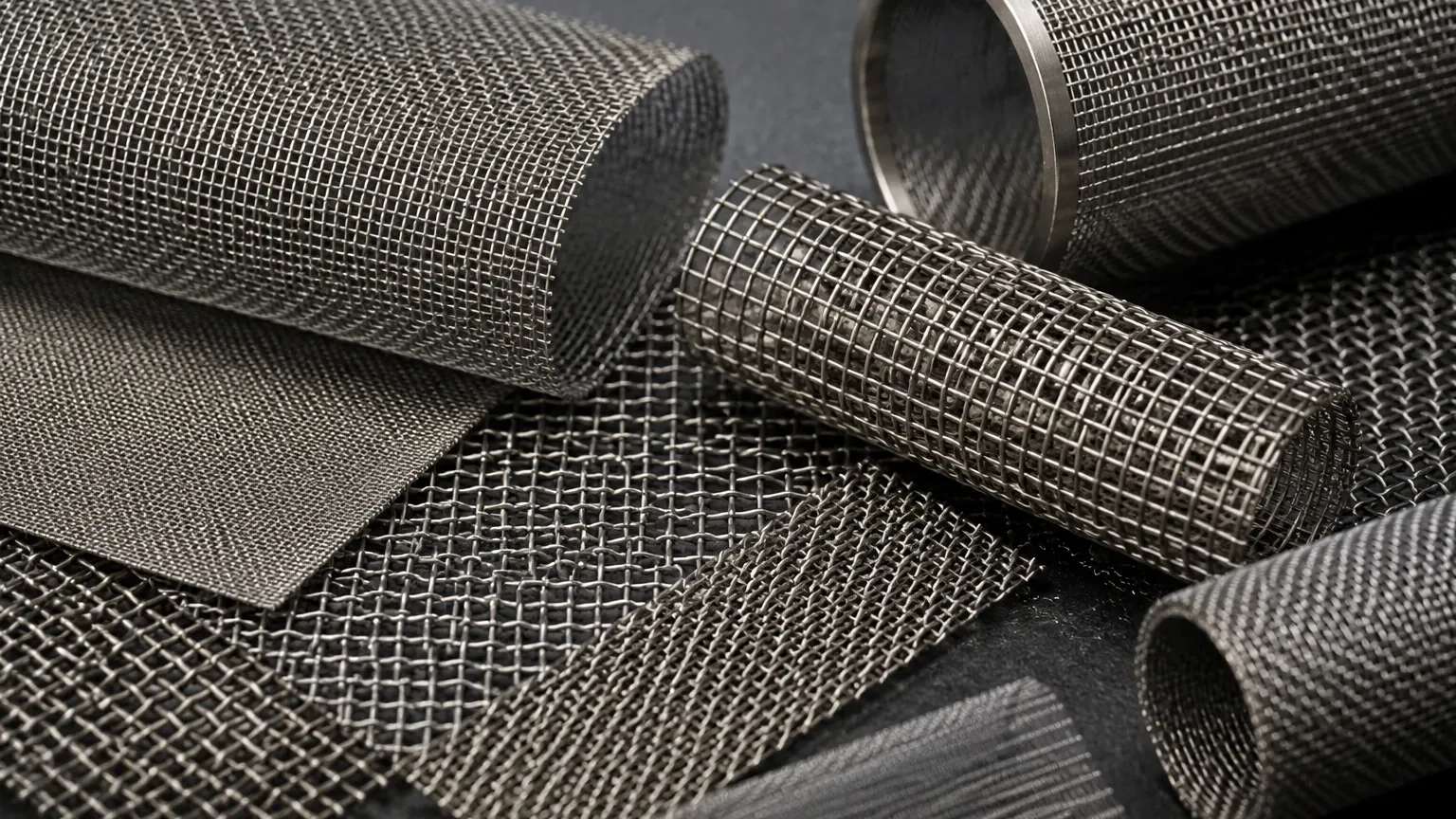
For those seeking specific configurations, Kaifil offers Plain, twill and dutch woven wire mesh in SS304/316L — rolls, cut mesh and framed panels. Send mesh count or micron target for a technical quote.
3. Material Selection: SS304 vs. SS316L
Material compatibility is a critical failure point in industrial filtration. While various alloys are available, stainless steel remains the industry standard due to its balance of cost, strength, and corrosion resistance.
* Stainless Steel 304: The most widely used grade, offering good corrosion resistance and excellent forming properties. It is suitable for most general industrial applications, food processing, and atmospheric exposure.
* Stainless Steel 316L: Containing molybdenum, 316L provides superior resistance to chlorides and acids. The "L" denotes low carbon content, which prevents carbide precipitation during welding, making it the preferred choice for marine environments, pharmaceutical manufacturing, and aggressive chemical processing.
When evaluating materials, engineers should also consider temperature limits. While stainless steel maintains its integrity at high temperatures, extreme thermal cycling can lead to material fatigue or oxidation, affecting the lifespan of the industrial woven wire mesh.
4. Technical Metrics: Micron Rating and Open Area
To ensure a filter meets the process requirements, two metrics must be analyzed: the micron rating and the percentage of open area.
Micron Rating: Absolute vs. Nominal
* Nominal Micron Rating: An approximate value indicating that the mesh will retain a high percentage of particles of a certain size. It does not guarantee 100% retention.
* Absolute Micron Rating: The diameter of the largest hard spherical particle that will pass through the mesh under specified test conditions. For critical applications like hydraulic systems or pharmaceutical sterile filtration, absolute ratings are often required to prevent downstream contamination.
Open Area and Flow Velocity
The percentage of open area determines the throughput and the initial pressure drop. A higher open area reduces the energy required to pump fluid through the system but may compromise the mesh's ability to withstand high differential pressures as it becomes loaded with contaminants.
5. Engineering Considerations for Customization
Standard off-the-shelf mesh rarely meets the specific needs of complex industrial equipment. Customization allows engineers to tailor the filtration component to the exact housing and flow dynamics of their system. Key customization options include:
* Edge Treatments: To prevent fraying and ensure a secure fit within a housing, mesh can be supplied with hemmed edges, welded borders, or integrated into custom metal frames.
* Multi-Layer Sintering: For applications involving extreme pressure or backwashing, multiple layers of Woven Wire Mesh can be sintered together. This process bonds the wires at their contact points, creating a rigid, high-strength filter plate that retains the filtration accuracy of the fine mesh layer while gaining the support of coarser backing layers.
* Geometric Shapes: Beyond simple rolls, mesh can be laser-cut, stamped, or pleated into cartridges to increase the effective filtration area within a compact footprint.
6. Identifying Risks and Maintenance Cycles
Even the highest quality industrial woven wire mesh is subject to wear and operational challenges. Understanding these risks helps in developing an effective maintenance strategy.
Blinding and Clogging
Blinding occurs when particles that are roughly the same size as the mesh openings become wedged, effectively sealing off parts of the filter. This leads to a rapid increase in differential pressure. Selecting a weave with a different geometry (such as Dutch weave) or implementing automated cleaning cycles can mitigate this issue.
Mechanical Fatigue
In systems with high-frequency pressure pulsations or vibration, the wires in the mesh can undergo fatigue. Over time, this may lead to wire breakage and media migration, where fragments of the filter enter the process stream. Regular inspection and the use of supported mesh structures are vital in these environments.
Cleaning and Reusability
One of the primary advantages of stainless steel mesh is its cleanability. Depending on the contaminant, mesh can be cleaned via ultrasonic baths, chemical cleaning, or high-pressure backflushing. Establishing a clear cleaning protocol can significantly extend the service life of the filter, reducing the total cost of ownership compared to disposable polymer filters.
7. Procurement Checklist: What to Confirm Before Ordering
To ensure a successful procurement process, technical teams should confirm the following details with their manufacturer:
1. Chemical Environment: What is the pH, chloride concentration, and presence of oxidizing agents?
2. Operating Pressure: What is the normal operating pressure and the maximum allowable differential pressure before cleaning or replacement?
3. Particle Characteristics: Are the particles hard, soft, fibrous, or spherical? This influences the choice between plain and Dutch weaves.
4. Regulatory Compliance: Does the mesh need to meet FDA, 3A, or pharmaceutical standards for material purity and traceability?
5. Installation Requirements: Does the mesh need to be formed into a specific shape, or will it be cut to size on-site?
By addressing these technical parameters early in the design or replacement phase, industrial operators can achieve a more reliable filtration process. Kaifil’s expertise in manufacturing and engineering ensures that every Woven Wire Mesh solution is optimized for the specific challenges of the application, providing a balance of precision, durability, and cost-effectiveness.
