


Woven Wire Mesh 500 Mesh: Technical Specifications and Industrial Applications
In the field of precision industrial filtration, the selection of filter media is a critical engineering decision that directly impacts process efficiency, product purity, and equipment longevity. Among the finest grades of metal filter cloth available, woven wire mesh 500 mesh represents a pinnacle of weaving technology. This ultra-fine mesh is engineered for applications where microscopic particle retention is mandatory, yet the durability of stainless steel is required to withstand pressure, temperature, and chemical exposure.
As a specialized manufacturer, Kaifil provides high-performance Woven Wire Mesh solutions tailored to demanding industrial environments. Understanding the technical nuances of 500-mesh specifications—including wire diameter, open area, and weave type—is essential for engineers and procurement professionals tasked with optimizing filtration systems.
Understanding the Technical Specifications of 500 Mesh
The term "mesh count" refers to the number of openings per linear inch. In a 500-mesh specification, there are 500 wires and 500 openings in every 25.4mm of the fabric. This density results in extremely small apertures, typically in the range of 25 to 30 microns, depending on the wire diameter used during the weaving process.
Wire Diameter and Aperture Size
For a woven wire mesh 500 mesh configuration, the wire diameter is exceptionally thin, often measuring approximately 0.025 mm (0.0010 inches). The relationship between the wire diameter and the mesh count determines the aperture size (the clear distance between two adjacent wires) and the percentage of open area.
* Aperture (w): Approximately 0.025 mm to 0.028 mm (25-28 microns).
* Open Area: Usually ranges between 25% and 35%.
Because the open area is relatively low compared to coarser meshes, 500 mesh introduces significant flow resistance. Engineers must account for a higher pressure drop (ΔP) across the filter element and ensure that the system's pump capacity can maintain the required flow rate through such a dense barrier.
The Necessity of Twill Weave in Ultra-Fine Filtration
While coarser meshes often utilize a Plain Weave (where each warp wire passes alternately over and under each shute wire), 500 mesh is almost exclusively produced using a Twill Weave or a Plain Dutch Weave variant.
In a standard Twill Weave, each shute wire passes successively over two and under two warp wires, and each warp wire passes successively over and under two shute wires. This staggered arrangement is a mechanical necessity for high-mesh counts. At 500 wires per inch, the wire diameter required for a Plain Weave would be so thin that the mesh would lack structural integrity and be prone to "mesh migration" or tearing under minimal stress. The Twill Weave allows for a slightly heavier wire to be used, providing the necessary mechanical strength to maintain the precision of the apertures during industrial operation.
For applications requiring even finer nominal filtration or higher pressure resistance, a Twill Dutch Weave may be employed. This combines the twill pattern with different diameters for warp and shute wires, resulting in a "zero-open" appearance where the fluid path is tortuous, offering superior particle retention for sub-25-micron requirements.
Material Selection: SS304 vs. SS316L
The performance of woven wire mesh 500 mesh is not only defined by its geometry but also by its metallurgy. Stainless steel is the industry standard due to its balance of mechanical strength and corrosion resistance.
1. Stainless Steel 304: This is the most common grade, providing excellent resistance to atmospheric corrosion and many organic and inorganic chemicals. It is suitable for food-grade applications and general industrial filtration where extreme acid or chloride exposure is not present.
2. Stainless Steel 316L: For more aggressive environments, SS316L is preferred. The addition of molybdenum and a lower carbon content enhances its resistance to pitting and crevice corrosion, particularly in chloride-rich environments or pharmaceutical processes involving stringent CIP (Clean-in-Place) chemicals.
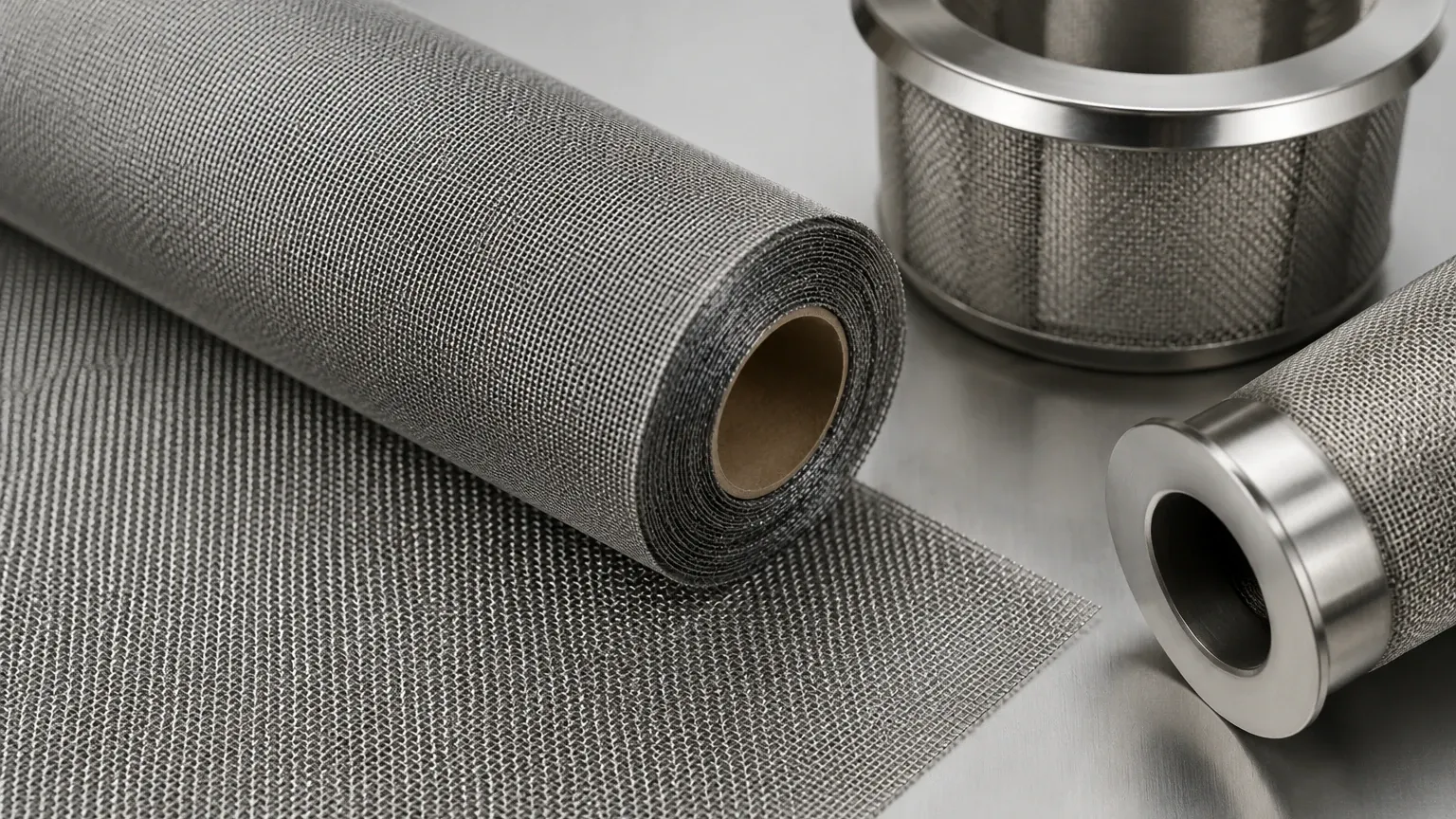
Kaifil ensures that all Plain, twill and dutch woven wire mesh in SS304/316L — rolls, cut mesh and framed panels meet strict material certification standards to prevent premature failure in corrosive service.
Critical Industrial Applications for 500 Mesh
Due to its ability to retain particles as small as 25 microns, 500 mesh is utilized in sectors where purity and precision are non-negotiable.
Aerospace and Defense
In hydraulic and fuel systems, even microscopic contaminants can lead to catastrophic component failure. 500-mesh stainless steel filters are used to protect sensitive valves and actuators from fine metallic debris and environmental particulates.
Pharmaceutical and Biotechnology
Ultra-fine mesh is used in the recovery of expensive catalysts and the filtration of active pharmaceutical ingredients (APIs). The smooth surface of stainless steel wire mesh allows for easier cleaning and sterilization compared to polymer-based media, making it ideal for multi-batch processes.
Precision Electronics and Printing
In the manufacturing of semiconductors and high-end screen printing, 500 mesh serves as a critical sieve. It ensures that pastes and inks are free of agglomerates that could clog nozzles or cause defects in micro-circuitry.
Laboratory and Analytical Equipment
Test sieves and specialized laboratory filters often utilize 500 mesh for particle size analysis and the separation of fine powders in research and development environments.
Engineering Considerations: Support and Maintenance
When integrating woven wire mesh 500 mesh into a filtration system, engineers must address the inherent fragility of ultra-fine wires. A single layer of 500 mesh is easily damaged by mechanical impact or high-pressure surges.
Pleating and Support Layers
To increase the effective filtration area and structural rigidity, 500 mesh is often pleated. To prevent the pleats from collapsing under pressure, the fine mesh is typically sandwiched between coarser "support meshes" (such as 20 or 40 mesh). This multi-layer construction, often sintered together in high-performance cartridges, ensures that the 500-mesh layer remains stable and functional throughout its service life.
Cleaning and Regeneration
Unlike disposable depth filters, stainless steel wire mesh is cleanable. However, because the apertures in 500 mesh are so small, standard backwashing may not be sufficient to remove deeply embedded particles. Ultrasonic cleaning is the recommended method for regenerating 500-mesh filters. High-frequency sound waves create cavitation bubbles that dislodge contaminants from the weave intersections without damaging the delicate wires.
Quality Evaluation and Procurement Checklist
When sourcing 500-mesh components, purchasing teams and engineers should confirm the following technical details to ensure the product meets the application's rigorous demands:
* Mesh Uniformity: Inspect for "wire shifts" or irregularities in the weave pattern. In 500 mesh, even a slight deviation can lead to a bypass of oversized particles.
* Edge Stability: For cut-to-size discs or panels, ensure the edges are properly treated (e.g., plasma cut or framed) to prevent fraying and wire shedding into the filtrate stream.
* Material Verification: Request MTRs (Material Test Reports) to confirm the alloy composition, especially for SS316L applications.
* Pressure Rating: Confirm the maximum allowable differential pressure (PSID) for the specific filter housing or assembly.
Kaifil specializes in providing customized filtration components that address these engineering challenges. Whether you require standard rolls or complex, multi-layered filter cartridges, our technical team can assist in selecting the optimal mesh configuration for your specific flow rates and particle retention targets.
If you are designing a new filtration system or seeking to improve the efficiency of an existing process, Send mesh count or micron target for a technical quote to receive expert guidance on material selection and custom fabrication options. By focusing on precision manufacturing and rigorous quality control, Kaifil helps industrial operators achieve reliable, long-term filtration performance in the most demanding environments.
